





Are Burning Mannikins still used today?
2026/05/28
Share:

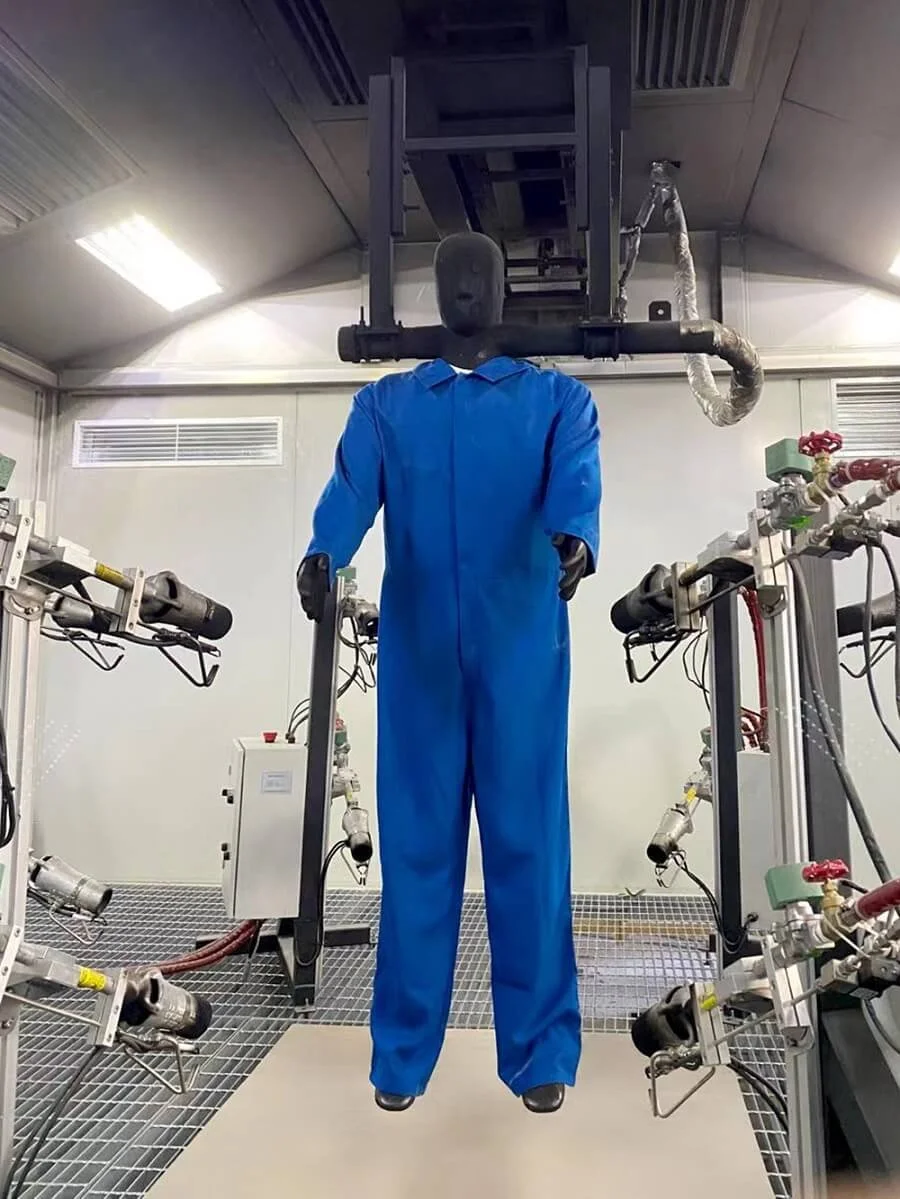
Working Principle of the Burning Manikin System
The complete testing system is equipped with 12 groups of propane burners, capable of generating uniformly distributed standard flames that fully surround and act upon the surface of the test manikin.
A total of 124 high-precision heat flux sensors are installed across the manikin’s body to capture real-time heat flux data from different areas. Each sensor is precisely numbered and corresponds to a specific region of the human body surface, ensuring accurate and clear positioning.
The data acquisition unit rapidly converts the collected heat flux electrical signals into corresponding temperature values while simultaneously storing all data in real time for future analysis and traceability.
The system features a built-in burn injury evaluation module that utilizes a temperature–time integration algorithm to accurately calculate the probability of second-degree and third-degree skin burns. The calculated results are then synchronized with a digital human body model to generate an intuitive and visualized body surface burn distribution map.
The supporting control software automatically records the entire testing process, including test duration, flame intensity, and all raw sensor data collected during the experiment. This ensures complete retention of testing data, making the entire testing procedure fully traceable and verifiable.
Functions and Applications of the Burning Manikin System
The Burning Manikin System is a highly realistic instrumented manikin device used to quantitatively evaluate the overall thermal protective performance of specialized protective clothing—such as firefighting suits, military uniforms, and racing suits—under controlled fire conditions, while also predicting the degree of burn injuries that may be sustained by the human body.
Core Function
When the manikin wearing a complete protective garment is exposed to a simulated flash fire or flashover environment (with a heat flux of approximately 84 kW/m² for several seconds), the 100–135 high-precision heat sensors distributed across the body surface continuously collect skin-equivalent temperature data in real time. By combining this data with burn injury evaluation models, the system calculates the percentage and occurrence time of first-, second-, and third-degree burns.
Key Applications
Objectively evaluating the overall thermal protective performance of protective clothing, which is more comprehensive and reliable than fabric-only testing
Supporting the research, development, and standard certification of firefighting, military, and industrial flame-resistant clothing in accordance with standards such as ISO and ASTM
Assessing human thermal injury risks related to vehicle interior materials and building fire protection materials
Providing scientific data for improving protective equipment design and enhancing personnel safety in extreme thermal environments
Applicable Industries of the Burning Manikin System
The Burning Manikin System is primarily used in industries that require evaluation of thermal protective performance, including firefighting and emergency rescue, industrial safety (such as petrochemical and power industries), military protective equipment, aerospace, and the development and testing of specialized protective clothing such as racing suits and welding garments.
Firefighting and Emergency Rescue
Used to evaluate the thermal protective performance of firefighters’ protective clothing under simulated fireground conditions.
Industrial Safety
Applied in industries such as petroleum, chemical processing, metallurgy, and electric power to assess the heat and flame resistance performance of protective garments worn by workers exposed to high-temperature environments.
Military and Defense
Used to test the performance of soldiers’ personal protective equipment under extreme conditions such as explosions, flash fires, and thermal exposure scenarios.
Protective Clothing Research, Development, and Certification
Universities, testing laboratories, and manufacturers use the system to conduct thermal injury simulations and evaluate protective clothing and material designs through “flame manikin” testing.
Aerospace and Motorsports
Used for thermal response evaluation of specialized protective clothing, including spacesuits and racing driver fire-resistant suits, ensuring safety under extreme heat conditions.
Technical Features of the Burning Manikin System
The core technical features of the Burning Manikin System focus on simulating the human body’s thermal response in fire environments to evaluate the protective performance of thermal protective clothing.
Human-like Thermal Distribution Simulation
The surface of the manikin is covered with high-precision heat flux sensors, such as copper calorimeters. These sensors are distributed according to the surface area and thermal sensitivity of different human body regions—including the head, chest, abdomen, and limbs—allowing quantitative assessment of second-degree and more severe burn risks based on the Palmer formula or similar burn prediction models.
Controllable Flame Exposure Environment
The manikin is typically exposed to combined radiant and convective heat sources within a standard fire simulation chamber. Common heat flux levels range from 5–10 kW/m², with exposure durations from several seconds to tens of seconds, simulating realistic flash fire or flashover conditions.
Real-time Temperature Measurement and Data Analysis
The sensor array simultaneously captures instantaneous temperature–time curves during testing. Combined with dedicated analysis software, the system automatically calculates total heat flux, predicted burn area percentage, and pain threshold distribution. It then generates visualized thermal maps and protective performance ratings, such as classifying “total burn area <5%” as a high-level protection rating.
Non-living, Repeatable, and Highly Safe Testing
The system replaces human or animal testing, enabling safe and repeatable experiments while meeting ethical and standardization requirements. Protective garments are typically replaced after each test cycle. Some advanced systems, such as China’s “Donghua Fire Manikin,” feature automatic positioning, rapid reset functions, and multi-posture simulation capabilities.
Standards-oriented and Industry-focused Applications
The Burning Manikin System is widely used for certification testing of firefighting suits, military flame-resistant clothing, industrial thermal protective garments, and aerospace escape suits. Test results are directly related to protective performance classifications. However, the system is not intended for evaluating flame spread behavior of fabrics, which belongs to separate testing categories such as vertical flammability or Manchester flame spread tests.
Importance of the Burning Manikin System
The Burning Manikin System is internationally recognized as the only method capable of realistically and quantitatively evaluating the thermal protective performance of complete protective garments—such as firefighting suits, military uniforms, and flame-resistant workwear—against human thermal injuries in real fire environments. It overcomes the critical limitations of traditional fabric sample tests, which cannot accurately reflect garment structure, human posture, or realistic thermal exposure risks.
Accurate Evaluation of Overall Protective Performance
Traditional tests, such as vertical flammability testing, can only evaluate the flame resistance of fabric materials. In contrast, the Burning Manikin System tests complete garments worn by the manikin under controlled flash fire conditions (for example, heat fluxes of approximately 84 kW/m² with exposure durations of 4–10 seconds). Through 100–135 high-precision heat sensors distributed across the manikin’s body and combined with skin burn prediction models such as the Henriques model, the system predicts the distribution and percentage of second- and third-degree burns. This provides a direct and realistic assessment of protective performance under actual “garment + human posture” conditions.
Promoting Protective Equipment Development and Standard Advancement
The system supports the development of advanced flame-resistant materials—such as meta-aramid fibers—as well as improvements in garment structural design, including joint mobility and seam protection. It also facilitates customized protective clothing designs adapted to different body types. Domestic systems developed by institutions such as Donghua University and Darong Instruments have helped reduce dependence on foreign technologies. Furthermore, the system plays a significant role in supporting the implementation of international standards such as ASTM and ISO.
Protecting Personnel in High-risk Occupations
The Burning Manikin System provides quantifiable protective performance data for firefighters, miners, racing drivers, military personnel, and other workers exposed to extreme heat hazards. It helps prevent injuries and fatalities caused by insufficient protection (underestimating heat penetration) or excessive protection (reducing mobility and operational efficiency). In addition, the system can be used to evaluate thermal injury risks associated with vehicle interiors, aircraft cabins, naval vessels, and building interior materials during fires.
Achieving Safe “Substitute Human” Testing
The system enables testing under extreme conditions such as flash fires and fuel pool fires, where temperatures can instantly reach up to 800°C, without risking human lives. This ensures both scientific reliability and ethical compliance. Advanced dynamic manikin systems can also simulate different body movements and postures—including standing, running, and crawling—to study how motion affects thermal protective performance.
Without the Burning Manikin System, protective clothing development would largely depend on empirical judgment or single-fabric testing, which could easily lead to protective failure in real-world applications. Its core value lies in advancing evaluation methods from simple “material flame resistance” toward comprehensive “human thermal injury prevention,” making it an irreplaceable fundamental tool in the field of fire safety engineering.
Social Significance of the Burning Manikin System
1. Improving Public Safety in High-risk Industries
The application of the Burning Manikin System has directly improved public safety standards in fields such as firefighting, military operations, and industrial protection. By scientifically evaluating the performance of protective equipment, the system helps industries establish stricter and more reliable safety standards. Statistics show that protective equipment tested using burning manikin systems has significantly reduced casualty rates in real-world applications, demonstrating the vital role of technological innovation in safeguarding human life and public safety.
2. Promoting the Upgrading of the Protective Equipment Industry
The independent development of domestic Burning Manikin Systems has broken foreign technological monopolies, reduced testing costs, and accelerated the localization of high-performance protective equipment manufacturing. This technological advancement has not only strengthened the competitiveness of domestic industries but has also contributed valuable Chinese solutions to the global development of protective equipment technologies.
3. Demonstrating the Potential of Multidisciplinary Innovation
The development of the Burning Manikin System reflects the enormous potential of interdisciplinary collaboration. Experts in materials science, biomedical engineering, automation control, and other technical fields have worked together to solve numerous engineering challenges during system development. This innovation model provides valuable experience for scientific and technological breakthroughs in other industries and contributes to the advancement of overall technological capabilities.
4. Enhancing Public Awareness of Safety Protection
The application of the Burning Manikin System has also increased public awareness of personal safety and protective measures. Through media coverage and educational outreach, the testing process has become an effective and vivid tool for safety education, helping improve public emergency response awareness and overall safety consciousness. This educational value is of long-term significance in building a stronger safety culture and preventing accidents.
Overall, as a technology with significant application value in the fields of safety testing and thermal protection, the Burning Manikin System possesses substantial future development potential and practical importance. We remain committed to providing the latest product information and technical support. We sincerely welcome you to leave a message or contact our professional team directly so that we can offer more detailed, customized product information and tailored solutions based on your specific requirements.
Previous: What is a Shoe Heel Impact Fatigue Tester?
N e x t : What is creep in geosynthetics?
