





How does the Down Feather Filling Power Tester work?
2026/05/29
Share:

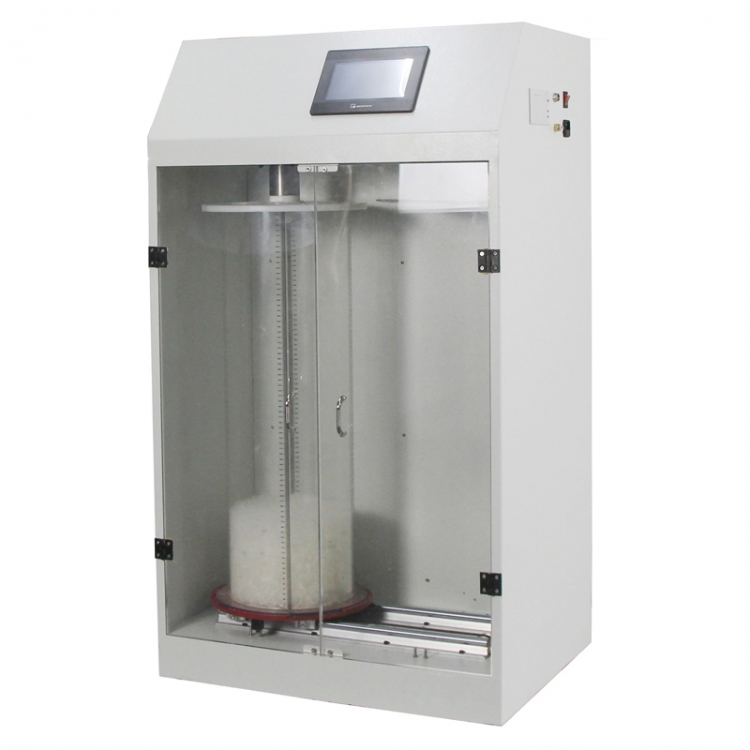
Functions and Applications of the Down Feather Filling Power Tester
The Down Filling Power Tester is used to measure the fill power of down or feathers, which refers to the volume occupied by a unit weight of down under standard conditions. It is a key indicator for evaluating thermal insulation performance.
Function:
Within a sealed cylinder, a fixed weight of down sample (e.g., 30 g) is evenly dispersed by airflow. A standard pressure (e.g., 94.25 g) is then applied using a compression plate, and the recovered height of the sample is measured (unit: cm³/g). The instrument can automatically or semi-automatically complete the processes of filling, settling, compression, and reading. It complies with international standards such as JIS L, EN, and ASTM.
Application:
It is widely used in textile manufacturing enterprises and quality inspection laboratories for down jackets, sleeping bags, and home textiles. It is used to determine down quality, control raw material costs, ensure product thermal performance and compliance, and support R&D comparison as well as incoming material inspection.
Applicable Industries of the Down Feather Filling Power Tester
The Down Filling Power Tester is primarily used in the production, quality inspection, and research and development of down and fiber-filled products. Its applications include:
Down product manufacturing (down jackets, quilts, pillows, etc.)
Used in the production of household down products to evaluate fill power and control thermal insulation performance and production cost.
Textile and apparel industry
Especially for standardized testing of filling materials, in compliance with standards such as GB/T, EN, and JIS.
Third-party testing laboratories and certification institutions
Provides authoritative fill power data for quality assessment and product certification.
Down raw material suppliers and processing factories
Used for grading, classification, and incoming quality inspection of down and feathers.
Outdoor sports and high-end thermal insulation equipment R&D
Ensures precise control of filling material performance to meet functional and performance requirements.
Technical Features of the Down Feather Filling Power Tester
Automated operation: The equipment adopts a fully automatic design, requiring minimal manual intervention during the testing process, which significantly improves testing efficiency and accuracy.
High-precision measurement: Equipped with precision sensors and a control system, the instrument can accurately measure the fill power of down and meet the requirements of various testing standards.
Filtered ventilation design: A filtration and ventilation structure is adopted to effectively prevent feather dispersion and protect the health of operators.
Stepper motor drive: The system is driven by a stepper motor with adjustable speed, allowing it to meet the requirements of different testing standards.
Microcontroller control system: Programmable control via a microcontroller enables compatibility with multiple testing standards.
Touchscreen LCD display: A touchscreen LCD interface provides intuitive and user-friendly operation, making it easy to perform tests and view data.
Working Principle of the Down Feather Filling Power Tester
The Down Filling Power Tester determines the test result by measuring the volume occupied by a fixed-weight down sample in a container of a specified diameter under constant pressure.
The instrument is typically equipped with an automatic airflow system to ensure that the down is fully and evenly fluffed, maintaining its natural loft state. This helps improve the accuracy, authenticity, and repeatability of the measurement results.
Operating Procedure of the Down Feather Filling Power Tester
The Down Filling Power Tester is used to determine the fill power of down. The standard operating procedure follows ISO, JIS L, or ASTM standards. A typical test process is as follows:
Sample preconditioning:
Take a specified mass of down sample (e.g., 2.0 g or 2.5 g) and condition it in a constant temperature and humidity environment (e.g., 20 ± 2°C, 65 ± 2% RH) for at least 24 hours.
Loading into the measuring cylinder:
Place the preconditioned sample into the bottom of the instrument’s cylindrical measuring tube (typically with an inner diameter of 284 mm or 288 mm), ensuring the sample is free of clumps and evenly spread.
Airflow and compression plate activation:
Start the compressed air system (flow rate 2–20 L/s) to fluff the down evenly inside the cylinder. Then automatically or manually release the standard weight compression plate (e.g., a 94.25 g plate suitable for a 284 mm diameter cylinder), allowing it to gently settle on the surface of the sample.
Reading fill height:
After the compression plate stabilizes (stabilization time typically ranges from 30 seconds to 5 minutes depending on the standard), measure the vertical distance from the bottom of the plate to the bottom of the cylinder using a high-precision displacement sensor or graduated scale (unit: mm).
Calculation of fill power:
Divide the fill height (mm) by the sample mass (g) to obtain the result (e.g., 700 mm/g). Some instruments can automatically calculate and display the final value.
Repeat testing:
Perform at least three parallel tests and take the average as the final result. Before each test, the cylinder should be emptied and the zero position of the compression plate calibrated.
Maintenance Recommendations for the Down Feather Filling Power Tester
The maintenance of the Down Feather Filling Power Tester focuses on cleaning, calibration, mechanical upkeep, and environmental control.
Thorough cleaning after each use:
Remove residual down fibers and dust from the measuring cylinder, platen, airflow disc, and other components to prevent air-path blockage or affecting the smooth movement of the platen. Clean with a soft brush or compressed air. Do not use wet cloths or solvents on sensors or electronic components.
Regular calibration and verification:
Perform full-scale calibration at least every 6 months in accordance with relevant standards, using standard weights and airflow calibration devices to ensure the accuracy of the encoder and weighing system. Calibration is mandatory after long periods of inactivity or relocation.
Lubrication and mechanical inspection:
Check the drive belt/stepper system, guide rails, and platen lifting mechanism weekly to ensure smooth operation. Apply an appropriate amount of food-grade or low-volatility lubricant to avoid sample contamination. Inspect belt wear, tension, and encoder contact conditions. If abnormalities are found, stop operation and contact the manufacturer.
Air system and fan maintenance:
Inspect fan filters and air ducts regularly for dust accumulation. Clean or replace intake filter cotton monthly. Ensure stable air pressure and no abnormal noise to avoid measurement deviation caused by airflow fluctuations.
Environmental and power control:
Place the equipment in a constant temperature (20 ± 2°C) and humidity (65 ± 2% RH), vibration-free laboratory environment. Avoid direct airflow or turbulent air from air conditioners. Use a voltage stabilizer or UPS to prevent power fluctuations from damaging the servo system or encoder.
Do not disassemble electronic modules:
In case of display errors, motor stepping issues, or data drift, do not attempt internal repair. Contact the manufacturer or authorized technician for inspection of circuits, sensors, or control boards.
Maintenance and usage log:
Record test conditions, calibration dates, abnormal events, and maintenance actions for each use. This helps trace accuracy deviations and predict component lifespan (e.g., stepper motor service life is typically 5.000–10.000 hours).
Importance of the Down Feather Filling Power Tester
The core value of the Down Filling Power Tester lies in its ability to objectively quantify the lofting capacity (Fill Power) of down, which is a key indicator determining thermal insulation performance, lightweight characteristics, and overall product value.
Direct correlation with thermal insulation performance:
Higher fill power (e.g., 800+ FP) indicates that a unit weight of down can trap more still air, resulting in stronger insulation performance. This directly affects the functional performance of end products such as jackets and sleeping bags.
Support for quality grading and pricing:
International standards classify down quality based on fill power. The tester ensures accurate grading, prevents substandard substitution, and helps maintain trust in the market.
Ensuring consistency in R&D and quality control:
In production processes, the instrument is used for raw material inspection, formulation optimization, and finished product sampling. It ensures batch-to-batch consistency of fill power. Automated systems (such as fully automatic testers) reduce human error and improve repeatability, with accuracy up to 0.1 cm³/g.
Compliance with regulations and trade requirements:
Exported products must comply with standards in regions such as the EU, the United States, and Japan. Test data is a mandatory basis for compliance reports and customs clearance. Without reliable test results, products cannot pass certification by organizations such as SGS or BV.
Driving material innovation and cost control:
The tester helps manufacturers accurately compare performance in blended materials or alternative fillings, avoiding overfilling (increasing cost) or underfilling (reducing insulation performance), thereby achieving a balance between lightweight design and warmth.
In summary, the fully automatic Down Filling Power Tester is an advanced instrument integrating high-precision measurement and intelligent operation. It offers powerful functionality and stable performance, significantly improving testing efficiency and data reliability. The operation process is simple and intuitive, allowing users to quickly master the equipment without complex training, greatly reducing the entry barrier.In the field of fill power testing for down, feathers, and related filling materials, this instrument demonstrates excellent accuracy and high efficiency, with strong market potential and broad application prospects.We sincerely invite interested customers to leave a message or contact us directly, so we can provide more comprehensive technical documentation, detailed specifications, and customized solutions tailored to your needs.
Previous: What is creep in geosynthetics?
N e x t : What is the Automotive Cargo Cover Screw Inspection Line?
