





What are the principles and functions of Male Side Impact Dummy (RE Type)?
2026/06/02
Share:

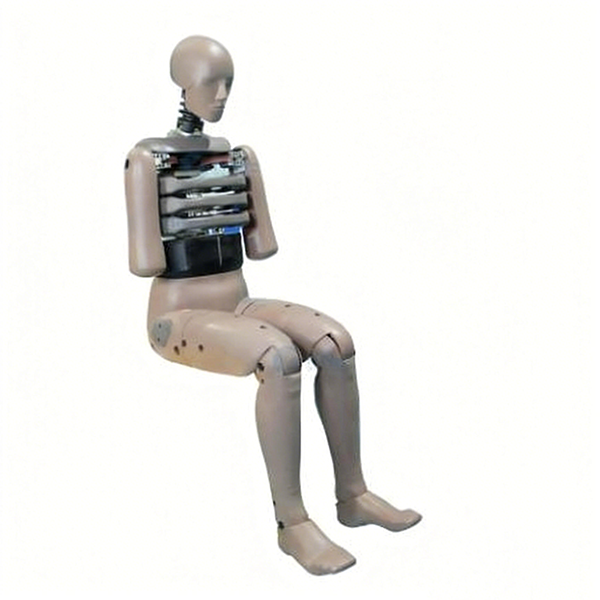
Working Principle of the Male Side Impact Dummy (RE Type)
The Male Side Impact Dummy (RE Type) is a highly instrumented anthropomorphic test device (ATD) specifically designed to simulate the biomechanical response of a 50th percentile adult male during vehicle side-impact collisions. By accurately reproducing human body mass distribution, joint characteristics, and injury responses, the dummy enables engineers to evaluate occupant protection systems and assess injury risks under side-impact conditions.
1. Biofidelic Body Structure and Human Simulation
The RE-type dummy's "skeleton" and "musculature" are carefully engineered to replicate the mass distribution and inertial characteristics of an average adult male.
The dummy has a total mass of approximately 72.4 kg, with individual body segment masses closely matching anthropometric data for a 50th percentile male occupant. Typical component masses include:
Head: approximately 4 kg
Thorax: approximately 22.4 kg
Pelvis: approximately 12 kg
To ensure realistic occupant kinematics during testing:
Joints are designed with specific friction characteristics and ranges of motion.
The spine consists of alternating metal discs and rubber elements that mimic the flexibility and dynamic behavior of the human spinal column.
Body segment articulation allows realistic movement under crash loading conditions.
This biofidelic design enables the dummy to reproduce the inertial and structural responses of a human occupant during a side collision.
2. Advanced Thoracic Response Simulation
Since the thorax is particularly vulnerable during side-impact crashes, the RE-type dummy incorporates an optimized rib cage design featuring a Rear Extension (RE) rib structure.
A specialized rib extension mechanism allows the dummy to more accurately reproduce:
Lateral chest compression
Rib displacement
Thoracic deformation
Interaction with seatbacks and vehicle interior structures
When subjected to side-impact loading from components such as door trim panels, side structures, or B-pillars, the dummy's thoracic system responds in a manner that closely resembles human chest biomechanics.
This realistic mechanical response provides critical data for evaluating:
Rib fracture risk
Lung injury potential
Internal organ trauma
Thoracic injury severity
3. Integrated Sensor Network
The RE-type dummy contains an extensive network of sensors functioning much like a human nervous system, capable of capturing crash data within milliseconds of impact.
The sensor system continuously monitors forces, accelerations, and deformations throughout the collision event, providing engineers with detailed biomechanical information for injury analysis.
4. Acceleration Measurement System
High-precision accelerometers are installed at multiple locations, including:
Head
Upper thoracic spine (T1)
Lower thoracic spine (T12)
Sacrum
Rib structures
These sensors measure three-dimensional acceleration responses during impact.
The recorded data are used to assess:
Head injury potential
Brain injury risk
Spinal loading conditions
Occupant kinematics
Acceleration measurements form one of the most important datasets for evaluating occupant protection performance.
5. Force Measurement System
Force sensing is one of the most critical functions of the RE-type dummy.
The dummy is equipped with multiple force transducers located throughout the body, including:
Six-axis neck load cell
Shoulder force sensors
Torso load sensors
T12 spinal force sensors
Abdominal force sensors
Lower lumbar load sensors
Femur load sensors
These sensors accurately measure:
Compression forces
Shear forces
Tensile forces
Bending loads
The collected data help engineers determine how crash forces are transmitted through the body and identify potential injury mechanisms.
6. Chest Deflection Measurement System
Linear potentiometers are installed within the rib structure to directly measure thoracic deformation during side impacts.
These displacement sensors record:
Rib movement
Chest compression depth
Thoracic deflection rates
When combined with rib acceleration measurements, engineers can calculate the Viscous Criterion (VC), an important biomechanical parameter used to predict:
Soft tissue injury
Lung trauma
Internal thoracic damage
VC is widely recognized as a key injury assessment metric in side-impact crash testing.
7. Crash Test Operation and Data Acquisition
During testing, the RE-type dummy is positioned in the driver's seat or rear passenger seat according to regulatory requirements.
The seating position is carefully adjusted to specified parameters, including:
H-point location
Seat geometry
Arm angle (typically 40° ± 5°)
Leg and torso posture
During a side-impact test, the vehicle is struck by a moving deformable barrier, such as a 1.400 kg Advanced European Mobile Deformable Barrier (AEMDB) or equivalent impact system.
As the collision occurs:
The vehicle structure deforms.
The dummy experiences lateral inertial loading.
Door intrusion and structural deformation interact with the dummy.
Sensors throughout the body record biomechanical responses.
The Data Acquisition System (DAS) simultaneously collects and synchronizes all sensor signals, generating detailed force, acceleration, displacement, and injury assessment curves for engineering analysis.
Summary
The Male Side Impact Dummy (RE Type) combines a biofidelic body structure, advanced rib extension technology, high-precision force and acceleration sensing, and sophisticated chest deformation measurement capabilities. By accurately reproducing human biomechanical responses during side collisions, it provides essential data for evaluating vehicle crashworthiness, improving restraint systems, reducing occupant injury risks, and advancing automotive safety standards worldwide.
Functions of the Male Side Impact Dummy (RE Type)
The Male Side Impact Dummy (RE Type), commonly known as the ES-2re, is a highly biofidelic anthropomorphic test device designed to simulate the biomechanical response of a 50th percentile adult male occupant (approximately 175 cm tall and 78 kg in weight) during vehicle side-impact collisions. Its primary function is to quantify occupant injury risks and evaluate the effectiveness of vehicle body structures and side-impact restraint systems, such as side airbags, doors, and B-pillars.
1. Accurate Measurement of Thoracic Injury Indicators
One of the most important functions of the ES-2re dummy is the assessment of chest injuries during side impacts.
The dummy features an optimized rib cage design equipped with a rib extension mechanism, enabling it to accurately measure:
Lateral chest compression
Rib displacement
Thoracic loading forces
Chest deformation velocity
Using these measurements, engineers can calculate the Viscous Criterion (VC), a key injury parameter used to predict:
Rib fracture risk
Lung injury potential
Soft tissue trauma
Internal organ damage
This capability makes the dummy particularly effective for evaluating occupant protection against severe thoracic injuries.
2. Multi-Region Biomechanical Data Acquisition
The ES-2re incorporates a comprehensive sensor network that captures biomechanical responses throughout the body during a collision.
Key instrumentation includes:
Six-axis neck force and moment sensor
Head accelerometers
Thoracic spine (T1 and T12) accelerometers
Sacral accelerometers
Pelvic and pubic force sensors
Rib displacement sensors
Abdominal force sensors
These sensors continuously record:
Forces
Accelerations
Moments
Displacements
within milliseconds of impact, providing detailed information on occupant injury mechanisms and crash dynamics.
3. Compliance with International Side-Impact Regulations
The RE-type dummy is widely used for regulatory and certification testing and complies with major side-impact safety standards, including:
FMVSS 214 (United States Federal Motor Vehicle Safety Standard)
GB 20071 (China Side Impact Protection Regulation)
Other international side-impact assessment protocols
It has largely replaced earlier-generation ES-2 dummies in many regulatory applications due to its improved biofidelity and measurement capabilities.
By supporting standardized testing procedures, the dummy helps manufacturers demonstrate compliance with vehicle safety requirements before market approval.
4. Realistic Simulation of Occupant Motion and Contact
Through its anthropomorphic body design, realistic mass distribution, articulated joints, and friction-simulating skin surfaces, the ES-2re accurately reproduces occupant movement during side collisions.
The dummy can realistically simulate interactions between the occupant and:
Vehicle doors
Side interior trim panels
B-pillars
Seats and seatbacks
Side curtain airbags
Thorax airbags
This allows engineers to evaluate:
Occupant kinematics
Airbag coverage effectiveness
Energy absorption performance
Occupant containment during impact
The resulting data provide valuable insights into real-world crash behavior.
5. Supporting Vehicle Safety Development and Optimization
The Male Side Impact Dummy (RE Type) serves as an essential tool for vehicle safety research and development.
It provides repeatable and comparable quantitative data for optimizing:
B-pillar structural strength
Door intrusion resistance
Side sill reinforcement
Side airbag deployment strategies
Seat and seatback design
Occupant restraint systems
By analyzing dummy responses under various crash conditions, manufacturers can refine both active and passive safety technologies, ultimately improving occupant protection and reducing injury risks.
The Male Side Impact Dummy (RE Type / ES-2re) is a critical tool in modern automotive safety engineering. Through advanced thoracic injury measurement, comprehensive biomechanical data acquisition, regulatory compliance testing, realistic occupant simulation, and support for vehicle safety development, it enables manufacturers and researchers to accurately assess side-impact protection performance and continuously enhance vehicle crashworthiness. Its role is fundamental in reducing injuries and improving occupant survival rates in real-world side-impact collisions.
Industries and Applications of the Male Side Impact Dummy (RE Type)
The Male Side Impact Dummy (RE Type) is primarily used in the automotive industry for vehicle safety development, crashworthiness evaluation, and regulatory certification testing. It is specifically designed to assess occupant injury risks during side-impact collisions involving passenger vehicles and commercial vehicles.
1. Vehicle Manufacturing and Safety Development
The most important application of the RE-type dummy is in vehicle safety engineering and crash testing programs conducted by automobile manufacturers.
It is widely used to evaluate the side-impact performance of vehicle structures, including:
Vehicle doors
B-pillars
Side sills
Side body reinforcements
Roof side rails
Occupant compartment structures
The dummy also helps assess the effectiveness of occupant restraint and protection systems such as:
Side airbags
Curtain airbags
Seat-integrated airbags
Energy-absorbing interior components
Test data obtained from the dummy enable engineers to optimize vehicle designs and improve occupant protection during side collisions.
2. Regulatory Compliance and Vehicle Certification
The RE-type dummy is extensively used in regulatory crash testing to verify compliance with national and international safety standards.
Typical regulations and assessment programs include:
FMVSS 214 – Side Impact Protection (United States)
GB 20071 – Side Impact Protection for Motor Vehicles (China)
Regional and international side-impact safety evaluation procedures
Manufacturers rely on the dummy to demonstrate that vehicles meet mandatory side-impact performance requirements before entering the market.
3. Automotive Component Research and Development
The dummy is also used by automotive suppliers and engineering companies involved in the development of safety-related components.
Applications include testing and optimization of:
Vehicle seats and seat structures
Interior trim systems
Door panels
Energy-absorbing materials
Side-impact protection modules
Structural reinforcement components
By measuring occupant injury responses, engineers can improve component designs and enhance overall vehicle safety performance.
4. Research Institutions and Universities
Research organizations, testing laboratories, and universities use the RE-type dummy for:
Biomechanics research
Human injury mechanism studies
Vehicle crashworthiness investigations
Occupant protection technology development
Safety engineering education and training
The dummy provides highly repeatable and scientifically reliable data, making it a valuable tool for both academic research and professional engineering studies.
5. Automotive Safety Testing Laboratories
Independent testing centers and certification organizations employ the RE-type dummy for:
Regulatory compliance testing
Vehicle safety validation
Comparative safety evaluations
Certification programs
Research projects involving side-impact protection systems
Its standardized design ensures consistency and comparability across different testing facilities.
Application Limitations
The Male Side Impact Dummy (RE Type) is specifically designed to represent the anthropometric characteristics and biomechanical responses of a 50th percentile adult male occupant in automotive side-impact collisions.
Therefore, it is primarily intended for automotive crash testing and is not generally used as the standard test device for side-impact evaluations in non-automotive transportation sectors, such as:
Aviation and aerospace safety testing
Railway and metro vehicle crash testing
Military vehicle protection assessments
Marine transportation safety evaluations
These industries typically employ specialized test devices, standards, and injury assessment methodologies tailored to their unique operational environments.
The Male Side Impact Dummy (RE Type) is an essential testing tool for automotive manufacturers, component suppliers, regulatory agencies, testing laboratories, universities, and research institutions. By providing accurate and repeatable biomechanical data during side-impact collisions, it plays a crucial role in vehicle safety development, regulatory certification, occupant protection research, and the continuous advancement of automotive crashworthiness technologies.
Operation Procedure for the Male Side Impact Dummy (RE Type)
The RE-type male side impact dummy (ES-2re) is a highly instrumented anthropomorphic test device. Its operation follows strict procedures to ensure accurate and reproducible side-impact test results. Below is a step-by-step workflow:
1. Dummy Calibration and Inspection
Before testing, all sensors must be calibrated according to the manufacturer’s specifications:
Neck: 6-DoF (force and moment) sensor
Thorax: Rib displacement and acceleration sensors
Pelvis: Pubic force sensors
Head/Spine/Sacrum: Acceleration sensors
Checks to perform:
Ensure the mid-sagittal plane of the dummy is aligned.
Confirm joint range of motion and freedom of movement.
Inspect for loose or damaged components.
Verify total mass is ~72.4 kg (50th percentile adult male).
2. Vehicle and Seat Preparation
Position the test vehicle facing the side-moving deformable barrier (e.g., 1400 kg AEMDB) on the test track.
Adjust the driver’s seatback to 25° ±1° (GB standard) or as required.
Position the seat longitudinally so that the H-point is at the manufacturer-specified test location (commonly mid-track or per UMTRI protocol).
Headrest: remove if allowed, or fix at the uppermost position.
3. Dummy Placement and Posture Setup
Place the RE dummy in the driver seat:
Pelvis centered, spine vertical.
Arms naturally hanging, elbows slightly flexed at 40° ±5°.
Feet flat on pedals or footrests.
Knees flexed ~110–120°.
Use laser or optical positioning systems to ensure:
Mid-sagittal plane within ≤5 mm of vehicle longitudinal centerline.
H-point matches calibration value ±2 mm.
4. Sensor Connection and DAS Initialization
Connect the dummy’s Digital Transducer Interface (DTI) to the vehicle Data Acquisition System (DAS).
Set sampling rate ≥ 10 kHz.
Ensure synchronous triggering of barrier movement and vehicle release.
5. Collision Execution and Data Recording
Trigger the side-impact collision.
DAS continuously records critical metrics:
Head: Head Injury Criterion (HIC)
Thorax: Chest compression (≤44 mm for RE-type limits)
Pelvis: Pubic force (≤6 kN)
Neck: Load and moment data
After the test, immediately power off DAS to protect data.
Download the raw waveforms with timestamp for further analysis.
6. Dummy Removal and Injury Assessment
Remove the dummy from the vehicle without tools as required by regulation.
Inspect all sensors and structural components for integrity.
Use DAS data to calculate injury metrics:
Rib deformation
Thoracic VC (Viscous Criterion)
Pubic forces
Neck loads
Evaluate whether values comply with side-impact injury criteria and regulatory limits.
This workflow ensures high reproducibility, accuracy, and safety, enabling engineers to reliably assess occupant protection performance in side-impact collisions.
The Role of the Male Side Impact Dummy (RE Type)
With the widespread adoption of side airbags and side curtain airbags, ensuring that these safety systems provide effective protection for occupants of different body sizes has become a major challenge in automotive safety engineering. Thanks to its high level of biofidelity, the Male Side Impact Dummy (RE Type) can accurately reproduce occupant motion and injury responses during side-impact collisions, making it an indispensable tool for vehicle safety development and certification.
1. Evaluating the Effectiveness of Side Airbags and Curtain Airbags
One of the primary functions of the RE-type dummy is to verify the performance of side-impact restraint systems.
By analyzing data collected from the dummy's:
Head accelerometers
Neck force and moment sensors
Thoracic force sensors
Abdominal load sensors
Pelvic force sensors
engineers can determine whether:
Side curtain airbags effectively protect the head from striking the window, door frame, or B-pillar.
Side airbags provide sufficient energy absorption and cushioning for the chest and abdomen.
Occupant movement is properly controlled throughout the collision event.
Injury risks remain within acceptable regulatory limits.
These evaluations help manufacturers optimize airbag deployment strategies and improve occupant protection performance.
2. Supporting Compliance with Vehicle Safety Regulations
Modern vehicle safety regulations require increasingly stringent side-impact performance standards.
Before a new vehicle can enter the market, it must successfully pass side-impact tests conducted using approved anthropomorphic test devices such as the RE-type dummy.
Compared with earlier-generation side-impact dummies, the RE-type dummy provides:
More accurate chest injury measurements
Enhanced abdominal injury assessment
Improved pelvic force evaluation
Higher overall biofidelity
As a result, vehicle manufacturers are required to strengthen side-impact protection systems, improve body structures, and incorporate advanced safety features such as side airbags and curtain airbags as standard equipment.
This contributes directly to improved occupant safety and a reduction in traffic-related injuries.
3. Assisting in Vehicle Structure Optimization
The RE-type dummy plays a crucial role in evaluating and improving vehicle side-impact crashworthiness.
Test data help engineers optimize:
B-pillar strength
Door intrusion resistance
Side sill reinforcement
Energy absorption structures
Passenger compartment integrity
Through repeated testing and analysis, manufacturers can identify structural weaknesses and enhance the vehicle's ability to protect occupants during severe side-impact crashes.
4. Supporting Automotive Component Development
In addition to complete vehicle testing, the RE-type dummy is extensively used during the development of individual automotive components.
Applications include evaluating:
Vehicle seats
Door trim panels
Armrests
Energy-absorbing interior materials
Side-impact protection modules
For example, engineers can reduce peak loads on the pelvis and ribs by optimizing:
Seat foam stiffness
Interior padding materials
Door panel energy absorbers
Structural reinforcement designs
The resulting improvements help minimize occupant injury risks while enhancing comfort and safety.
5. Advancing Research and Education
Universities, research institutes, and automotive laboratories use the RE-type dummy as a valuable platform for:
Human biomechanics research
Occupant injury mechanism studies
Crash safety technology development
Automotive engineering education
Safety system validation
The dummy provides realistic and repeatable test data, helping researchers develop innovative safety technologies while supporting the training of future automotive safety engineers.
6. Supporting Emerging Vehicle Safety Technologies
As the automotive industry transitions toward:
Autonomous driving systems
Electric vehicles (EVs)
Intelligent transportation technologies
New occupant seating configurations
side-impact crash scenarios are becoming increasingly complex.
The RE-type dummy continues to evolve to address these challenges, providing reliable biomechanical data for the development of next-generation occupant protection systems.
The Male Side Impact Dummy (RE Type) serves as a critical benchmark within the modern automotive safety ecosystem. Through its ability to accurately simulate human biomechanical responses during side-impact collisions, it supports vehicle certification, structural optimization, airbag development, component testing, scientific research, and safety innovation.As vehicle technologies continue to advance, the RE-type dummy will remain an essential tool for improving crashworthiness and helping create safer transportation systems for future generations.If you would like to learn more about the Male Side Impact Dummy (RE Type), we warmly invite you to leave a message on our website or contact us directly. Our team will be pleased to provide detailed product specifications, technical documentation, and professional consultation tailored to your testing requirements.
Previous: What is a geosynthetic direct shear drawing friction tester?
N e x t : How to test the tensile strength of fabric?
