





What is Spinneret Inspection Microscope?
2026/06/04
Share:

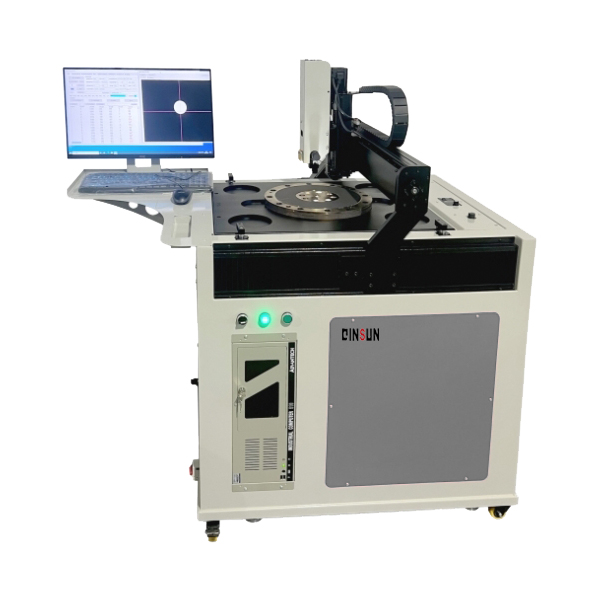
Detailed Working Principle of the Spinneret Inspection Microscope
Automated Inspection Process
The Spinneret Inspection Microscope utilizes a high-precision mechanical system and advanced control technology to achieve automatic feeding, positioning, inspection, and sorting of spinnerets. During the entire process, the device can automatically adjust focus, lighting, and shooting angles, ensuring that each spinneret is captured with a clear and accurate image.
Image Acquisition and Analysis
Equipped with a high-resolution built-in camera, the device captures images of the spinneret, which are then pre-processed, enhanced, and analyzed through image processing techniques. Subsequently, algorithms are applied to identify and count the fibers in the images, enabling an accurate assessment of the spinneret’s quality.
Ensuring Inspection Accuracy
To guarantee inspection precision, the Spinneret Inspection Microscope employs multiple technical measures. First, the device performs automatic calibration to ensure consistent and accurate imaging each time. Second, advanced image processing algorithms allow precise recognition of fiber morphology and quantity. Finally, the system features automatic feedback and adjustment functions, which fine-tune inspection parameters based on real-time conditions to ensure reliable and consistent results.
Functions and Applications of the Spinneret Inspection Microscope
The Spinneret Inspection Microscope is a specialized optical inspection device designed to detect defects in the micro-holes of spinnerets used in industries such as synthetic fibers and nonwoven fabrics. It evaluates hole shape, size, cleanliness, blockage, out-of-roundness, and contamination. The device is available in manual and fully automated models, with the core purpose of ensuring spinning quality and process stability.
Functions:
Using a high-magnification zoom optical system combined with an industrial camera, coaxial/ring/bottom illumination, and image processing software, the device can magnify and observe micro-holes, measure hole diameter, area, roundness, and contamination rate, automatically detect defects (highlighted in red/green), determine coordinates, and record historical data.
Fully automated models can integrate X-Y-Z three-axis motion platforms, automatic focusing, air-blowing cleaning, and stamping/marking functions, enabling comprehensive inspection with minimal manual intervention.
Applications:
Incoming quality control of new spinnerets.
Cleanliness evaluation of spinnerets in use.
Spinning anomaly tracing, e.g., identifying regions of concentrated blocked holes to indicate process issues.
Spinneret life-cycle management.
The device is applicable to all types of spinnerets, including those used in synthetic filament and staple fibers, meltblown and spunbond nonwoven fabrics, and various shapes (round, rectangular, etc.). By detecting micro-hole defects early, it prevents issues such as broken filaments, fuzz, uneven fiber fineness, thereby improving spinning stability and overall product yield.
Industries Applicable to the Spinneret Inspection Microscope
The Spinneret Inspection Microscope is primarily used in the chemical fiber and nonwoven fabric manufacturing industries for inspecting the micro-holes of spinnerets, spinning plates, or spinning packs. It is designed to evaluate micro-hole dimensions, shape, cleanliness, and blockage conditions, ensuring stable production quality and process performance.
Chemical Fiber Industry
The instrument is widely used for quality control of spinnerets in the production of various filament and staple fibers, including:
Nylon (Polyamide)
Polyester
Acrylic Fiber
Spandex (Elastane)
Carbon Fiber
Aramid Fiber
It helps manufacturers verify spinneret hole quality and maintain consistent fiber production performance.
Nonwoven Fabric Industry
The Spinneret Inspection Microscope is commonly applied in:
Spunbond nonwoven production
Meltblown nonwoven production (such as mask filtration materials)
Composite nonwoven manufacturing processes
By inspecting the micro-holes of spinnerets and die heads, the system ensures fiber uniformity, stable web formation, and consistent product quality.
Spinneret Manufacturing Industry
For spinneret manufacturers, the instrument serves as an essential quality inspection tool for newly produced spinnerets. It is used to verify:
Hole diameter accuracy
Geometric and positional tolerances
Hole shape consistency
Internal wall surface finish and cleanliness
This ensures that spinnerets meet design specifications before delivery to customers.
Regenerated Fiber and Specialty Fiber Research
The system is also suitable for research institutions and manufacturers engaged in the development of:
Regenerated fibers
High-performance fibers
Specialty fibers with complex cross-sections
Ultra-fine fiber production
Its high-precision optical imaging and measurement capabilities enable accurate inspection of special-shaped holes, micro-holes, and ultra-fine spinneret structures, supporting advanced fiber development and process optimization.
Key Benefits Across Industries
Ensures spinneret quality and cleanliness
Reduces filament breakage and fiber defects
Improves spinning process stability
Enhances product consistency and yield
Supports quality assurance and process optimization
Facilitates preventive maintenance and lifecycle management of spinnerets
The Spinneret Inspection Microscope has become an indispensable inspection solution for modern fiber and nonwoven manufacturing, helping enterprises achieve higher product quality, production efficiency, and process reliability.
Technical Features of the Spinneret Inspection Microscope
The Spinneret Inspection Microscope focuses on high-precision optical imaging, automated motion control, and intelligent image analysis, designed for inspecting the shape, size, contamination, out-of-roundness, and blockage of micro-holes in chemical fiber spinnerets.
Optical System:
Equipped with a 0.7×–4.5× continuous zoom objective, combined with high-resolution black-and-white or color industrial cameras and coaxial, ring, and transmitted LED illumination, providing large depth-of-field, low-distortion, and glare-free imaging.
Capable of clearly resolving circular, trilobal, and other shaped holes, as well as assessing inner wall surface finish and conical defects.
Motion and Positioning:
Fully automated models feature an X-Y-Z three-axis servo motion platform, supporting automatic hole finding, sequential scanning, and autofocus.
Manual models rely on sliding stages or metal specimen holders with infrared-assisted positioning.
Inspection Capabilities:
Measures parameters including hole diameter, area, roundness (out-of-roundness), contamination rate, and perimeter.
Inspection speed ranges from 0.2–1 second per hole, with an accuracy of ±0.01 mm.
High-end models support layered scanning, allowing sectional assessment of hole depth contamination, and software can automatically classify holes as pass (green) or fail (red) with position marking.
Automation Level:
Fully automated systems integrate image processing algorithms, template matching, air-blowing cleaning, and marking functions, achieving a complete workflow:
“Place → Autofocus → Scan → Judgment → Clean/Mark → Data Archive.”
Manual models rely on operator-controlled sliding stages and visual inspection via monitor.
Structure and Adaptability:
Metal or thickened aluminum worktables ensure flatness.
Supports φ130mm–φ170mm spinnerets for manual models, or custom multi-plate fixtures for fully automated models (up to 30+ spinnerets at once).
Software supports multiple languages, historical data tracking, and template loading for various shapes (round, square, rectangular, meltblown, spunbond, etc.), with coaxial light guidance for re-inspection on some models.
Optional/Extended Features:
Optional compressed air cleaning, laser/coaxial positioning, database management, and Excel/CSV export.
Typical inspection range covers 0.01–5 mm hole diameters, with custom options available for below 0.1 mm or above 5 mm.
Operating Procedure of the Spinneret Inspection Microscope
Inspection of spinnerets is a critical step in quality control within the textile industry. The following outlines the detailed operating procedure for spinneret inspection.
1. Preparation
Before performing the inspection, thorough preparation is required:
Equipment readiness: Ensure all necessary instruments and devices, such as the microscope, lighting system, and imaging devices, are properly set up. The equipment should be stable, reliable, and easy to operate to meet inspection requirements.
Spinneret cleaning: Clean the spinneret to remove surface impurities, dust, or residues, ensuring that the microstructures can be clearly observed during inspection.
2. Inspection Operation
Placing the spinneret: Position the cleaned spinneret on the microscope stage, aligning it with the microscope lens.
Adjusting the microscope: Adjust the focus and illumination to clearly observe the spinneret’s details. Select the appropriate magnification to examine the micro-hole features and surface conditions effectively.
Observation and recording: Carefully examine all areas of the spinneret, paying special attention to critical regions such as the orifices and flow channels. Document any anomalies or defects and capture photographs. These records are essential for subsequent quality analysis and process improvement.
3. Data Analysis and Processing
After completing the inspection, collected data should be systematically analyzed:
Defect classification and statistics: Categorize observed defects and quantify their distribution and severity.
Root cause analysis: Correlate defects with production processes and equipment conditions to identify potential causes and influencing factors.
Improvement measures: Based on the analysis, implement corrective actions to enhance spinneret quality and production efficiency.
Benefits of the Spinneret Inspection Microscope for Enterprises
The Spinneret Inspection Microscope provides significant advantages in quality control, production efficiency, cost reduction, and process optimization. By combining high-precision optical inspection with intelligent image analysis, it helps manufacturers improve product consistency, reduce waste, and enhance operational efficiency.
1. Improve Product Quality and Reduce Defective Products
The system enables 100% hole-by-hole inspection and recording, ensuring that no spinneret hole is overlooked during the inspection process. Each spinning hole is evaluated based on objective measurement data rather than subjective visual judgment, providing highly accurate and reliable inspection results.
By identifying blocked, contaminated, deformed, or out-of-tolerance holes before production, the system helps achieve optimal spinning performance, reduce defective fibers, and minimize unnecessary production losses.
2. Increase Efficiency and Reduce Labor Costs
The system can accommodate multiple spinnerets simultaneously, ranging from several pieces to dozens of spinnerets depending on their size, significantly improving inspection efficiency compared with manual single-plate inspection.
For defective holes:
Surface contaminants can be automatically removed using compressed air cleaning.
If contaminants cannot be removed automatically, the system uses coaxial light guidance to accurately locate the affected hole for manual cleaning.
Alternatively, the defective position can be automatically marked on the spinneret for subsequent maintenance.
This automated workflow reduces labor intensity, shortens inspection time, and maximizes production efficiency while maintaining effective quality control.
3. Verify the Quality of New Spinnerets Upon Arrival
The system can accurately measure critical parameters such as hole diameter and geometry. As a result, manufacturers can perform incoming quality inspections on newly purchased spinnerets and verify compliance with design specifications before installation.
This prevents substandard spinnerets from entering production lines, thereby reducing the risk of defective products and unnecessary economic losses.
4. Monitor Spinneret Service Life and Condition
Because every inspected spinneret is associated with a complete historical inspection record, manufacturers can track:
Installation dates
Operating duration
Number of production cycles
Maintenance history
Quality trends over time
These records help evaluate spinneret lifespan and support predictive maintenance planning.
5. Evaluate the Performance of Cleaning Equipment
Inspection results provide valuable information about the cleanliness condition of spinnerets after cleaning operations.
By analyzing contamination patterns and residual deposits, manufacturers can:
Assess the effectiveness of cleaning equipment
Identify cleaning process deficiencies
Optimize cleaning schedules
Improve overall spinneret cleanliness
This contributes to more stable spinning performance and longer spinneret service life.
6. Real-Time Evaluation and Optimization of the Spinning Process
The system can reveal defect distribution patterns across the spinneret surface.
For example, if contaminated holes are concentrated within a specific region, it may indicate:
Abnormal temperature distribution
Polymer degradation
Material flow issues
Equipment malfunctions
Other process-related problems
By identifying these patterns early, manufacturers can quickly locate root causes and optimize production parameters, leading to more stable and efficient spinning operations.
By following standardized inspection procedures and utilizing advanced Spinneret Inspection Microscopes, enterprises can obtain accurate, reliable, and traceable inspection results that support continuous quality improvement and process optimization.For more information about Spinneret Inspection Microscopes and their applications, please feel free to contact us. Our team will be pleased to provide detailed technical specifications, product documentation, and customized inspection solutions tailored to your production requirements.
Previous: What is a Medical Face Mask Differential Pressure Tester?
N e x t : What is the ignition distance test for spray aerosols?
