





What is the ignition distance test for spray aerosols?
2026/06/04
Share:

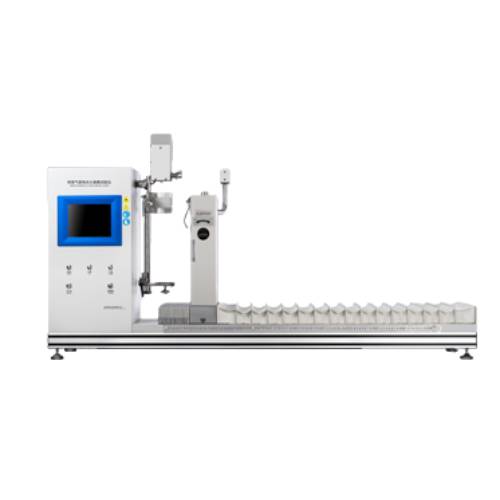
Functions of the Spray Aerosol Ignition Distance Tester
The Spray Aerosol Ignition Distance Tester is designed to meet the requirements for high accuracy and operational flexibility in fire safety testing of aerosol products.
Dual Working Modes: The device features two operational modes—“Standard Mode” and “Custom Mode”—allowing users to switch freely according to specific testing requirements, ensuring efficient and precise experiments.
Precise Positioning System: The tester employs a stepper motor in combination with a photoelectric encoder, ensuring highly accurate positioning of the measurement platform. This precise control is critical for achieving reliable and reproducible test results.
Automated Spraying: The instrument utilizes automatic aerosol spraying technology with precisely controllable spray durations, significantly improving operational convenience. Additionally, the aerosol can holder is equipped with an automatic tilting mechanism, simplifying the testing procedure and reducing manual handling.
Safety Monitoring: The tester is equipped with a dual-detection safety module, including thermocouples and nanosecond-level photosensitive sensors, which continuously monitor key parameters during testing to ensure that all operations remain within safe limits and protect personnel from potential hazards.
Remote Monitoring and Data Transmission: The system supports remote supervision and network-based data transmission, allowing operators to monitor testing progress in real time from any location. This capability improves work efficiency while minimizing operational risks.
Structural Components of the Spray Aerosol Ignition Distance Tester
Main Frame and Environmental Chamber:
Closed stainless steel frame with built-in windproof and thermal insulation layers, creating a wind-free test space. Equipped with temperature and humidity control and monitoring modules to ensure a stable environment.
Sample Holder and Automatic Spray System:
Adjustable fixtures compatible with aerosol cans of various sizes (diameter 20–80 mm, height 100–400 mm). Electric pressing mechanism allows precise control of spray duration and pressure, supports automatic tilting and continuous testing.
Ignition Source and Moving Positioning System:
Standard gas burner (methane or butane) with flame height adjustment. Stepper motor-driven platform with photoelectric encoder enables precise movement and positioning within a 15–90 cm range.
Dual Combustion Detection System:
Near-infrared photosensitive sensor (760–1100 nm) combined with high-precision thermocouple. Dual-signal verification with millisecond response automatically detects sustained combustion, preventing false positives.
Control System and Data Processing Module:
Embedded PLC with dedicated software. Supports standard or custom modes, preset test parameters, automatic gradient testing, real-time curve display, automatic calculation of average ignition distance, and generation of standard reports. Remote operation is supported to ensure personnel safety.
Technical Features of the Spray Aerosol Ignition Distance Tester
Dual Flame Detection Technology: Combines ultraviolet and near-infrared detection, avoiding interference from visible light.
Gas Burner Ignition Source: Flame height 4–5 cm, blue non-luminous flame, adjustable flame shape.
Fixed Gas Supply: Burner gas source remains stationary inside the instrument, isolated from the sample spray area.
Sample Spray Protection: Black stainless steel protective cover over the spray area prevents equipment contamination and is easy to clean.
Multiple Control Methods: Supports remote control start, instrument-end delayed start, and wireless network remote start, ensuring operator safety.
Automated Test Process: Automatically performs can pressing, ignition timing, can tilting, data recording, and automatic test result evaluation.
Emergency Stop Button: Red one-touch stop button cuts power immediately in emergencies, protecting personnel.
Embedded Industrial PC: 10.1-inch capacitive touchscreen preloaded with professional operation software.
Wireless Networking: Single computer can remotely control multiple instruments via wireless network, enabling centralized data storage and management.
Operating Procedure of the Spray Aerosol Ignition Distance Tester
1. Test Conditions and Preparation
Sample Preparation:
Prepare six test samples: three full-can products and three at 10%–12% of the labeled volume. Immerse all samples in a thermostatic water bath at 20°C ± 1°C for no less than 30 minutes before testing.
Environmental Conditions:
Conduct tests in a well-ventilated environment with no significant airflow. Maintain an ambient temperature of 20°C ± 5°C and relative humidity between 30% RH and 80% RH.
Equipment Installation:
Install and calibrate the ignition distance tester according to the manufacturer’s instructions. For example:
The burner cylinder should be mounted at the end of the aerosol discharge line and secured with screws.
The ignition tube should be installed horizontally above the burner cylinder, with the outlet 50–100 mm from the burner exit.
High-energy igniters should be installed 20 m away from the burner cylinder along the discharge line to ensure a safe distance.
Safety Precautions:
Take effective measures to prevent personnel from inhaling harmful substances and to avoid fire hazards. Operators should maintain a safe distance and use remote or manual ignition control.
2. Selecting Test Distances
Distance Sequence:
Test distances include 15 cm, 30 cm, 45 cm, 60 cm, 75 cm, and 90 cm. For initial full-can tests, start at 60 cm. For subsequent tests, adjust based on previous results.
Adjustment Principle:
If ignition occurred in the previous test, increase the test distance by 15 cm.
If no ignition occurred, decrease the distance by 15 cm.
Maximum test distance is 90 cm.
3. Full-Can Aerosol Ignition Test
Burner Setup:
Place the burner on a horizontal surface or secure it with a clamp on the stand. Adjust the aerosol can and burner height and orientation so that the spray passes horizontally through the upper portion of the flame.
Flame Height Adjustment:
Ignite the burner and set the flame height to 4–5 cm.
Spraying and Observation:
Press the aerosol spray button, limiting spray time to no more than 5 seconds. If ignition occurs, stop spraying immediately.
If no ignition occurs, reposition the sample at the same distance and spray again, up to two times.
Multi-Sample Testing:
If ignition does not occur in the first test, repeat the above procedure with the remaining two full-can aerosols at the same distance. If ignition still does not occur, adjust the test distance and continue until the maximum ignition distance is determined.
4. 10%–12% Volume Aerosol Ignition Test
Test Distance Selection:
If no ignition occurred at 15 cm during full-can testing, use 15 cm as the test distance.
If ignition occurred in full-can testing with a maximum ignition distance between 15 cm and 75 cm, add 15 cm to that distance as the test distance.
Single Test:
Perform the test following the same procedure, only once per sample.
If ignition occurs, the test is terminated. If not, repeat with the remaining two samples of the same volume at the same distance.
5. Data Processing
Data Recording:
Record each test result in a table. The ignition distance of the aerosol spray is defined as the maximum distance at which ignition occurs.
Data Analysis:
Analyze the test data to evaluate ignition risk under different conditions, providing a basis for safety management and operational guidelines.
Importance of the Aerosol Ignition Distance Tester
The Aerosol Ignition Distance Tester is of critical importance because it accurately determines the minimum ignition distance of flammable aerosol products through standardized testing procedures. The test results directly affect the classification of flammability hazards and play a vital role in ensuring the safety of transportation, storage, usage, and regulatory compliance of aerosol products.
1. Basis for Safety Classification
The ignition distance is a key parameter for determining whether an aerosol product should be classified as a “flammable aerosol.” This classification directly influences packaging requirements, hazard labeling, transportation conditions, and fire-risk management measures.
2. Essential for Regulatory Compliance
Most countries and regions around the world require aerosol products to undergo ignition distance testing before obtaining hazardous goods or consumer product safety certifications. This requirement is particularly important for products intended for international trade, maritime shipping, air transportation, and export markets.
3. Critical for Risk Prevention and Control
By utilizing automated and highly accurate testing methods, the Aerosol Ignition Distance Tester minimizes human error and ensures reliable assessment of product behavior under normal or inverted spraying conditions and in the presence of ignition sources. This helps manufacturers identify potential fire and explosion hazards before products enter the market.
4. Promotes Safer Product Design
Test data provide valuable insights for optimizing aerosol formulations, improving propellant systems, and enhancing warning labels. According to relevant standards, products exhibiting an ignition distance greater than 75 cm may be classified as “extremely flammable,” requiring stricter control measures throughout their lifecycle.
5. Enhances Operational Safety
Modern Aerosol Ignition Distance Testers are equipped with advanced safety features such as remote-controlled spraying, automatic sample inversion, and real-time monitoring systems. These functions effectively isolate operators from open flames and combustible vapors, while integrated explosion-proof chambers and interlock protection systems ensure compliance with laboratory safety regulations.
In conclusion, the Aerosol Ignition Distance Tester is a professional and indispensable testing instrument for evaluating the safety performance of aerosol products. Its precise and reliable test results are directly related to product compliance, hazard classification, and end-user safety.We strongly encourage manufacturers, testing laboratories, regulatory agencies, and industry professionals to recognize the importance of this equipment and its role in ensuring product safety and market compliance.We are committed to maintaining an open and collaborative approach and sincerely welcome inquiries from industry partners, researchers, and potential users. Our team is pleased to provide comprehensive technical documentation, operating guidance, and customized testing solutions tailored to your specific requirements. We look forward to discussing your testing needs and exploring opportunities for cooperation.
Previous: What is Spinneret Inspection Microscope?
N e x t : What is a Sandbag Mechanical Load Testing Machine?
