





How does the Full Vehicle Sunlight Simulation Test Chamber work?
2026/06/10
Share:

What Is the Testing Principle of a Full Vehicle Sunlight Simulation Test Chamber
I. Full-Spectrum Solar Radiation Simulation Principle
The core operating principle of a Full Vehicle Sunlight Simulation Test Chamber is the replication of the full-spectrum characteristics of natural solar radiation. Natural sunlight consists primarily of three spectral regions: ultraviolet (UV) radiation, visible light, and infrared (IR) thermal radiation. Each wavelength range affects automotive materials differently and contributes to distinct aging mechanisms.
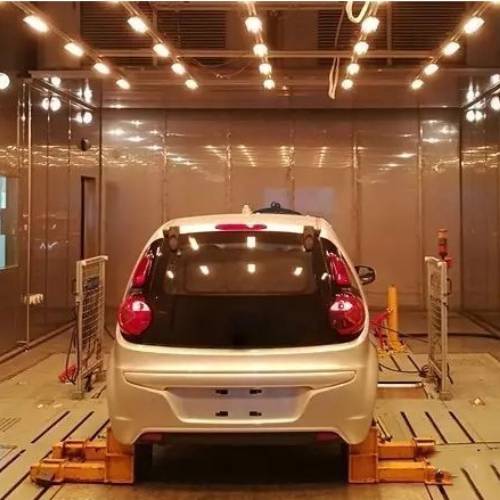
Professional full-spectrum solar simulation lamps are uniformly arranged on the ceiling and sidewalls of the chamber. Through precise matching of light source types and emission modules, the system accurately reproduces the spectral energy distribution of natural sunlight reaching the Earth's surface, thereby restoring authentic daylight exposure conditions.
Equipped with an intelligent irradiance control system, the chamber allows users to freely adjust solar radiation intensity to simulate various geographical sunlight conditions, including temperate climates, tropical regions, and desert environments with intense solar exposure. In addition, the irradiation angle of the light sources can be adjusted to reproduce different sunlight incidence angles encountered during vehicle parking and driving.
Under continuous exposure to full-spectrum simulated sunlight, vehicle body paint, exterior plastic trims, headliners, seat fabrics, instrument panels, wiring harness insulation, rubber and plastic components, and other materials undergo accelerated photothermal aging reactions. Typical degradation phenomena such as fading, yellowing, cracking, softening, and embrittlement can be reproduced within a shortened timeframe, effectively accelerating the natural aging process experienced during long-term outdoor exposure.
II. Temperature and Humidity Control Principle within a Fully Enclosed Environment
The chamber adopts a fully enclosed, thermally insulated structure combined with high-capacity bidirectional heating and cooling units and constant temperature and humidity control modules. Based on the principle of circulating air convection, the system achieves uniform environmental conditions throughout the entire test space.
The equipment provides a wide temperature control range, enabling precise simulation of various climatic scenarios, including summer heat exposure, winter cold soaking, and day-to-night temperature fluctuations.
At the same time, integrated humidity generation, dehumidification, and air purification systems allow accurate regulation of relative humidity within the chamber. In combination with solar irradiation, the chamber can create composite environments such as dry heat with intense sunlight, humid heat exposure, and condensation under solar radiation.
The combination of elevated temperature, high humidity, and intense irradiation effectively accelerates the aging of vehicle sealing systems, mold growth in interior components, and moisture-induced oxidation of electrical connectors. This enables comprehensive verification of a vehicle's environmental adaptability in hot and humid regions.
Multiple temperature and humidity sensing points are distributed throughout the chamber to provide real-time closed-loop feedback control, ensuring uniform environmental conditions across the entire vehicle testing area without dead zones.
III. Vehicle Airflow Convection and Environmental Cycling Principle
To closely replicate real outdoor parking and road-driving conditions, the chamber incorporates a full-area low-noise air circulation system capable of simulating natural breezes and airflow generated during vehicle operation.
These airflow conditions enhance heat exchange on vehicle surfaces and prevent localized heat accumulation within the chamber. As a result, temperature distributions across the vehicle body, engine compartment, underbody, and passenger cabin closely resemble those encountered in natural outdoor environments.
The chamber supports programmable multi-stage cyclic test profiles. Users can freely define complete environmental cycles involving daytime high-temperature sunlight exposure, nighttime cooling periods, intermittent condensation, and humidity phases. The system automatically switches between different conditions according to preset programs, accurately reproducing seasonal climate variations experienced by vehicles during outdoor service.
By accelerating these environmental cycles, the chamber can achieve aging effects equivalent to several years of natural outdoor exposure within a significantly shorter period, thereby greatly reducing the duration of vehicle durability validation programs.
IV. Vehicle Thermal Balance and Interior Heat Damage Testing Principle
Under intense simulated solar irradiation, the chamber can perform precise vehicle thermal balance studies and interior heat resistance evaluations.
Infrared thermal radiation generated by simulated sunlight accumulates within the passenger compartment, rapidly increasing the surface temperatures of interior components such as instrument panels, seats, and door trims. This reproduces the severe thermal conditions encountered after vehicles are parked outdoors under direct summer sunlight.
Through multiple high-precision temperature acquisition channels, the system continuously monitors temperatures at critical locations, including the engine compartment, underbody, passenger cabin, and interior component surfaces.
These measurements are used to verify air-conditioning cooling performance, cabin insulation and heat dissipation capability, and the resistance of interior materials to heat-induced deformation. Potential risks such as interior melting, warping, electronic display malfunction, and high-temperature failures of onboard electrical systems can therefore be identified and evaluated.
The resulting data provide valuable support for optimizing vehicle thermal insulation design, HVAC system calibration, and the selection of heat-resistant interior materials.
V. Intelligent Automatic Control and Data Acquisition Principle
The entire chamber is built around a centralized industrial control system integrated with a visualized operating platform.
Before testing begins, operators can preset all required test parameters, including environmental conditions, cycle sequences, test duration, and the number of repetitions. After one-touch activation, the system automatically executes the complete testing procedure, including lamp operation, temperature adjustment, humidity regulation, airflow control, and environmental condition switching.
Throughout the entire test process, the chamber automatically acquires and stores extensive testing data, including solar irradiance intensity, chamber temperature and humidity, temperatures at various vehicle measurement points, and total operating time.
The system automatically generates comprehensive test curves and reports and supports remote data export, traceability inquiries, and comparative analysis. With no need for continuous manual supervision, the chamber enables intelligent and unmanned operation of full vehicle environmental simulation testing.
Why Is Full Vehicle Sunlight Simulation Testing Necessary
Vehicles that are exposed to outdoor environments for extended periods are continuously subjected to intense sunlight and varying climatic conditions. These environmental factors can significantly affect vehicle durability, safety, comfort, and overall reliability. Therefore, Full Vehicle Sunlight Simulation Testing has become an essential validation procedure during vehicle development and quality assurance.
1. Effects of High Temperature
Under direct sunlight, the temperature inside a parked vehicle can rise rapidly, often reaching 70°C or even higher. Excessive heat can negatively impact both passenger comfort and vehicle safety.
High temperatures may cause electronic components, such as sensors and control modules, to overheat and malfunction. They can also accelerate the aging, deformation, discoloration, and deterioration of interior materials. In addition, elevated temperatures promote the release of volatile organic compounds (VOCs) from interior components, potentially affecting cabin air quality and occupant health.
2. Effects of Solar Radiation
Solar radiation contains ultraviolet (UV), visible, and infrared (IR) wavelengths, each of which affects vehicle materials differently.
Ultraviolet radiation can cause seat leather, plastic parts, paint coatings, adhesives, and other materials to fade, crack, chalk, or become brittle over time. Infrared radiation generates substantial thermal loads that challenge the vehicle's thermal management capability and contribute to heat accumulation within the passenger compartment.
3. Combined Environmental Stress
The combined effects of high temperature, intense solar radiation, and optional humidity conditions can significantly accelerate material degradation and system failures.
Such composite environmental stresses may lead to premature aging of components, electrical failures, deterioration of sealing systems, moisture-related corrosion, and other reliability issues that are difficult to identify through conventional testing methods.
Benefits of Full Vehicle Sunlight Simulation Testing
By using a Full Vehicle Sunlight Simulation Test Chamber, manufacturers can reproduce the effects of months or even years of natural sunlight exposure within just a few days or weeks. This accelerated testing capability provides several important benefits:
Verify the reliability and durability of complete vehicles and components under high-temperature and solar exposure conditions;
Identify potential design weaknesses and material defects at an early stage of product development;
Optimize vehicle thermal management systems, interior material selection, and the layout of electronic components;
Improve occupant comfort, safety, and long-term product quality;
Reduce development risks and shorten vehicle validation cycles;
Ensure compliance with relevant domestic and international regulations, standards, and certification requirements.
In summary, Full Vehicle Sunlight Simulation Testing enables automotive manufacturers to accurately evaluate vehicle performance under severe solar environments, accelerate durability verification, and deliver safer, more reliable, and higher-quality vehicles to the market.
Main Test Items of Full Vehicle Sunlight Simulation Testing
Full Vehicle Sunlight Simulation Testing encompasses a variety of test procedures designed to evaluate the performance, durability, and environmental adaptability of complete vehicles under prolonged solar exposure. Depending on development objectives and validation requirements, the following test programs are commonly conducted.
1. Static Sunlight Exposure Test (Most Common)
In this test, the complete vehicle is parked inside the environmental test chamber and subjected to continuous simulated solar radiation for an extended period, typically ranging from several days to multiple weeks.
During the exposure process, engineers monitor temperature distribution throughout the vehicle and evaluate the temperature rise and functional performance of critical components, including the instrument panel, seats, steering wheel, infotainment systems, displays, and other electronic devices.
The test is primarily used to assess:
Cabin temperature build-up characteristics;
Surface temperature changes of interior components;
Aging resistance of interior materials;
Color fading and gloss reduction;
Warpage, deformation, and dimensional stability;
Odor generation and volatile organic compound (VOC) emissions;
Functional stability of onboard electronic equipment under prolonged heat exposure.
2. Dynamic Sunlight Simulation Combined with Driving Conditions (Optional)
This testing method combines solar radiation exposure with simulated vehicle operating conditions to reproduce the thermal loads experienced during actual driving under sunlight.
By evaluating the interaction between solar heat gain and vehicle operation, manufacturers can assess the dynamic response of vehicle systems under realistic conditions.
Typical evaluation items include:
Air-conditioning cooling efficiency and pull-down performance;
Battery thermal management capability in new energy vehicles;
Powertrain and electronic system thermal behavior;
Passenger compartment thermal comfort;
HVAC control strategy effectiveness;
Overall vehicle heat balance during operation.
3. Thermal Shock and Thermal Cycling Test (Extended Validation)
Following periods of intense solar exposure, the vehicle is subjected to rapid cooling processes, such as activating the air-conditioning system or applying external water spray.
This procedure simulates environmental conditions associated with sudden weather changes, large day-to-night temperature fluctuations, or vehicle operation after prolonged sun exposure.
The test is used to evaluate:
Thermal fatigue resistance of materials;
Durability of interior and exterior components;
Resistance of sealing systems to repeated expansion and contraction;
Structural integrity under cyclic thermal stress;
Reliability of bonded joints and adhesive assemblies;
Long-term performance stability under repeated temperature transitions.
4. Combined Light and Humidity Test (Tropical Environment Simulation)
This composite environmental test reproduces severe climatic conditions characterized by high humidity, elevated temperatures, and intense solar radiation, which are commonly encountered in tropical and subtropical regions.
The synergistic effects of heat, moisture, and sunlight significantly accelerate material degradation and system aging, allowing potential weaknesses to be identified within a shortened testing period.
Typical evaluation objectives include:
Corrosion resistance of metallic components;
Mold and mildew resistance of interior materials;
Insulation performance of electrical systems;
Moisture resistance of electronic connectors and assemblies;
Durability of coatings and protective finishes;
Aging resistance of rubber seals and polymer components;
Environmental adaptability in hot and humid operating regions.
Through a combination of static exposure, dynamic operation, thermal cycling, and composite environmental testing, Full Vehicle Sunlight Simulation Testing provides a comprehensive assessment of a vehicle's durability, thermal performance, material stability, and environmental adaptability. These tests enable manufacturers to identify potential issues early in the development process, optimize vehicle design, shorten validation cycles, and ensure that vehicles maintain reliable performance throughout their service life under diverse climatic conditions.
Typical Application Scenarios of Full Vehicle Sunlight Simulation Testing
1. New Vehicle Development
Full Vehicle Sunlight Simulation Testing is widely used during the vehicle development phase to verify the performance of overall vehicle designs under prolonged high-temperature and intense solar exposure conditions.
Particular attention is given to evaluating the effectiveness of thermal management strategies, the durability of interior materials, and the rationality of electronic component layouts. Potential weaknesses can be identified and corrected before vehicles enter mass production, thereby improving product quality and shortening development cycles.
2. Material and Component Selection
The test chamber provides an accelerated evaluation platform for comparing the durability of various automotive materials and components exposed to solar radiation.
Manufacturers can assess the weathering resistance of different interior trims, coatings, adhesives, sealants, rubber weatherstrips, and polymer materials by observing changes such as fading, cracking, embrittlement, deformation, and loss of performance. The resulting data support the selection of more durable and environmentally suitable materials.
3. HVAC and Thermal Management System Validation
Sunlight simulation testing plays a critical role in validating vehicle heating, ventilation, and air-conditioning (HVAC) systems, as well as overall thermal management performance.
Engineers can evaluate:
Air-conditioning cooling capacity and pull-down efficiency;
Cabin temperature reduction performance;
Air outlet temperature distribution;
Defrosting and demisting capability;
Solar load compensation strategies;
Thermal comfort within the passenger compartment;
Heat dissipation effectiveness of key vehicle systems.
The data obtained contribute to optimizing HVAC calibration and improving occupant comfort under extreme climatic conditions.
4. Electrical and Electronic Reliability Verification
Modern vehicles incorporate an increasing number of electronic systems whose performance can be significantly influenced by high temperatures and prolonged solar exposure.
Sunlight simulation testing is therefore used to verify the functional stability and reliability of components such as:
Vehicle control units and onboard computers;
Infotainment and navigation displays;
Digital instrument clusters;
Cameras and vision systems;
Sensors and control modules;
Communication devices and electronic accessories.
The test helps identify potential risks including overheating, display malfunction, signal instability, and thermal-induced electronic failures before products reach the market.
5. Environmental Adaptability Validation for Export Vehicles
Vehicles intended for export markets often face climatic conditions that differ substantially from those in their country of manufacture.
For markets located in regions such as the Middle East, Africa, Southeast Asia, and other areas characterized by high temperatures and intense solar radiation, Full Vehicle Sunlight Simulation Testing enables manufacturers to verify whether vehicles can maintain their durability, safety, and comfort under severe environmental conditions.
The results provide critical evidence supporting vehicle adaptation and localization strategies for global markets.
6. Regulatory Compliance Verification
Many domestic and international markets impose requirements related to vehicle weather resistance, thermal safety, and environmental durability.
Full Vehicle Sunlight Simulation Testing assists manufacturers in demonstrating compliance with applicable regulations, certification requirements, and customer specifications concerning heat resistance and climatic performance.
Conducting these evaluations during development helps reduce certification risks and facilitates successful entry into target markets.
In summary, Full Vehicle Sunlight Simulation Testing is a highly sophisticated and indispensable evaluation method in modern automotive engineering. It transforms the uncontrollable and time-consuming process of natural outdoor weathering into a scientific laboratory procedure that is controllable, repeatable, and significantly accelerated.Through this testing, engineers can systematically optimize a vehicle's heat resistance and environmental adaptability, ensuring that vehicles continue to provide passengers with comfortable, reliable, and safe mobility experiences, regardless of how harsh or demanding the climatic conditions may be anywhere in the world.We sincerely welcome you to contact us at any time through messages or direct inquiries. Your questions, comments, and suggestions are extremely valuable to us. Through close communication, we can better understand your specific requirements and provide more comprehensive, detailed, and customized product information and technical support.We look forward to hearing from you and having the opportunity to offer you more professional and attentive service.
Previous: What is the test for fabric absorbency?
N e x t : What is a Garment Fabric Wet Adhesion Performance Tester?
