





What is a fabric induction static electrical meter?
2026/06/15
Share:

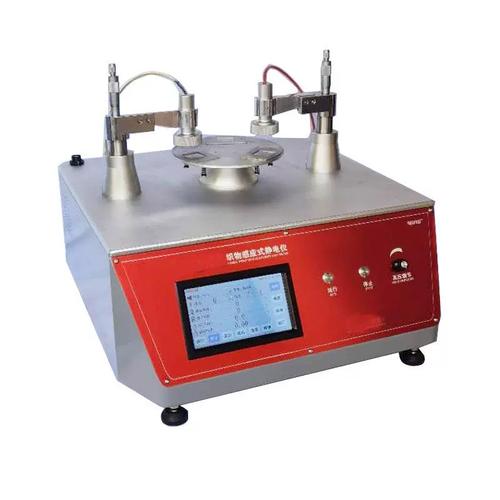
Applications and Features of the Fabric Induction Static Tester
1. Instrument Application
Under specified laboratory environmental conditions, this instrument is suitable for determining the electrostatic properties of fabrics and sheet-like or plate-like products made from various non-metallic materials. By applying a predetermined high-voltage electric field, the instrument performs timed discharge to induce static electricity on the fabric sample. It can then measure the electrostatic voltage, the half-life of electrostatic voltage decay, and the residual electrostatic charge, thereby evaluating the electrostatic characteristics of the tested material. The test results provide valuable guidance for the selection and application of professional textile materials.
2. Accurate and Reliable Testing
The instrument adopts microcontroller-based testing and control technology integrated with advanced programmed algorithms, ensuring accurate and reliable test results. The entire testing process is fully automated, making operation convenient and safe. In addition, the instrument is equipped with a printer. A large LCD screen provides an intuitive display of the DC high-voltage generator output voltage, the instantaneous peak electrostatic voltage generated during high-voltage discharge, and the electrostatic half-life of the tested fabric.
3. Intelligent Control System
Featuring computerized control and intelligent testing, the instrument offers an intuitive operating interface with a color touch screen. The display is clear and easy to understand, allowing users to operate the equipment simply and efficiently.
4. Automatic and Manual Operating Modes
The instrument provides both Automatic Mode and Manual Mode:
Automatic Mode: The entire testing procedure is completed automatically by the instrument. This mode is suitable for most routine testing applications, enabling operators to accomplish testing tasks without extensive manual intervention.
Manual Mode: This specialized mode is intended for professional researchers or factory personnel who require customized operation settings and greater control over the testing process.
5. Principle of Electrostatic Half-Life Measurement
Whether a fabric retains static electricity depends not only on the magnitude of the electrostatic voltage remaining after high-voltage discharge, but also on the duration for which the electrostatic voltage is maintained.
The rate at which static electricity dissipates from the specimen is expressed by the electrostatic half-life, which is an important indicator for evaluating the electrostatic performance of textiles. The testing principle is as follows:
After the specimen is charged to a stable state within a high-voltage electrostatic field, the high-voltage power supply is disconnected. The electrostatic voltage on the specimen is then allowed to decay naturally through the grounded metal platform. The electrostatic half-life is defined as the time required for the voltage to decrease to one-half of its initial value.
6. Indicators of Fabric Electrostatic Properties
The electrostatic property of fabrics refers to the degree to which static electricity is generated and accumulated on textile materials. As chemical fiber products are increasingly used in clothing applications, the static electricity generated by synthetic fiber fabrics can cause considerable inconvenience to users. Moreover, understanding these electrostatic characteristics can provide guidance for workers in special industries when selecting appropriate garments, thereby helping to prevent accidents caused by electrostatic discharge.
The primary indicators used to evaluate the electrostatic properties of fabrics include:
Electric charge quantity;
Electrostatic voltage;
Specific electrical resistance (resistivity);
Electrostatic half-life.
Technical Features of the Fabric Induction Static Tester
The Fabric Induction Static Tester offers significant advantages in measuring the electrostatic characteristics of fabric surfaces. Its unique induction technology enables the accurate determination of electrostatic charge quantity and electrical resistivity, while delivering fast, stable, and reliable test results. The instrument features the following characteristics:
1. High-Quality Materials
The Fabric Induction Static Tester is manufactured using high-quality materials, ensuring excellent stability and long-term durability. This robust construction helps maintain the accuracy and consistency of test results throughout the instrument's service life.
2. Precision Manufacturing Process
Advanced and precise manufacturing techniques are employed during production to ensure the accuracy and uniformity of every component. This meticulous craftsmanship enhances the reliability and repeatability of the testing results.
3. Multiple Testing Modes
The instrument provides multiple testing modes and parameter-setting options, allowing flexible configuration and adjustment according to different testing requirements. This versatility enables users to evaluate the electrostatic properties of various fabrics more accurately and efficiently.
4. Comprehensive Safety Protection
The Fabric Induction Static Tester is equipped with comprehensive safety protection features to effectively safeguard both operators and the equipment during testing. It also incorporates an intelligent control panel and a user-friendly operating interface, making operation, maintenance, and daily use simple and convenient.
5. Data Reporting and Analysis
The instrument provides intuitive charts and detailed data reports, enabling users to analyze and compare the electrostatic performance of different fabrics with ease. Through these reports, users can gain a deeper understanding of fabric electrostatic characteristics and make corresponding adjustments and improvements to material selection, product development, and process optimization.
Working Principle of the Fabric Induction Static Tester
The working principle of the Fabric Induction Static Tester mainly involves the mechanisms of induction charging and discharge decay, together with the appropriate selection of testing methods.
1. Induction Charging and Discharge Decay
Induction Charging
Induction charging primarily occurs in dielectric materials, where polarization caused by an external electric field leads to the accumulation of electric charges on the material surface. This phenomenon forms the basis for the instrument's ability to detect and evaluate the electrostatic behavior of fabrics.
Discharge Decay
The dissipation of static electricity follows an exponential decay law. By measuring the charge decay time constant (τ), the instrument can assess the static charge dissipation capability of the material. The electrostatic half-life (t₁/₂), defined as the time required for the electrostatic voltage or charge to decrease to one-half of its initial value, is an important indicator for evaluating the antistatic performance of fibers and textiles.
2. Testing Methods
Corona Discharge Method
The corona discharge method is one of the most commonly used testing techniques. It requires the establishment of a non-uniform electric field to generate a high concentration of unipolar ions, thereby inducing electrostatic charges on the fabric specimen. The resulting electrostatic characteristics can then be measured and analyzed.
Non-Contact Measurement
Non-contact measurement techniques, such as the comparison electrode method, determine electrostatic properties by detecting the differences between the charged and uncharged states of a rotating specimen. This approach eliminates potential interference caused by direct contact, thereby improving measurement accuracy and repeatability.
Measurement of Peak Voltage and Half-Life
The determination of peak electrostatic voltage and electrostatic half-life depends on several factors, including the discharge voltage, corona discharge duration, and surrounding environmental conditions. Since these variables can significantly affect the accuracy of the test results, they must be carefully controlled throughout the testing process.
3. Test Environment
Temperature and Humidity Control
Changes in temperature and relative humidity directly influence the generation of corona discharge and the electrostatic behavior of textile fibers. Therefore, maintaining suitable environmental conditions during testing is essential for improving the reliability, consistency, and reproducibility of the measurement results.
In summary, the Fabric Induction Static Tester combines the principles of induction charging, electrostatic decay analysis, corona discharge technology, and non-contact measurement techniques to provide an accurate and scientific evaluation of the electrostatic properties of fabrics. The instrument plays an important role in textile research, quality control, material selection, and the development of antistatic products.
Operating Procedure of the Fabric Induction Static Tester
1. Sample Preparation
Prepare the specimens in accordance with the relevant testing standards. Randomly select three groups of specimens, with each specimen measuring 45 mm × 45 mm.
2. Loading the Specimens
Open the test chamber door and place the three groups of specimens into the chamber. Select one specimen for testing and mount it securely onto the specimen holder with the test surface facing upward.
3. Electrode Height Calibration
Use the calibration block to adjust the heights of the induction electrode and the discharge needle. The induction electrode should be positioned 15 mm above the specimen surface, while the discharge needle should be positioned 20 mm above the specimen surface. The required distances can be adjusted by rotation.
4. Power On and Enter the Settings Menu
Switch on the instrument and press the Settings key to enter the parameter setting interface.
5. Set the Test Parameters
Adjust the testing parameters as follows:
Motor running time: 15 seconds
High-voltage holding time: 30 seconds
6. Configure the Test Conditions
Set the testing conditions according to the specified requirements:
Discharge electrode distance from specimen surface: 20 mm
Induction electrode distance from specimen surface: 15 mm
Applied voltage: 10.000 V
Decay ratio: 0.5
7. Adjust the Test Humidity
Use the Up and Down keys to adjust the test humidity until the relative humidity reaches 35%.
8. Calibration and Zero Adjustment
Before each test, perform calibration and zero adjustment to ensure measurement accuracy. After calibration is completed, click the Run button.
9. Start the Test
When the environmental humidity reaches the preset value of 35% RH, press the Run key to begin the test.
10. Record the Decay Data
If the electrostatic half-life exceeds 180 seconds, press the Run button to stop the test and record the residual electrostatic voltage at the 180-second decay point. Residual electrostatic voltage values at other specified time intervals, such as 60 seconds and 120 seconds, may also be recorded if required.
11. Obtain the Test Results
After a single test cycle has been completed, the corresponding test results can be obtained and reviewed.
12. Print the Final Results
Once all specimens have been tested, use the instrument's printing function to generate and obtain the complete test report containing all measurement results.
In summary, the Fabric Induction Static Tester features a straightforward and standardized operating procedure. By strictly controlling specimen preparation, electrode positioning, environmental conditions, and testing parameters, the instrument can provide accurate and reliable evaluations of fabric electrostatic performance, offering valuable support for textile quality control, product development, and antistatic performance assessment.
Importance of the Fabric Induction Static Tester
The importance of the Fabric Induction Static Tester lies in its ability to quantitatively evaluate the electrostatic dissipation capability of textile materials in a non-contact and highly accurate manner. This provides a critical basis for assessing the safety, comfort, and regulatory compliance of textile products.
1. Ensuring Safety in Special Industries
In industries such as petroleum, chemical processing, and military manufacturing, where flammable and explosive materials are frequently present, electrostatic sparks can trigger serious accidents or explosions. The Fabric Induction Static Tester can accurately determine the electrostatic charge level and charge decay rate of antistatic protective clothing and fabrics, ensuring that they comply with relevant standards and effectively eliminating potential safety hazards at their source.
2. Objectively Evaluating Wearing Comfort
Static electricity accumulated on everyday garments can lead to problems such as dust attraction, clinging, and unpleasant electric shocks during wear. By measuring the peak electrostatic voltage and electrostatic half-life, the instrument scientifically evaluates the antistatic performance of fabrics. The resulting data help manufacturers optimize fiber compositions and finishing processes, thereby improving product quality and enhancing user comfort.
3. Providing Standardized Data for Research and Quality Control
Compared with conventional friction charging methods, the induction method combines corona discharge technology with non-contact comparative measurement techniques, avoiding mechanical damage to the specimen caused by friction. In addition, it is less susceptible to environmental interference, enabling researchers and quality control personnel to obtain more objective, repeatable, and standardized test data.
4. Revealing the Dynamic Behavior of Static Charge Dissipation
The instrument not only determines how much static charge is generated, but more importantly, how quickly the charge dissipates.
The electrostatic half-life is a key parameter used to characterize the rate of charge dissipation. It provides a more realistic reflection of a material's electrostatic release capability during actual use and compensates for the limitations of evaluations based solely on peak voltage measurements. As a result, it offers a more comprehensive assessment of the true antistatic performance of textile materials.
5. Bridging Microscopic Charge Characteristics and Macroscopic Performance
In simple terms, the Fabric Induction Static Tester serves as a standardized quantitative bridge between the microscopic electrostatic characteristics of textile materials and their macroscopic safety and comfort performance. Without such scientific measurement, it would be impossible to accurately verify whether a textile product genuinely possesses antistatic properties or merely claims to do so.
Conclusion
In conclusion, the Fabric Induction Static Tester is an advanced textile electrostatic testing instrument that combines excellent performance with comprehensive functionality. Its wide range of applications extends beyond traditional industries such as textiles, dyeing and finishing, and chemical fiber manufacturing, while also meeting the demanding requirements of scientific research and quality inspection laboratories.With its efficient data acquisition capability, precise measurement accuracy, and long-term operational stability, the instrument significantly enhances the efficiency and effectiveness of quality control throughout the production process. It provides manufacturers with powerful technical support for product development, process monitoring, and quality assurance, helping them improve product competitiveness and maintain compliance with industry standards.We remain committed to providing our customers with high-quality products and professional services. Should you have any questions about this equipment or require further technical information, please feel free to leave us a message or contact us directly. Our team will be delighted to provide you with comprehensive product information and expert technical assistance.
Previous: Why Does Automotive Seat Thermal Testing Require a Thermal Manikin?
N e x t : What is the safety feature of the headrest?
