





What is the Manikin Breathing System?
2026/06/17
Share:

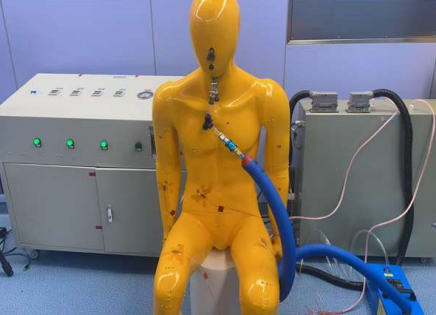
Principle and Features of the Manikin Breathing System
The core function of a Manikin Breathing System is to replicate the key physiological characteristics of human respiration, making it suitable for professional applications such as environmental testing, protective equipment evaluation, indoor air quality assessment, and thermal comfort research. Its operating principles and features are mainly reflected in its structural design, breathing simulation mechanism, and application objectives.
Working Principle of Breathing Simulation
1. Artificial Lung-Based Respiration Simulation
The manikin simulates the human breathing process through an artificial lung system, which reproduces inhalation and exhalation cycles under controlled conditions.
2. Sinusoidal Breathing Cycle Control
The system uses a sinusoidal breathing waveform to regulate airflow rate, pressure, and temperature during inhalation and exhalation. Combined with the heat generated by a thermal manikin, it creates realistic thermal plumes and airflow distributions similar to those produced by the human body.
3. Air Quality and Exposure Assessment
Under various experimental conditions, the system can measure and analyze the concentration and distribution of airborne particles and gaseous pollutants. This enables applications such as human respiratory exposure assessment, airborne infectious disease research, and indoor airflow pattern analysis.
4. Breathing Waveform Control
Early breathing simulation systems commonly used square-wave outputs. However, studies have shown that natural human breathing more closely follows a sinusoidal pattern. Therefore, modern high-precision manikin breathing systems generally employ sinusoidal waveform control to achieve greater simulation accuracy and realism.
5. Breathing Parameter Configuration
For office-environment simulations, typical respiratory settings include a ventilation rate of 6 L/min and a breathing frequency of 10 breaths per minute. Each breathing cycle generally consists of 2.5 seconds of inhalation, 2.5 seconds of exhalation, and a 1-second pause, closely replicating the breathing pattern of a seated adult at rest.
6. Airflow Path Simulation
Breathing can be performed through either the mouth or nose. When the nasal and oral structures are designed to match human anatomy, the direction and distribution of exhaled airflow can be reproduced with greater accuracy.
Structural Features
1. Human-Like Geometry and Skin Layer
The manikin features a realistic human body geometry, including the head, nasal cavity, and oral passages, ensuring accurate replication of airflow pathways and breathing behavior.
2. Heating System and Sensors
Integrated heating elements, temperature sensors, and humidity sensors simulate heat and moisture exchange between the human body and the surrounding environment. These components maintain predefined skin temperatures and thermal characteristics.
3. Artificial Lung System
As the core component of the system, the artificial lung may be installed inside or outside the manikin. It uses a piston-cylinder mechanism or vacuum pump to generate cyclic inhalation and exhalation, allowing precise control of breathing frequency and ventilation volume.
Product Features
1. Highly Accurate Breathing Simulation
The system can precisely replicate human respiratory cycles and airflow parameters. Customized breathing functions are supported, allowing the import of measured human respiratory data, such as high-intensity breathing patterns of athletes or pathological breathing characteristics of patients.
2. Adjustable Exhaled Air Temperature and Humidity
The exhaled air temperature can be adjusted within a range of 35–37°C (±0.5°C), while humidity can be controlled between 20% and 95% RH. These features ensure that test conditions closely match actual human physiological conditions.
3. Compatible with a 16-Zone Thermal Manikin
The system can be integrated with a 16-zone thermal manikin to simulate the interaction between body heat and respiratory airflow. This capability is particularly valuable for applications such as winter sportswear thermal insulation testing and human thermal comfort studies.
4. Modular Design
Its modular architecture allows both independent operation and localized testing. Users can conduct specific experiments, such as nasal airflow resistance measurements or oral cavity drying-effect studies, thereby reducing testing costs and increasing flexibility.
5. High-Sensitivity Airflow Control Components
Equipped with high-performance airflow control components imported from Germany, the system offers millisecond-level response times (≤10 ms) and automatically adapts to changes in ambient pressure, ensuring highly stable and accurate airflow control.
6. Comprehensive Safety Protection
The system incorporates multiple safety features, including:
Automatic overpressure relief valves
Short-circuit protection with fuse safeguarding
Lockable caster wheels for secure positioning during operation
These protections ensure safe, reliable, and stable performance throughout the testing process.
Core Functions and Applications of the Manikin Breathing System
The Manikin Breathing System serves a wide range of applications in medical training, healthcare equipment testing, scientific research, and respiratory protection evaluation. Depending on its design and intended use, the system can be integrated into medical training manikins or function as an independent respiratory simulation platform.
1. Emergency Response and Clinical Skills Training
In this application, the breathing system is integrated into CPR or Advanced Life Support (ALS) training manikins and is primarily used for training healthcare professionals, emergency responders, and the general public in life-saving procedures.
Core Functions
Simulated Chest Rise and Fall
Using internal air bladders or mechanical mechanisms, the system generates visible chest movement during artificial ventilation. This allows trainees to verify whether the delivered ventilation volume is appropriate and whether the technique is being performed correctly.
Airway Management Simulation
The system replicates realistic airway resistance and anatomical structures, enabling users to practice essential airway management procedures such as endotracheal intubation, mask sealing techniques, and bag-valve-mask (BVM) ventilation.
Real-Time Performance Feedback
Some advanced models can monitor ventilation pressure, tidal volume, and breathing frequency in real time. Visual and audible feedback helps users identify and correct issues such as excessive ventilation, insufficient ventilation, or air leakage during training.
Main Applications
Training proper artificial ventilation techniques, including mouth-to-mouth resuscitation and mask ventilation.
Practicing coordinated airway opening and ventilation procedures.
Supporting Basic Life Support (BLS) and Advanced Cardiovascular Life Support (ACLS) certification programs.
Widely used in hospitals, emergency medical centers, medical schools, and training institutions.
2. Medical Device Testing and Scientific Research
In this category, the Manikin Breathing System functions as an independent respiratory simulation instrument designed to reproduce human respiratory mechanics. It is widely used in ventilator development, medical device quality control, respiratory research, and laboratory testing.
Core Functions
Parameterized Breathing Simulation
The system allows precise adjustment of key respiratory parameters, including:
Lung compliance
Airway resistance
Breathing frequency
Tidal volume
These settings enable simulation of various physiological and pathological respiratory conditions, ranging from neonates to adult patients.
Dynamic Respiratory Waveform Generation
The system can generate and display respiratory waveforms in real time, including:
Flow-time curves
Pressure-volume loops
Pressure-time curves
Volume-time curves
These data help evaluate the performance and responsiveness of respiratory devices under different operating conditions.
Active Breathing Simulation
Some advanced systems can simulate spontaneous breathing efforts and trigger signals, allowing engineers and researchers to assess ventilator-patient synchrony and device response characteristics.
Main Applications
Ventilator Performance Testing
Used by hospital biomedical engineering departments, medical device manufacturers, and third-party testing laboratories to:
Verify tidal volume delivery accuracy
Calibrate respiratory equipment
Test alarm systems and safety functions
Evaluate ventilator performance under various respiratory conditions
Respiratory Protective Equipment Evaluation
When used with tracer gases or aerosol generators, the system can assess:
Filtration efficiency of masks and respirators
Air leakage rates
Protective performance under different breathing patterns and flow rates
Scientific Research
The system supports a wide range of respiratory and environmental studies, including:
Aerosol drug delivery and deposition research
Indoor air quality investigations
Airborne pathogen transmission modeling
Ventilation effectiveness studies
Human exposure assessment to airborne pollutants
Importance of the Manikin Breathing System
The importance of the Manikin Breathing System lies in its ability to accurately simulate real human respiratory dynamics, providing highly realistic and repeatable experimental data for emergency response training, environmental exposure assessment, protective equipment evaluation, and sensor validation. By transforming human breathing into measurable and controllable engineering parameters, the system significantly improves both life-safety training outcomes and scientific research accuracy.
1. Enhancing the Effectiveness of Emergency Response Training
Quantitative Performance Feedback
By simulating chest movement and respiratory airflow pathways, the system can monitor ventilation performance in real time, including tidal volume delivery and airway patency. This enables trainees to identify and correct common mistakes such as insufficient ventilation, excessive ventilation, or unintended air delivery into the stomach.
Psychological Desensitization
Practicing on a realistic breathing manikin allows trainees to overcome the hesitation and anxiety often associated with performing resuscitation procedures on unfamiliar individuals. Repeated practice helps develop confidence and establish standardized muscle memory for emergency situations.
Compliance with International Training Standards
The system helps ensure that CPR and ventilation training aligns with internationally recognized guidelines, such as those established by the American Heart Association (AHA), including proper compression-to-ventilation ratios and the avoidance of excessive ventilation.
2. Supporting Scientific Assessment of Health Risks
Quantification of Inhalation Exposure
In hospitals, laboratories, and polluted environments, the system can replicate realistic breathing frequencies and ventilation rates, allowing researchers to accurately calculate the inhaled dose of infectious aerosols, airborne pathogens, and hazardous particulate matter experienced by healthcare workers or the general public.
Validation of Protective Measures
By simulating respiratory airflow plumes under various postures and environmental conditions, the system enables researchers to evaluate the real-world effectiveness of protective measures such as masks, respirators, and ventilation systems. The resulting data provide valuable scientific support for public health policies and infection-control strategies.
3. Driving the Development of Intelligent Technologies
Training and Validation of Detection Algorithms
The system can generate dynamic respiratory signals for the development and validation of life-sign monitoring technologies, including in-vehicle child presence detection systems, millimeter-wave radar monitoring devices, and other non-contact sensing solutions. This approach reduces the challenges and ethical concerns associated with collecting large volumes of human subject data.
Multi-Modal Sensor Fusion Verification
When combined with thermal manikins and motion simulation systems, the Manikin Breathing System can simultaneously reproduce respiration, body temperature, and micro-movements. This enables engineers to evaluate the accuracy and reliability of multi-sensor fusion algorithms under conditions that closely resemble real physiological states.
Conclusion
In summary, the Manikin Breathing System transforms the complex physiological process of human breathing into measurable, repeatable, and controllable engineering parameters. It serves as a critical bridge connecting medical education, public health protection, environmental research, and advanced technology development. Whether used for emergency response training, exposure assessment, respiratory protection evaluation, or intelligent sensing research, the system provides a reliable and scientifically robust platform for obtaining accurate experimental results.We sincerely welcome you to leave a message or contact us directly for more detailed product information and customized solutions. Our team will be pleased to provide professional technical support and recommendations tailored to your specific application requirements.
Previous: What is wash fastness?
N e x t : What is a walk-in constant temperature and humidity test chamber?
