





What is a walk-in constant temperature and humidity test chamber?
2026/06/18
Share:

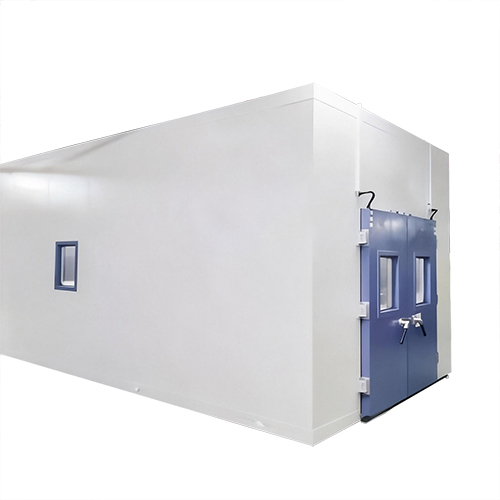
Main Components of a Walk-in Constant Temperature and Humidity Test Chamber
A complete walk-in constant temperature and humidity test chamber typically consists of the following core subsystems:
Chamber Structure:
Frame: Constructed with high-strength steel profiles to ensure overall structural stability.
Panel (Insulation Walls): The inner and outer walls are usually made of high-quality color-coated steel sheets or stainless steel sheets, with the middle layer filled with high-density, flame-retardant polyurethane foam to provide excellent thermal insulation.
Doors: Large single or double doors equipped with a wide observation window and an anti-condensation heating strip. The door edges are sealed with high-quality silicone rubber gaskets to ensure airtight performance.
Floor: High load-bearing capacity, typically made of stainless steel checkered plates, offering anti-slip and corrosion-resistant properties.
Test Ports: Reserved cable and sensor access ports for routing electrical wires and instrumentation.
Refrigeration System:
Compressor: The core power unit, commonly using semi-hermetic or fully hermetic compressors.
Condenser / Evaporator: High-efficiency heat exchange components.
Expansion Device: Such as expansion valves or capillary tubes for refrigerant regulation.
Electrical Control System:
Controller: The central control unit, usually from imported or domestic brands, supporting multi-segment programmable control and complex temperature-humidity profile settings.
Sensors: Platinum resistance sensors for temperature measurement, and polymer thin-film capacitive sensors for humidity measurement.
Electrical Components: Including AC contactors, intermediate relays, circuit breakers, etc., typically from brands such as Schneider and Siemens to ensure stable and reliable operation.
Air Circulation System:
Centrifugal Fan: Drives air circulation to ensure uniform temperature and humidity distribution.
Heater: Nickel-chromium alloy electric heating wire.
Humidifier: Stainless steel shallow-tray electric humidifier or boiler-type humidification system.
Water Supply System: Includes water tank, water pump, and water level control. It is recommended to use purified or deionized water to prevent scaling.
Safety Protection System:
Compressor overheating, overcurrent, and overpressure protection.
Chamber over-temperature protection.
Humidifier water shortage protection.
Fan overload protection.
Leakage and short-circuit protection.
Optional System:
CO₂ fire suppression system (for large-scale equipment).
Core Working Principle of a Walk-in Constant Temperature and Humidity Test Chamber
The working principle is mainly based on a precise system consisting of refrigeration, heating, humidification, and dehumidification. A circulation fan is used to ensure uniform airflow inside the chamber, so that temperature and humidity remain consistent at all locations.
Temperature Control:
Heating:
Electric heating tubes are typically used. The controller regulates the on/off state or power output of the heating elements to achieve controlled air heating.
Cooling (Refrigeration):
The core is a vapor-compression refrigeration system. In order to meet a wide temperature range from room temperature down to ultra-low temperatures (e.g., -70°C), cascade refrigeration systems or two-stage compression systems are commonly adopted. The refrigerant absorbs heat from the chamber air in the evaporator, thereby lowering the temperature.
Air Circulation:
A high-power centrifugal fan forces the conditioned air (heated or cooled) through air ducts and evenly distributes it into the test space, forming a continuous circulation loop.
Humidity Control:
Humidification:
The most commonly used method is shallow-pan or boiler-type steam humidification. Pure water is electrically heated to generate clean steam, which is then introduced into the air circulation system to increase relative humidity inside the chamber.
Dehumidification:
This is mainly achieved through the refrigeration-based condensation method. When low humidity is required, the system activates the refrigeration evaporator, lowering its surface temperature below the dew point of the air. As moist air passes over the cold evaporator surface, water vapor condenses on the fins, reducing the absolute humidity and achieving dehumidification.
The entire process is precisely controlled by a Programmable Logic Controller (PLC) and a touchscreen Human-Machine Interface (HMI). Sensors continuously monitor the temperature and humidity inside the chamber and feed the data back to the controller. The controller then commands all actuators—such as compressors, heating elements, humidifiers, and solenoid valves—to operate accordingly, forming a closed-loop control system that ensures stable conditions at the set values.
Main Application Fields of Walk-in Constant Temperature and Humidity Test Chambers
Walk-in constant temperature and humidity test chambers are widely used across industries that require large-volume and batch testing:
Automotive Industry:
Used for testing complete vehicles and large assemblies such as battery packs, motors, controllers, and interior components.
New Energy Industry:
Applied in high- and low-temperature storage and cycling tests for power batteries, energy storage battery systems, and photovoltaic inverters.
Electronics and Electrical Industry:
Used for large server cabinets, network switches, communication base stations, and household appliances.
Aerospace Industry:
Used for environmental adaptability testing of onboard equipment, aerospace materials, and various components.
Building Materials Industry:
Used to evaluate the performance of coatings, panels, doors, and windows under varying temperature and humidity conditions.
Scientific Research and Quality Inspection:
Widely used by third-party testing laboratories, universities, and research institutes for reliability studies and environmental simulation testing.
Selection Key Points for Walk-in Constant Temperature and Humidity Test Chambers
When selecting a walk-in constant temperature and humidity test chamber, the following key factors should be carefully considered:
Internal Chamber Size:
Select based on the volume, quantity, and placement method of the test specimens. It is generally recommended that the total product volume does not exceed one-third of the effective chamber volume. In addition, ensure that the door size allows smooth entry and exit of the equipment.
Temperature Range:
Define the required upper and lower temperature limits, such as -40°C to +85°C or -70°C to +150°C, depending on testing standards and product requirements.
Humidity Range:
Determine the required humidity range. It should be noted that achieving very low humidity simultaneously with low temperature conditions is often technically limited.
Control Accuracy:
Evaluate the allowable fluctuation and uniformity of both temperature and humidity inside the chamber, as these directly affect test reliability.
Temperature Change Rate (Ramp Rate):
Determine whether linear temperature changes are sufficient or if rapid thermal cycling is required (e.g., 5°C/min or 10°C/min). Faster rates require higher compressor capacity and stronger airflow systems.
Load Conditions:
Consider whether the tested products generate heat during operation (thermal load). This will significantly affect refrigeration system capacity design.
Controller and Functional Requirements:
Check whether programmable control is required and whether the number of program steps is sufficient to meet complex test profiles.
Installation Conditions:
Evaluate site constraints, including floor load-bearing capacity, door/elevator/access dimensions, power supply (typically 380V industrial power), water supply (preferably purified or deionized water), and drainage conditions.
Operation and Maintenance Precautions for Walk-in Constant Temperature and Humidity Test Chambers2
Before Operation:
Ensure the equipment is properly grounded and the power supply is stable.
Check the water supply and drainage system, ensuring the water tank is filled and the water quality is clean.
The test specimens must not include flammable, explosive, or highly volatile substances.
During Operation:
Do not frequently open and close the chamber door to avoid temperature and humidity fluctuations and repeated compressor start-ups.
Testing of flammable and explosive materials is strictly prohibited.
Maintenance and Care:
Regular Cleaning:
Clean the interior of the chamber regularly to maintain a clean working environment.
Condenser Dust Removal:
Periodically use compressed air to remove dust from the condenser fins to ensure efficient heat dissipation.
Humidifier Maintenance:
Clean the humidification water tray regularly to remove scale buildup, preventing blockage and corrosion.
Door Seal Inspection:
Inspect the door sealing gasket regularly. Replace it promptly if aging, deformation, or damage is found to ensure proper sealing performance.
Long-term Shutdown:
If the equipment is not used for a long period, it should be powered on periodically (e.g., once a month) for short operation to maintain system stability and extend service life.
Functions of a Walk-in Constant Temperature and Humidity Test Chamber
A walk-in constant temperature and humidity environmental test chamber plays a crucial role in many scientific research and industrial fields.
It provides a precisely controlled temperature and humidity simulation environment, enabling enterprises and research institutions to conduct performance testing and optimization of various products effectively.
For electronic components, the walk-in constant temperature and humidity test chamber acts as a rigorous testing environment. Under different temperature and humidity conditions, the performance of electronic components may change significantly. By simulating extreme environments such as high temperature and high humidity or low temperature and low humidity, potential issues can be identified in advance—such as short circuits caused by moisture absorption or performance degradation under high temperatures. This helps electronics manufacturers improve production processes, enhance product quality, and ensure stable and reliable operation under various complex conditions.
In the field of materials research, this equipment is also indispensable. The performance of materials is often influenced by environmental temperature and humidity. A walk-in constant temperature and humidity test chamber can simulate climatic conditions from different regions and seasons, allowing researchers to study material aging, deformation, and other properties under such environments. For example, for new building materials, long-term exposure to simulated temperature and humidity variations helps evaluate durability and applicability, providing a reliable basis for selecting higher-quality materials in the construction industry.
Another key advantage of walk-in constant temperature and humidity test chambers lies in their large capacity and high-precision control. They can accommodate large-scale specimens or batch testing requirements. In addition, the temperature and humidity control accuracy is extremely high, reaching very small tolerance ranges, which ensures the accuracy and reliability of test results.
In conclusion, the walk-in constant temperature and humidity test chamber is not only a “benchmark tool” for product quality evaluation but also a strong support for scientific and technological innovation. As China’s manufacturing industry continues to move toward high-end and intelligent development, the importance of such large-scale environmental simulation equipment will become increasingly prominent.We sincerely welcome every reader to leave comments or contact us directly. Whether you would like to share valuable suggestions, inquire about product details, or explore cooperation opportunities, we are always ready to assist. Every communication helps us better understand your needs, enabling us to provide more comprehensive product information and personalized professional services.
Previous: What is the Manikin Breathing System?
N e x t : What is an AATCC Viewing Board?
