





What is an AATCC Viewing Board?
2026/06/18
Share:

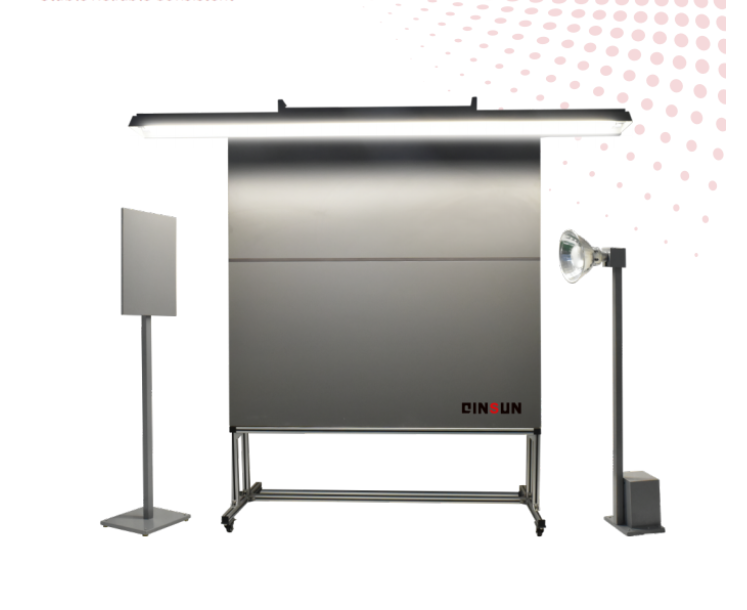
Equipment Composition of a Garment Viewing Board
A garment viewing board typically consists of the following main components:
Standard Light Source:
Provides consistent and stable illumination conditions to ensure that evaluation results are not affected by changes in lighting. The light source is usually a cool white lamp, and its brightness and color temperature can be adjusted according to requirements.
Evaluation Panel:
Used for placing garments or textile samples to be evaluated. The panel is usually equipped with magnetic fixing devices, making it convenient to install and secure the specimens.
Shading Board:
Used to block external light, ensuring that the evaluation process is conducted only under standardized lighting conditions.
Floodlight:
Works together with the shading board to provide additional illumination, helping inspectors observe the details of the test samples more clearly.
Support Stand:
An optional component used to support three-dimensional samples, enabling a more comprehensive and accurate evaluation.
Application Fields of the Viewing Board
Wrinkle Evaluation After Washing and Ironing Cycles:
By simulating multiple household laundering processes (including hand washing and machine washing), the device evaluates the degree of wrinkling in fabrics after washing as well as their wrinkle recovery ability. The rating results provide a direct reflection of the fabric’s ease-of-care performance.
Surface Appearance Evaluation After Washing:
It is used to assess the smoothness and flatness of fabric surfaces after washing, determining whether issues such as pilling, deformation, or overall appearance degradation have occurred.
Seam Performance Evaluation:
This application focuses on assessing the performance of garment seams after repeated washing. It checks whether seams become distorted, wrinkled, deformed, or overly visible, all of which directly affect garment aesthetics and durability.
Comparative Quality Assessment and Sampling Inspection:
The viewing board can be used to compare garments from different batches, different suppliers, or different processing conditions (such as various detergents or washing procedures). It is also suitable for random sampling inspections in production lines or warehouses to quickly identify appearance defects.
Compliance with International Testing Standards:
The viewing board is an essential device for performing internationally recognized testing methods such as AATCC and B&C standards. It ensures that textile and apparel appearance performance meets trade contract requirements and market access standards.
Working Principle and Key Operating Parameters of the Rating Viewing Board
The core working principle of the AATCC Viewing Board is to establish a standardized visual environment that eliminates interference from external lighting conditions. This allows evaluators to perform direct visual comparisons between the test specimen and standard reference photographs under consistent illumination, thereby obtaining an objective grading result.
Core Working Mechanism
Standardized Light Source Control:
A specified color temperature cool white fluorescent lamp is installed vertically above the viewing board to provide uniform, flicker-free illumination. This is the physical foundation for ensuring consistency in rating results, as it eliminates visual deviations in color and shadow caused by different lighting conditions.
Darkroom Isolation Environment:
Evaluation must be conducted in a completely dark or light-free environment. The surrounding walls are typically coated in matte black or equipped with blackout curtains to eliminate reflected light from side walls, which could otherwise affect judgments of fabric smoothness, gloss, and shadow details.
Visual Comparison Rating:
The treated specimen is either hung vertically or placed flat on the viewing board and visually compared side-by-side with standard AATCC reference rating photographs placed adjacent to it. The evaluator assigns a grade based on the standard level that most closely matches the appearance of the specimen (e.g., wrinkling, smoothness, seam visibility).
Key Operating Parameters
Viewing Distance and Angle:
The evaluator should stand approximately 1.2 meters in front of the viewing board, with a viewing eye level of around 1.5 meters, ensuring a standardized observation angle.
Specimen Placement Requirements:
The fabric must be placed with the warp direction kept vertical. It must not be artificially stretched or distorted, so that its post-treatment appearance is accurately represented.
Multi-Observer Independent Evaluation:
Typically, three trained observers independently perform the rating. The final result is calculated as the average value to reduce individual subjective bias and improve evaluation reliability.
Operation Process and Precautions of the Viewing Board
Workflow
1. Preparation Stage:
Prepare all accessories and test samples, and ensure that all equipment is in normal working condition.
2. Specimen Installation:
Mount the garments or textile samples to be evaluated onto the evaluation panel and secure them using the magnetic fixing device.
3. Lighting Activation:
Turn on the standard light source and floodlight to ensure that the evaluation area is fully and evenly illuminated.
4. Evaluation Process:
Under the standard lighting conditions, testers use the shading board and auxiliary floodlight to carefully observe the appearance of the specimen. By comparing it with standard reference cards, evaluate defects such as wrinkling, smoothness, seam retention marks, and oil stains or other appearance flaws.
5. Result Recording:
Based on the evaluation results, the tester records the appearance grade of each specimen in the corresponding data sheet.
Precautions
1. Environmental Control:
The evaluation must be conducted in a darkroom environment, using only the device’s built-in light source. Any external or reflected ambient light may interfere with the rating accuracy.
2. Equipment Calibration:
Regular calibration of the light source and viewing board is required to ensure compliance with standard performance requirements.
3. Professional Training:
Operators must receive professional training and be familiar with equipment operation procedures as well as standardized evaluation criteria.
Main Functions of the Viewing Board
1. Standardized Evaluation Environment:
The viewing board provides a standardized lighting environment and evaluation benchmark that complies with international standards. By comparing samples with standard reference charts, it effectively reduces subjective judgment differences. This ensures that evaluation results of garment appearance properties such as wrinkling, smoothness, and seam impressions are comparable and reproducible across different laboratories and time periods.
2. Simulation of Real-Use Conditions:
The device is mainly used to evaluate the appearance retention of garments after multiple washing and ironing cycles, effectively simulating real consumer usage scenarios. By quantifying indicators such as wrinkling level and crease retention, it helps manufacturers optimize fabrics and production processes, ensuring that products maintain good appearance in actual use and improving customer satisfaction.
3. Full-Process Quality Control Tool:
From product development and R&D, through in-process quality monitoring, to final inspection before shipment, the viewing board plays a critical role at every stage. It quickly identifies appearance defects and provides reliable data support for quality control, reducing return rates and after-sales risks, and serving as a technical foundation for brand reputation assurance in the textile industry.
4. Flexible and Standard-Compliant Design:
The equipment is typically equipped with optional supports, mobile trolleys, and adjustable lighting modes, enabling multi-angle observation and adaptation to different testing environments. Its design complies with industry standards, ensuring that testing processes meet domestic and international market access requirements and providing authoritative data support for product export and certification.
In summary, the garment viewing board enables accurate evaluation of textile appearance under standardized lighting and observation conditions, supported by a range of auxiliary components. This evaluation method is objective and reproducible, providing strong support for textile quality control and product development. We sincerely welcome you to leave messages or contact us directly at any time, so that we can better understand your needs and provide more detailed and accurate product information and professional support.
Previous: What is a walk-in constant temperature and humidity test chamber?
N e x t : What is a thermal comfort environmental chamber?
