





What is a chemical protective robotic manikin?
2026/06/23
Share:

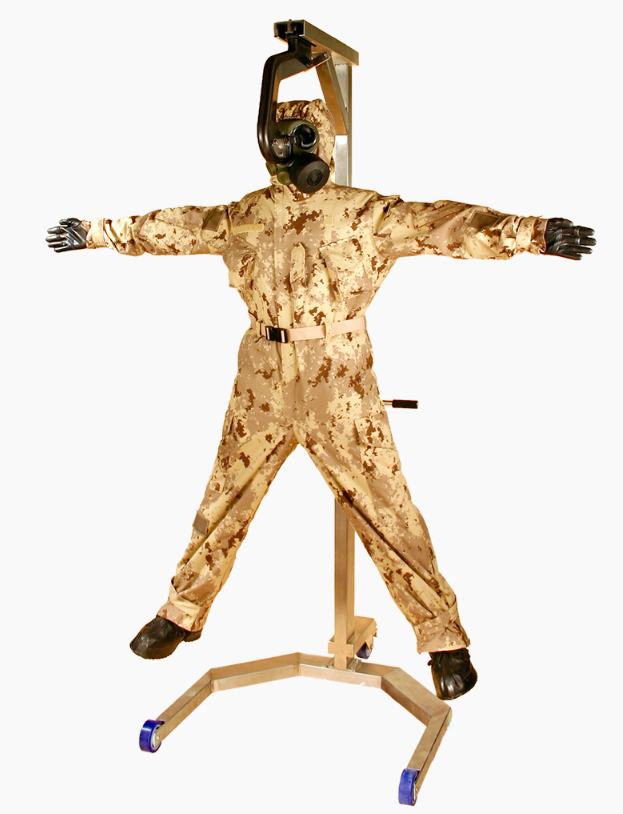
Testing Principles of Chemical Protective Clothing Manikins
The testing principles of chemical protective clothing manikins involve exposing a manikin or headform to a controlled chemical or biological environment while executing pre-programmed human motion sequences. Under dynamic conditions, mechanical stresses are applied to the protective garment and its interface areas. During the test, dosimeters positioned at critical locations sample and analyze potential permeation or leakage, thereby evaluating the garment's sealing performance, material resistance, and overall protective capability under realistic usage conditions.
1. Airtightness Testing Principle
One of the primary functions of chemical protective clothing is to prevent the penetration of toxic and hazardous gases, vapors, and aerosols. Airtightness testing assesses the overall sealing performance of the garment by introducing compressed air or a tracer gas into the suit and monitoring pressure decay or constant-volume airflow variations.
Pressure Decay Method:
The protective suit is inflated to a specified pressure, after which the air supply is shut off. The pressure drop over a defined period is recorded. A smaller pressure decrease indicates a lower leakage rate and better sealing performance.
Constant-Volume Flow Method:
A constant positive pressure is maintained inside the suit while measuring the airflow required to compensate for leakage. A higher makeup airflow rate indicates more severe leakage.
2. Thermal Protective Performance Testing Principle
A thermal manikin system is used to expose a manikin dressed in protective clothing to high-temperature flames simulating fire conditions. Heat transfer data are collected through thermal sensors distributed over the manikin's body. The Henriques burn integral model is then applied to predict the extent of second- and third-degree skin burns, thereby evaluating the garment's thermal insulation performance.
A smaller predicted burn area indicates better protective performance.
The test can generate color-coded contour maps to visually display the risk levels of different body regions.
3. Thermo-Physiological Comfort Testing Principle
A heated sweating manikin is employed in a controlled temperature and humidity environment to simulate human metabolic heat production and perspiration. The thermal resistance and evaporative resistance of the clothing are measured, and the moisture permeability index is calculated to comprehensively assess wearing comfort.
Higher thermal resistance corresponds to better thermal insulation.
Lower evaporative resistance indicates superior moisture management, sweat dissipation, and breathability.
Functions and Applications of Chemical Protective Clothing Testing Manikins
Chemical protective clothing testing manikins are not a single type of equipment. Depending on the testing objective, they can be broadly classified into thermal protective performance testing systems and physical/chemical barrier performance testing systems. Their primary function is to replace human subjects in high-risk evaluations, providing quantitative assessments to ensure the safety, reliability, and comfort of protective equipment.
1. Core Functions and Applications
1.1 Evaluation of Thermal Protection and Burn Risk (Thermal Manikins)
Simulation of Flash Fire Conditions
Thermal manikins can be exposed to high-temperature flames in a controlled burn chamber to assess the integrity of chemical protective clothing, particularly garments requiring flame-resistant properties, under extreme thermal exposure conditions.
Prediction of Skin Burn Severity
Data collected from high-density heat flux sensors distributed across the manikin's surface are processed using burn injury prediction algorithms to calculate the rate of heat transfer to the skin. This enables accurate prediction of the location and extent of second- and third-degree burns, rather than simply determining the temperature resistance limit of the material.
Verification of Whole-Garment Performance
Thermal testing evaluates the resistance of seams, closures, zippers, and other garment interfaces to heat penetration, helping identify potential system-level failures that cannot be detected through individual fabric testing alone.
1.2 Testing of Chemical Liquid Resistance and Airtightness (Specialized Manikin Systems)
Liquid Splash Resistance Testing
When used in conjunction with rotating platforms or other dedicated equipment, the manikin can simulate chemical splash scenarios to assess the permeation resistance of protective clothing surfaces, seams, and interface regions.
Airtightness Verification
The system can be employed to conduct leakage tests on positive-pressure or negative-pressure chemical protective suits, ensuring the integrity and reliability of the garment system when used in environments containing toxic or hazardous gases.
1.3 Quantification of Thermo-Physiological Comfort and Ergonomic Performance (Heated/Sweating Manikins)
Simulation of Human Metabolism
Equipped with integrated heating and sweating systems, the manikin replicates human metabolic heat generation and perspiration, enabling measurements of the garment's thermal resistance and evaporative resistance.
Prevention of Heat Stress Injuries
By evaluating heat dissipation and moisture transport during prolonged wear, the system helps determine whether protective clothing can effectively reduce the risk of heat exhaustion, dehydration, and thermal stress, thereby balancing protection performance with allowable working duration.
2. Application Value
Ensuring Personnel Safety
Chemical protective clothing testing manikins convert the risk of irreversible human injury into repeatable, high-precision objective data, providing a scientific basis for the development, certification, and market approval of protective garments.
Optimizing Product Design
Detailed regional performance data enable manufacturers to improve garment patterns, material combinations, seam constructions, and ventilation designs, ultimately enhancing mobility, comfort, and operational efficiency in real-world applications.
Compliance with International Standards
Testing procedures are conducted in accordance with internationally recognized standards, including ISO and GB/T requirements, ensuring global regulatory compliance and facilitating mutual recognition of protective equipment certifications.
In short, chemical protective clothing testing manikins serve as a critical bridge between material performance and human safety, protecting users not only from external hazards such as flames and toxic substances, but also from internal challenges including heat buildup and moisture accumulation.
How Chemical Protective Clothing Testing Manikins Simulate Protective Clothing Performance Tests
Chemical protective clothing testing manikins primarily evaluate the sealing integrity and barrier performance of protective garments under controlled conditions through three core testing methods: airtightness pressurization simulation, chemical permeation tracer detection, and dynamic movement leakage testing.
1. Core Simulation Testing Methods
1.1 Static Airtightness Pressurization Test
A manikin dressed in a chemical protective suit is placed inside a sealed test chamber. Clean compressed air is introduced into the garment through dedicated tubing to achieve a specified internal pressure, which is maintained for a predetermined period. The pressure decay is continuously monitored during the test.
If the pressure drop exceeds the acceptance criteria defined by relevant standards, the suit is considered to have leakage points. This method is widely used to verify the static airtightness of the entire protective clothing system, including seams, closures, and interface regions.
1.2 Simulation of Inward Leakage of Chemical Contaminants
A stable concentration of tracer gas or aerosol is released into the test chamber to simulate a contaminated external environment. Sampling pumps installed inside the manikin collect air samples from the breathing zone, which are subsequently analyzed using instruments such as mass spectrometers or photometers.
By comparing the contaminant concentrations inside and outside the garment, the Total Inward Leakage (TIL) rate can be calculated, allowing for the assessment of permeation risks associated with fabrics, seams, gloves, boots, visors, and other interface components under realistic exposure conditions.
1.3 Dynamic Movement and Doffing Leakage Test
The manikin's articulated joints are programmed to perform simulated work activities, such as bending, reaching, walking, or raising the arms. In addition, standardized doffing procedures, including unzipping the garment and removing gloves, can also be reproduced.
Throughout these dynamic operations, changes in internal pressure and contaminant intrusion levels are continuously monitored. This enables the identification of seal failures, interface gaps, or negative-pressure-induced contaminant ingress caused by garment deformation, thereby overcoming the limitations of purely static testing methods.
2. Supporting Technologies
2.1 Zoned Temperature Control and Sensor Systems
Advanced manikins are equipped with multiple independently controlled heating zones and high-precision sensors distributed over the body surface to mimic the thermal characteristics of the human body. Some systems also incorporate sweating capabilities, allowing researchers to evaluate sealing stability and barrier performance under humid conditions that closely resemble actual wear scenarios.
2.2 Environmental Simulation Capability
Testing is typically conducted within an environmental chamber where temperature, relative humidity, and air velocity can be precisely regulated. This ensures excellent repeatability and reproducibility of test results across a wide range of environmental conditions.
2.3 Quantitative Data Acquisition and Analysis
The testing system automatically records pressure decay curves, contaminant concentrations, leakage rates, and time-dependent data throughout the test process. Specialized software then generates comprehensive visual reports and directly outputs key performance indicators in accordance with applicable GB, ISO, and other international testing standards.
In essence, chemical protective clothing testing manikins provide a highly realistic and repeatable platform for simulating actual working conditions, transforming complex protective performance evaluations into objective, quantifiable data that support product development, certification, and personnel safety assurance.
Selection Recommendations for Chemical Protective Clothing Testing Manikins
Chemical protective clothing testing manikins are not universal devices. The appropriate manikin type should be selected according to the intended testing purpose. The key to procurement lies in matching the equipment with the target test standards and application scenarios, rather than attempting to substitute chemical protective clothing manikins with fall-arrest dummies, thermal burn manikins, or other unrelated systems.
1. Define Testing Requirements and Select the Appropriate Manikin Type
Airtightness and Liquid-Tightness Testing Manikins
These manikins are designed to evaluate the overall sealing performance of chemical protective suits. They should feature full-scale anthropometric dimensions, smooth surfaces free from inherent leakage points, and the capability to withstand internal pressurization. Such systems are typically used in conjunction with environmental chambers.
Key considerations include:
The ability to accurately simulate sealing conditions at articulated joints;
High-precision pressure measurement systems;
Compatibility with positive-pressure and negative-pressure protective garments.
Chemical Permeation and Resistance Testing Manikins
These systems are used to determine the resistance of protective materials to specific hazardous chemicals and to assess permeation breakthrough times.
Recommended features include:
Interchangeable headforms;
Multi-axis motion control systems;
The ability to reproduce realistic body movements for evaluating seam and interface integrity under dynamic conditions;
Chemically resistant surface materials;
Compatibility with trace-level chemical sensors for permeation monitoring.
Thermo-Physiological Comfort Testing Manikins
These manikins evaluate the thermal and moisture management properties of protective clothing under high-temperature and high-humidity conditions.
Essential capabilities include:
Segmented heating zones;
Sweating simulation functions;
High-precision heat flux sensors;
The ability to simulate physiological processes such as metabolic heat generation, perspiration, and breathing.
Dynamic Motion Testing Manikins
Dynamic manikins are intended to verify the integrity and performance of protective garments during simulated occupational activities, such as walking, crouching, crawling, or climbing.
Important characteristics include:
Multi-degree-of-freedom articulated joints;
Programmable motion sequences;
Structural materials capable of maintaining stability in chemically aggressive environments;
The ability to avoid abnormal stress concentrations on the garment during movement.
2. Key Technical Specifications for Procurement
Compliance with Applicable Standards
The selected manikin system should comply with the relevant testing standards associated with the intended application.
Examples include:
EN 943 for gas-tight chemical protective clothing;
ISO 16602 and ASTM F739 for chemical permeation testing;
ISO 15831 and GB/T 18398 for thermal insulation and evaporative resistance evaluation.
Equipment lacking documented compliance with recognized standards may not be suitable for issuing authoritative test reports.
Sensor Accuracy and Distribution
For airtightness testing:
Pressure resolution should preferably be within ±1 Pa;
Leakage detection sensitivity should be sufficiently high to identify minor seal defects.
For thermal comfort testing:
Surface temperature measurement accuracy should be better than ±0.1°C;
A minimum of 34 independently controlled zones is recommended to capture localized thermal variations.
For chemical permeation testing:
The system should support trace-level contaminant monitoring;
Sensors should provide rapid response times to accurately identify breakthrough events.
Motion Simulation Capability
For dynamic protective performance assessments, the manikin should be capable of reproducing a broad range of human postures, including:
Standing;Sitting;Squatting;Crawling;
Reaching and bending movements.
Motion control should ensure realistic garment deformation without introducing artificial stress concentrations.
Material Compatibility
The manikin's outer shell, joints, seals, and drive components should exhibit excellent resistance to common acids, alkalis, and organic solvents to prevent degradation that could compromise test accuracy or system durability.
3. Procurement Considerations and After-Sales Support
Avoid the "Universal Manikin" Concept
No single manikin system can perfectly satisfy the requirements for airtightness testing, chemical permeation assessment, thermal comfort evaluation, and flame exposure testing simultaneously.
For example:
Thermal burn manikins are generally constructed from materials optimized for high-temperature exposure;
Chemical testing manikins require chemically resistant surfaces and contamination monitoring systems.
Consequently, these systems should not be considered interchangeable.
Software and Data Management
Preference should be given to suppliers offering dedicated analysis software capable of:
Real-time acquisition of pressure, heat flux, and contaminant concentration data;
Automated processing and visualization of results;
Generation of test reports compliant with national and international standards.
Calibration and Maintenance Services
Since sensor accuracy directly affects measurement reliability, buyers should verify whether the supplier provides:
Annual calibration services;
Preventive maintenance programs;
Spare parts availability and guaranteed delivery schedules.
Customization Capability
For applications involving specialized protective equipment, unusual body sizes, or customized interfaces, purchasers should confirm whether the manufacturer supports:
Interchangeable headforms;
Anthropometric customization;
Integration of application-specific sensors and accessories.
In conclusion, chemical protective clothing testing manikins are indispensable tools for evaluating and optimizing the performance of protective equipment. Their continuous technological advancement and expanding application potential deserve sustained attention and in-depth research. We sincerely welcome experts, industry professionals, and all interested parties to engage in further discussions with us through comments or direct inquiries.We would be pleased to provide more detailed product information, technical specifications, and relevant application case studies to help you gain a more comprehensive understanding of this equipment and its practical value in real-world scenarios. We look forward to your feedback and the opportunity to establish fruitful cooperation in the future.
Previous: What is a textile fiber composition analyzer?
N e x t : What is a temperature/humidity chamber?
