





What is a temperature/humidity chamber?
2026/06/25
Share:

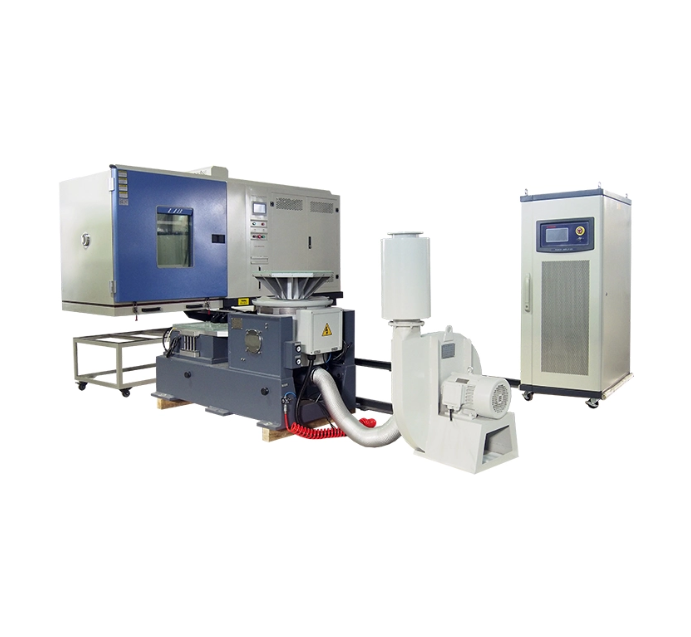
System Composition of the Temperature–Humidity–Vibration Combined Test System
Vibration System:
The core of the system is an electrodynamic vibration shaker, which operates based on the principle that a current-carrying conductor experiences a force within a magnetic field. The moving coil is located in the magnetic gap and is connected to the shaker table. The power amplifier amplifies the weak electrical signals from the controller and feeds them into the moving coil, driving the table and the test specimen to produce reciprocating motion. An accelerometer continuously monitors and feeds back real-time data, forming a closed-loop control system to ensure vibration accuracy.
Temperature and Humidity System:
The core component is the temperature and humidity test chamber. Temperature regulation is achieved through resistance wire heating, compressor-based refrigeration, or liquid nitrogen injection cooling. Humidification is realized by steam generation via water heating or ultrasonic humidifiers, while dehumidification is accomplished by cooling the air through the refrigeration system. In this way, precise control of temperature and humidity inside the chamber is achieved.
Control System:
The control system consists of integrated software and hardware and serves as the “brain” of the entire setup. It allows users to define complete test profiles and synchronously control both the temperature-humidity chamber and the vibration system. This ensures that temperature, humidity, and vibration stresses are applied to the test specimen accurately and in synchronization according to pre-set programs, while also enabling real-time monitoring and data recording of all relevant parameters.
Working Principle of the Temperature–Humidity–Vibration Combined Test System
First, the product under test is securely fixed onto the vibration table. The lower section of the temperature and humidity test chamber is then lowered to form a sealed test space. After the “temperature–humidity–vibration” combined test profile is programmed into the control computer, the system first brings the chamber to the specified initial temperature and humidity conditions. Once the environment stabilizes, the vibration shaker is activated and the test is carried out according to the preset vibration parameters.
Throughout the entire process, the control system continuously monitors all parameters in real time and dynamically adjusts them to ensure that temperature, humidity, and vibration conditions remain accurate, stable, and synchronized according to the test program.
Test Process and Detailed Procedure of the Temperature–Humidity–Vibration Combined Test System
1. Sample Preparation
Before conducting the combined test, a comprehensive visual inspection and performance verification of the samples must be carried out to ensure that they are in qualified condition and representative of mass-produced products. The number of samples should comply with relevant standards and customer requirements, and sufficient backup samples should be prepared for retesting if necessary. The packaging method should be consistent with the actual usage or transportation environment.
2. Test Equipment Setup and Calibration
The combined test requires the coordinated operation of both a climatic chamber and a vibration table. The environmental chamber is responsible for simulating temperature and humidity variations, while the vibration table applies mechanical vibration. Equipment setup includes calibration of temperature and humidity control accuracy, as well as configuration of vibration frequency and amplitude parameters. The environmental chamber used by Xunke Elite Division features high-precision control capabilities, and the vibration system supports three-axis vibration control, enabling it to meet various complex testing requirements.
3. Test Condition Setting
According to customer requirements and product standards, the temperature range, humidity range, and vibration parameters are defined. Typically, the temperature range is from -40°C to +85°C, humidity ranges from 20% RH to 95% RH, vibration frequency is commonly set between 5 Hz and 1000 Hz, and vibration acceleration ranges from 0.5 g to 10 g. In some applications, additional factors such as shock and drop may also need to be considered for safety evaluation.
4. Test Execution
The sample is first mounted on the vibration table, which is then placed inside the environmental chamber. The system is operated through programmed control to run temperature and humidity profiles in synchronization with vibration modes, achieving a combined effect of thermal, humidity, and mechanical stress. The test duration typically ranges from several hours to several thousand hours, depending on product standards and customer requirements. Throughout the test, environmental conditions and sample status are continuously monitored to ensure data validity.
5. Data Recording and Analysis
During the test, comprehensive data including environmental parameters, vibration data, and sample performance data are collected. The data acquisition system features power-loss protection to prevent data loss and facilitate post-test failure analysis. After the test is completed, the results are analyzed in combination with recorded data, visual changes of the sample, and functional test outcomes to determine whether the product meets qualification requirements.
Technical Difficulties and Key Considerations in Temperature–Humidity–Vibration Combined Testing
1. Compatibility between Vibration and Environmental Testing
When vibration equipment is installed inside a sealed environmental chamber, the structural integrity and airtight sealing of the chamber must be ensured. Otherwise, leakage or structural interference may occur, leading to instability or failure of temperature and humidity control.
2. Sample Fixation Method
Improper fixation can introduce artificial errors, while excessive clamping force may damage the specimen. Therefore, the fixture design must be carefully optimized according to the structural characteristics of the product to ensure both stability and safety during testing.
3. Rationality of Test Parameter Settings
If test parameters are too high or too low, the results may become invalid or fail to reflect the real operating conditions of the product. Parameters should therefore be selected based on the actual application environment and service conditions of the product to ensure meaningful test results.
4. Data Integrity Maintenance
The combination of multiple environmental stresses generates large volumes of multi-dimensional data. Therefore, the data acquisition system must have high reliability and stability to ensure complete data capture, storage, and traceability throughout the entire test process.
5. Failure Mode Tracking and Analysis
After testing, systematic failure analysis should be conducted to identify root causes of product failure. This helps in accurately locating design weaknesses and provides valuable feedback for product improvement and R&D optimization.
Application Fields and Value of the Temperature–Humidity–Vibration Combined Test System
In industrial applications, the temperature–humidity–vibration combined test plays an indispensable role in product reliability evaluation:
Electronic and Electrical Products:
Used to verify the operational stability of products under extreme environmental conditions, such as mobile phones, computer motherboards, and medical devices.
Automotive Industry:
Ensures the vibration resistance and thermal cycling durability of vehicles and components, thereby guaranteeing safe and stable driving performance.
Aerospace Industry:
Applied in harsh environmental testing of avionics components and equipment for aircraft and spacecraft, significantly enhancing flight safety assurance.
Materials Science:
Evaluates the physical and chemical property changes and failure mechanisms of metallic and non-metallic materials under complex environmental conditions.
Defense and Military Field:
Ensures the reliable operation of critical equipment and weapon systems under highly variable and demanding environmental conditions.
With the development of the Internet of Things (IoT), 5G technology, and intelligent manufacturing, products are increasingly required to withstand more complex environmental conditions. As a result, the importance of temperature–humidity–vibration combined test systems continues to grow, becoming a key competitive advantage for enterprises in gaining market trust and improving product reliability.
Industry Challenges and Improvement Suggestions
Although the standards for temperature–humidity–vibration combined test systems are relatively well established, several challenges still exist in practical implementation:
The investment cost of testing equipment is high, especially for high-precision constant temperature and humidity vibration test chambers, which places significant financial pressure on small and medium-sized enterprises.
Standard updates and iterations are relatively slow. For some high-tech products, environmental requirements evolve rapidly, resulting in a lag in the applicability of existing standards.
Test cycles are long, which limits testing efficiency and is not conducive to rapid design iteration.
In response, enterprises and testing institutions propose the following improvement directions:
Data management and analysis are complex; how to integrate big data and AI for intelligent decision-making is a key future development direction.
Strengthen technological upgrades of equipment by introducing modular and intelligent testing systems to optimize cost structure.
Promote a combination of international standardization and localized standards, and improve dynamic standard update mechanisms.
Integrate simulation and modeling technologies to reduce testing cycle time.
Utilize cloud data platforms and AI algorithms to improve the efficiency and accuracy of test data processing.
In summary, the temperature–humidity–vibration combined test is an important means of ensuring product quality and reliability. It helps enterprises detect design and manufacturing defects at an early stage, improves product environmental adaptability, reduces failure rates during use, and enhances customer satisfaction.With continuous technological advancement, it is believed that temperature–humidity–vibration combined testing will play an increasingly important role in more fields, safeguarding product reliability.We sincerely welcome friends, partners, and all interested individuals to contact us at any time through messages or direct communication. We highly value every inquiry and feedback, and we look forward to the opportunity to provide you with more detailed, comprehensive, and targeted product information to help you better understand and evaluate our products and services.
Previous: What is a chemical protective robotic manikin?
N e x t : What is a fabric washing shrinkage testing machine?
