





What is a pendulum impact testing machine for plastic film?
2026/06/25
Share:

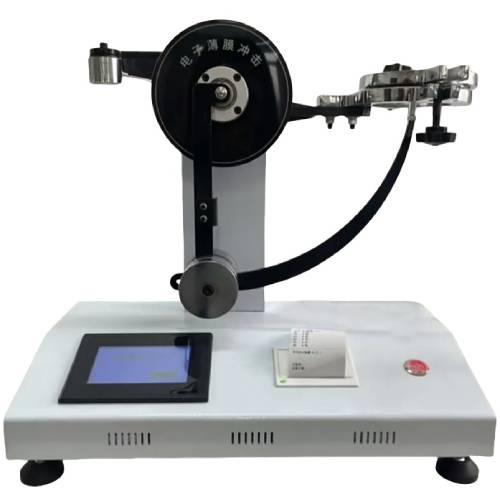
Working Principle of the Pendulum Impact Testing Machine for Plastic Film
The pendulum impact testing machine evaluates the impact resistance of thin films by using a hemispherical striker that impacts and penetrates the specimen at a constant speed. The impact performance of the film is assessed by measuring the energy consumed during the impact process.
The core working principle is based on the law of conservation of energy. The pendulum is released from a preset height, and its gravitational potential energy is converted into kinetic energy during the swing. When the pendulum strikes the specimen, part of the energy is absorbed by the film during deformation and fracture.
After impact, the pendulum swings upward again. The remaining energy is determined by measuring the rebound angle of the pendulum. The difference between the initial energy and the residual energy represents the impact energy absorbed by the film specimen, which is used to evaluate its pendulum impact resistance.
Operating Procedure of the Pendulum Impact Testing Machine for Plastic Film
1. Specimen Preparation:
Prepare at least 5 specimens for each test group, and calculate the average value to reduce random errors. Standard specimens are typically square samples of 100 mm × 100 mm, or as required by specific testing standards. For multilayer composite films, ensure that all layers are tightly bonded without air bubbles or delamination.
2. Specimen Pre-treatment:
Clean the surface of the specimen using an alcohol-soaked cotton ball to remove dust, grease, and other contaminants. Avoid direct hand contact with the test area. If testing performance under specific temperatures is required, place the specimens in a constant-temperature chamber for preconditioning for more than 30 minutes.
3. Equipment Calibration and Parameter Setting:
Select an appropriate pendulum energy level to ensure that the remaining energy after impact is not less than 10% of the initial energy (to avoid data distortion caused by insufficient energy or overload conditions).
4. Fixture Installation and Calibration:
Mount the specimen into the fixture, ensuring it is flat and free of wrinkles. Tighten the fixture evenly (torque wrenches may be used to control screw torque). Calibrate the center position of the fixture so that the pendulum impact point aligns with the center of the specimen.
5. Software Setup:
Set the testing standard, specimen dimensions, and other relevant parameters. Click the “Start Test” button to automatically release the pendulum, which then impacts the specimen at the preset speed. If the specimen is not fully penetrated (i.e., the pendulum does not completely pass through), a higher-energy pendulum should be selected and the test repeated. Test each specimen sequentially, and clean any residual fragments on the fixture after each test to ensure installation accuracy for subsequent samples.
6. Data Recording and Analysis:
The instrument automatically records the initial energy, residual energy, and energy loss for each impact, and calculates the impact strength of individual specimens. Remove outliers and calculate the average value, standard deviation, and coefficient of variation to evaluate data dispersion. Compare results with standard requirements or product technical specifications to determine whether the specimens are qualified.
Application Scenarios and Industry Requirements of the Pendulum Impact Testing Machine for Plastic Film
1. Food and Pharmaceutical Packaging
Packaging materials for food and pharmaceuticals must withstand vibration, drop impacts, and stacking pressure during transportation and storage. Impact resistance is a key factor in ensuring product safety.
Composite Film Bags: Materials such as PE/PP composite films, metallized films, and aluminum-plastic composite films must pass impact testing to verify puncture resistance, preventing contamination or spoilage caused by package failure.
Pharmaceutical Aluminum Foil: Aluminum foil used in direct contact with drugs must maintain sufficient toughness even under extreme conditions such as low-temperature freezing environments.
2. Tobacco and Electronics Industry
Tobacco Packaging Metallized Paper: Must meet the mechanical impact requirements of high-speed packaging equipment to prevent issues such as coating peeling or delamination during processing.
Electronic Component Films: Materials such as display protective films and battery packaging films must undergo impact testing to evaluate their resistance to drop impact and mechanical stress.
3. Scientific Research and Quality Inspection
Quality inspection institutions, universities, and research organizations use the pendulum impact testing machine to study the effects of material modification—such as the addition of toughening agents—on impact performance. It is also widely used in the development of new polymer composite materials, helping researchers evaluate and optimize mechanical properties under controlled conditions.
Functions of the Pendulum Impact Testing Machine for Plastic Film
The pendulum impact testing machine for plastic film plays an important role across multiple fields, mainly in the following aspects:
1. Material Performance Testing
The pendulum impact testing machine is a specialized device used to evaluate the pendulum impact resistance of plastic films. By simulating real-world impact conditions, it accurately measures the impact energy absorbed by the film.
This testing method effectively reflects the material’s ability to withstand impact in practical applications and provides essential data for material performance evaluation and research.
2. Wide Range of Applications
The device is widely used in multiple industries:
Food Packaging Industry: Used to evaluate the puncture and rupture resistance of packaging films, guiding packaging design and production process optimization.
Medical Device Field: Used to test the impact resistance of medical films, ensuring they do not rupture during use and maintaining safety and reliability.
Electronics Industry: Used to assess the impact resistance of protective films for electronic products such as display screens, helping improve product durability and service life.
3. Improvement of Product Quality
In addition to impact resistance testing, the instrument can also be used to evaluate other performance indicators of films, such as abrasion resistance. These properties are critical for determining the overall quality and suitability of the material.
Through systematic testing, manufacturers can identify potential issues in advance and make timely improvements, thereby enhancing product quality and customer satisfaction.
4. Support for Research and Development
The pendulum impact testing machine provides an important experimental tool for materials science research. By testing the impact performance of films under different materials and processing conditions, researchers can gain deeper insights into mechanical behavior and failure mechanisms.This supports material design optimization and expands application possibilities in engineering practice.
In summary, the pendulum impact testing machine for plastic film is a vital tool for evaluating impact resistance. It plays a key role in material testing, product quality improvement, and scientific research, significantly contributing to advancements in materials science and industrial applications.
Key Factors to Consider When Purchasing a Pendulum Impact Testing Machine
The plastic pendulum impact testing machine is a key instrument used to evaluate the impact resistance of plastic materials. It converts the potential energy stored in a swinging pendulum into kinetic energy, which impacts the specimen and records the failure behavior. The impact energy is then calculated to assess the toughness and stability of the material.
This equipment is widely used in plastic manufacturing and new material development to ensure that products meet required quality standards. The following are the key factors to consider when selecting a plastic pendulum impact testing machine:
1. Testing Range and Accuracy
Measuring range selection:
Clearly define the required energy range based on actual testing needs. Different models offer different energy capacities, so it is essential to ensure that the selected equipment covers the expected testing requirements.
Resolution and accuracy:
High-precision sensors and control systems are necessary to ensure accurate energy measurement results. Key technical indicators such as energy resolution, repeatability, and linearity should be carefully evaluated.
2. Pendulum Specifications and Ease of Replacement
Pendulum weight:
The weight of the pendulum determines the impact energy. Typically, multiple pendulum weights are available to meet different testing requirements. Confirm whether the supplier provides suitable pendulum options for your sample types.
Ease of replacement:
Fast and stable replacement of pendulums is essential when switching between different energy levels. It is important to assess whether the equipment is designed for easy and safe operation by users.
3. Safety Protection Measures
Protective devices:
High-quality equipment should be equipped with safety shields or protective enclosures to prevent injury from flying debris during specimen fracture.
Emergency stop function:
A clearly accessible emergency stop button should be available to immediately cut off power in case of any abnormal situation, ensuring operator safety.
4. Data Processing Capability
Data recording system:
Modern equipment is typically equipped with an automated data acquisition system that can record and display key parameters such as impact energy and displacement in real time. It is important to check whether the system supports multi-channel synchronous sampling.
Software support:
The data analysis software should provide a user-friendly graphical interface, enabling easy processing, storage, and export of test reports.
5. Degree of Automation
Fully automatic models:
Fully automatic machines can complete the entire process from sample loading to test completion, reducing human error and improving efficiency.
Semi-automatic or manual models:
If budget is limited or high automation is not required, semi-automatic or manual models can also be considered. However, attention should be paid to operational convenience and stability.
Conclusion
By carefully evaluating the above factors, users can select a pendulum impact testing machine that best fits their operational needs, enabling efficient and stable testing processes and supporting long-term business development.We sincerely welcome your inquiries or messages, and we are pleased to provide more detailed product information and technical support to help you make a well-informed decision.
Previous: What is a water vapor permeability tester?
N e x t : What is degradation and failure of PV module?
