





Which device measures both temperature and humidity?
2026/06/30
Share:

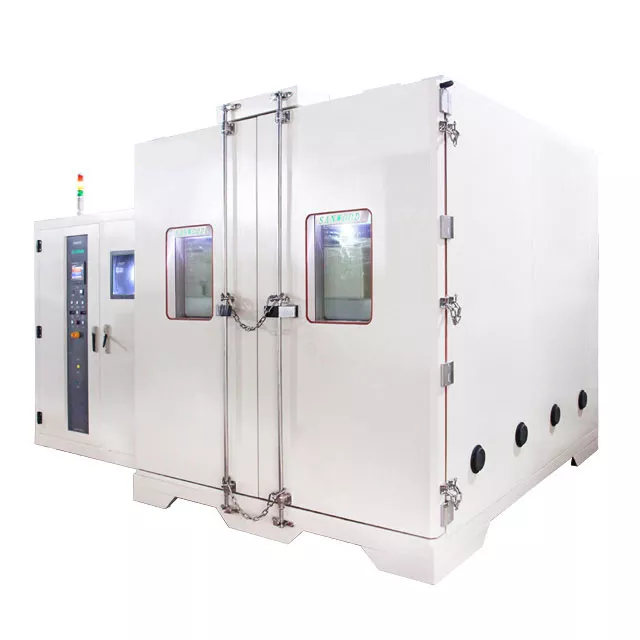
Structure of the High and Low Temperature and Humidity Test Chamber
The high and low temperature and humidity test chamber is mainly composed of a refrigeration system, heating system, control system, temperature system, air circulation system, and sensor system.
Refrigeration system:
The refrigeration system is one of the most critical parts of a constant temperature and humidity test chamber. Generally, the refrigeration method used in high and low temperature and humidity test chambers is mechanical refrigeration, which adopts vapor compression refrigeration. It mainly consists of a compressor, condenser, throttling device, and evaporator.
Heating system:
Compared with the refrigeration system, the heating system of the high and low temperature and humidity test chamber is relatively simple. It is mainly composed of high-power resistance wires. Since the chamber requires a high heating rate, the heating system usually has relatively high power, and heaters are also installed on the bottom plate of the chamber.
Control system:
The control system is the core of the test chamber. It determines key performance indicators such as heating rate and accuracy.
Humidity system:
The humidity system is divided into two subsystems: humidification and dehumidification.
Sensor system:
The sensors used in the test chamber are mainly temperature and humidity sensors.
Air circulation system:
The air circulation system is generally composed of a centrifugal fan and a driving motor. It provides air circulation inside the chamber and ensures temperature uniformity and testing accuracy.
Working Principle of the High and Low Temperature Test Chamber
The high and low temperature test chamber primarily tests products by controlling high temperature, low temperature, and humidity conditions. Internally, the chamber is equipped with systems that regulate the corresponding environmental parameters, mainly including a refrigerant circulation system, an air circulation system, and an electrical control system. These systems respectively control the temperature, humidity, and electrical functions within the chamber.
1. Refrigeration Working Principle
The refrigeration system operates based on the reverse Carnot cycle, which consists of two isothermal processes and two adiabatic processes to complete the refrigeration cycle. The detailed process is as follows:
The refrigerant is first adiabatically compressed by the compressor to a higher pressure, and the work done during compression increases the exhaust temperature. Then, the refrigerant passes through the condenser and undergoes an isothermal heat exchange process, releasing heat to the surrounding medium. After that, the refrigerant is expanded adiabatically through a throttling valve, causing its temperature to decrease. Finally, the refrigerant enters the evaporator, where it absorbs heat isothermally from the object being cooled, thereby reducing its temperature. This cycle repeats continuously to achieve the cooling effect.
2. Heating Working Principle
The heating system is composed of air electric heating elements, a heating control system, and an air circulation system.
Heating is typically achieved using nickel-chromium alloy electric heating wires. During operation, a circulating fan drives air convection inside the chamber, carrying heat generated by the heating elements into the working space, thereby heating the air inside the chamber.
The control system uses a microcomputer-based regulation method to control the conduction time of the heating wires. By balancing heat input and heat loss dynamically, precise temperature control is achieved.
3. Electrical Control Working Principle
The electrical control system operates through both manual and automatic power control. It uses contactors, compressors, fans, electrical components, and humidifiers for automated switching and operation.
The system includes temperature and humidity control as well as fault protection functions.
Temperature and humidity control is achieved through a dedicated controller, which compares the return-air temperature and humidity with the user-set values. Based on this comparison, it automatically operates components such as the compressor (for cooling and dehumidification), humidifier, and electric heater (for heating), thereby achieving automatic regulation of temperature and humidity.
Technical Features of the High and Low Temperature and Humidity Test Chamber
Simulation capability
The high and low temperature and humidity test chamber is capable of simulating various environmental conditions, including high temperature, low temperature, humidity, dryness, and salt spray. This allows products to undergo more realistic and comprehensive testing under laboratory conditions.
Under high-temperature conditions, products may experience deformation and aging. Under low-temperature conditions, both mechanical and chemical properties may change. In humid environments, products may suffer from corrosion and oxidation. Therefore, the test chamber helps enterprises or laboratories gain a more comprehensive understanding of product durability and adaptability, enabling further improvement and optimization.
High level of intelligence
The control system of the test chamber is generally advanced and can achieve automated operation through computer-based systems, offering a high level of intelligence. With a visual control interface and touchscreen panel, users can operate and adjust the equipment more conveniently, significantly improving testing efficiency and reliability.
In addition, the chamber is equipped with comprehensive safety protection functions, such as overload protection, short-circuit protection, and over-temperature protection, ensuring stable and reliable operation.
Wide range of testing applications
The high and low temperature and humidity test chamber can be used across multiple industrial fields, including electronics, electrical appliances, automotive, household appliances, and chemical industries. It supports various types of tests, such as low-temperature tests, high-temperature tests, damp heat tests, and salt spray tests.
Through these tests, enterprises or laboratories can evaluate product performance under different environmental conditions and analyze material stability and adaptability, providing effective solutions for product improvement and quality management.
Long service life
The test chamber is generally made of high-quality materials and undergoes strict inspection at every stage of design, development, and manufacturing to ensure excellent quality.
Due to its reasonable structural design and advanced manufacturing process, the chamber has a long service life and can operate efficiently and stably under various testing conditions, ensuring the scientific accuracy and reliability of test results.
Selection Guide for the High and Low Temperature Test Chamber
There are five key factors involved in selecting a high and low temperature test chamber: internal chamber size, temperature range, humidity range, whether the test sample is energized (powered during testing), heat load conditions, and power supply requirements.
As for the configuration of a high and low temperature test chamber, what kind of equipment is truly suitable for your needs? In general, “high and low temperature test chamber” is essentially equivalent to terms such as “environmental test chamber,” “temperature cycling chamber,” or “thermal cycling chamber.” It is also commonly referred to as a “high and low temperature humidity test chamber.”
Below are some selection experiences regarding high and low temperature and humidity test chambers, which may serve as a useful reference for users, research institutions, and universities when purchasing equipment.
1. Selection of internal chamber size
The internal chamber size should be selected according to the size of the test specimen, usually expressed as Depth × Width × Height.
When selecting suitable equipment, it is necessary to consider the size of the sample being tested. To ensure that the test product meets the environmental conditions specified in test standards, the working space of the chamber and the overall dimensions of the specimen should follow the principles below:
The volume of the test specimen should not exceed one-third of the effective working space of the chamber. For heat-generating products during testing, it is recommended to limit this to no more than 30%.
The ratio between the windward cross-sectional area of the test specimen and the total cross-sectional area of the chamber working space should not exceed one-third.
The distance between the outer surface of the specimen and the chamber wall should be at least 100–150 mm.
From the perspective of product performance, careful selection is essential.
2. Selection of temperature and humidity range
The following aspects should be considered carefully:
(1) Temperature range
At present, four standard temperature ranges are commonly available:
A: 0°C to 100°C
B: -40°C to 150°C
C: -70°C to 150°C
D: Other wide temperature ranges such as -70°C to 350°C
Customized non-standard temperature ranges are also available upon request, with minimum temperatures reaching -80°C.
Wide-range systems such as -70°C to 350°C are typically used in material testing industries and are often paired with material testing machines to provide multi-factor and multifunctional testing capabilities.
(2) Cycling function
This function is also known as “program operation,” “programmable control operation,” or “profile operation.”
It refers to the ability of the equipment to perform repeated temperature cycling according to a programmed curve. Equipment with this function is referred to as a thermal cycling test chamber or high and low temperature cycling test chamber.
(3) Humidity range
Whether the equipment includes humidity control determines if it is classified as a high and low temperature humidity test chamber or a constant temperature and humidity test chamber.
The typical humidity range is 30% to 98% RH.
(4) Control system hardware selection
Hardware selection should be based on actual user operation requirements, testing applications, and overall cost considerations.
3. Whether the sample is powered and heat load conditions
When selecting a test chamber, the heat load must be taken into account because both the cooling rate and the lowest achievable temperature are affected by the load.
Under no-load conditions, a standard environmental chamber is typically designed with a cooling rate of about 1°C/min. However, when loaded, the cooling performance will vary depending on the actual conditions. If the load is too large, the chamber may fail to reach the required temperature.
4. Power supply requirements
Due to the presence of high-power components such as heaters and refrigeration compressors, the default power supply for most high and low temperature test chambers is three-phase 380V. This ensures balanced power distribution and avoids interference with the customer’s electrical system.
For research and development companies located in office buildings where three-phase power is not available, a 220V configuration may be required. This must be specified in advance.
Conclusion
In general, the high and low temperature and humidity test chamber is an important environmental testing instrument. By accurately simulating extreme temperature and humidity conditions, it plays a critical role in product development and quality control.Whether it is used to verify the durability of new materials, evaluate the long-term reliability of electronic components, or ensure the stability of finished products under complex climatic conditions, this equipment is an indispensable testing tool.We sincerely welcome inquiries regarding equipment selection, technical parameters, testing solutions, or any related questions. Based on your specific application scenarios and testing requirements, we can provide detailed product information, technical support, and even customized solutions.
Previous: What is a Laser Compression Deformation Tester?
N e x t : What is the ICI pilling method?
