





What is the ICI pilling method?
2026/06/30
Share:

In the world of textiles, fabric pilling and fuzzing is a common issue that affects both the appearance quality and service life of fabrics. This problem is especially prominent in wool knitted fabrics and blended fabrics, which are prone to pilling and fuzzing after daily wear and friction, directly impacting the hand feel and visual grade of the product.In textile routine quality inspection, fabric development, and finished product acceptance processes, the tumbling box pilling test is a widely adopted industry testing method. The Fabric Pilling and Snagging Tester is specifically designed to simulate the free-tumbling friction condition of fabrics without pressure, enabling accurate evaluation of the natural pilling tendency of textiles.It is widely applicable to testing garments, home textiles, knitted fabrics, and other textile products. Fully compliant with multiple international and domestic industry standards, it is an essential testing instrument for textile laboratories.
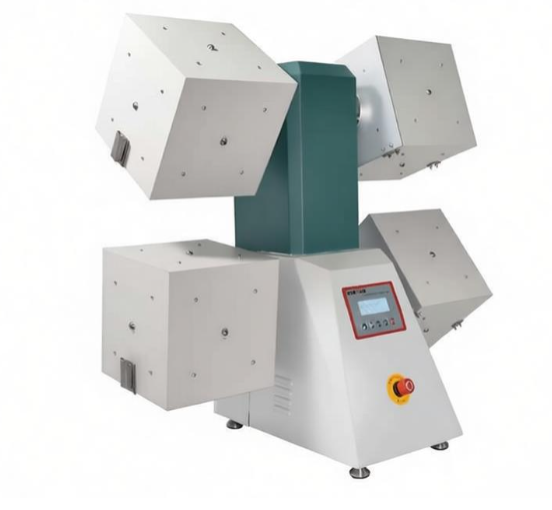
Working Principle of the Rotary Drum Pilling Tester
The rotary drum pilling tester is a specialized instrument designed for evaluating the pilling and snagging performance of textile materials. Its core principle is to simulate the rolling and friction conditions that fabrics experience during daily use.
During the test, fabric specimens are mounted onto polyurethane tubes and placed inside a square rotating drum lined with cork. The drum rotates at a constant speed, causing the samples to undergo continuous and uniform friction under controlled conditions.
After the drum completes the specified number of rotations, the specimens are removed and visually compared with standard rating images. Based on this comparison, the degree of pilling is assessed and the fabric’s pilling grade is determined.
Application Scenarios of the Rotary Drum Pilling Tester
In the textile industry, the rotary drum pilling tester is widely used to evaluate fabric pilling and snagging performance, serving as a key instrument in quality control and material development.
1. Knitting and wool textile enterprises:
Used for full inspection of products such as wool sweaters, cashmere fabrics, cotton knitted underwear, modal knits, and sweater yarn greige fabrics before shipment. It is a standard testing device in the wool textile industry.
2. Garment manufacturing quality inspection departments:
Applied for spot checks on finished products such as knitted hoodies, T-shirts, base layers, socks, scarves, and wool coats, ensuring control of fabric appearance quality in finished garments.
3. Third-party textile testing laboratories:
Used for fabric submission testing, trade arbitration, and export certification testing. It can provide legally recognized pilling test reports for international trade compliance.
4. Chemical fiber and new material R&D institutions:
Applied in the development of polyester, nylon, viscose, regenerated fibers, and functional antibacterial fabrics. It is used to compare the anti-pilling performance of different fibers and to develop anti-pilling modification technologies.
5. Textile engineering laboratories in universities:
Used for teaching experiments, graduation project testing, and fiber performance evaluation, supporting the teaching of fiber friction theory and textile material behavior.
6. Home textile testing applications:
Used for knitted blankets, towels, bedding sets, and sofa fabrics to evaluate pilling performance and long-term appearance durability of home textile products.
Operating Procedure of the Rotary Drum Pilling Tester
The rotary drum pilling tester is equipped with four independent pilling test chambers and two snagging test chambers. It supports bidirectional rotation (forward and reverse) testing, with multiple speed settings to meet different fabric types and various standard requirements. It is suitable for evaluating fabric pilling performance under a non-pressure tumbling condition.
The operation procedure is described in detail as follows:
I. Pre-test preparation
Before formal testing, comprehensive preparation of specimens, equipment, and accessories is required to ensure accurate and reliable test results.
Specimen preparation:
Cut the fabric samples according to the relevant testing standards. Condition the samples in a constant temperature and humidity environment in advance to ensure they are dry, clean, undamaged, and wrinkle-free.
Equipment inspection:
Check that the inside of the pilling chambers is clean and free of lint or debris. Ensure the cork liners are intact and not worn. Confirm that sample tubes, snagging needles, and other accessories are complete and in good condition.
Pre-operation check:
Before powering on the equipment, verify that all electrical connections are correct. Ensure the chamber is properly sealed and the door is tightly closed to prevent air leakage or foreign objects from entering during testing.
Power-on self-check:
After switching on the power, the LCD screen will light up and the system will automatically perform a self-diagnosis. Confirm that the motor, control system, and alarm functions are operating normally before entering standby mode.
II. Detailed operating steps
Specimen mounting:
Using the quick-mount sample holder, securely fix the preconditioned fabric sample onto the sample tube, with the fabric face outward. Ensure it is tightly fitted to prevent slipping or displacement during testing.
According to testing requirements, install the corresponding cork liner and auxiliary components. Multiple samples can be mounted simultaneously for parallel testing, improving efficiency.
Parameter setting:
Set the required parameters via the LCD control panel based on fabric type and relevant standards. The equipment supports adjustable rotation speeds from 20–70 rpm to meet the requirements of fine fabrics, coarse fabrics, and knitted textiles.
Set the test duration and rotation direction as required. The system supports both forward and reverse rotation modes. Save the parameters after configuration.
Start testing:
Place the mounted sample tubes into the pilling or snagging test chambers and securely close the chamber door. After confirming all settings and sample placement, start the test.
During operation, the drum rotates uniformly to simulate natural fabric friction without external force interference, closely replicating real wearing conditions.
The equipment is equipped with a motor protection system. In case of blockage or abnormal resistance, it will automatically stop and trigger an alarm to protect the motor and prevent damage.
Completion and grading:
After the preset test duration is reached, the equipment automatically stops and issues an end-of-test alarm. Once the drum has fully stopped, open the chamber door and remove the samples.
Detach the sample tubes and flatten the fabrics for evaluation. Compare the samples with standard rating images and assess the pilling grade on a 1–5 scale. A higher grade indicates better anti-pilling performance.
Finally, record and archive all test data to complete the inspection process.
Functions of the Rotary Drum Pilling Tester
The rotary drum pilling tester plays an important role in evaluating and managing the appearance quality and durability of textile fabrics. Its main functions include:
1. Fabric performance grading and evaluation
The instrument quantitatively measures the fuzzing and pilling degree of various fabrics after non-pressure friction. It provides standardized pilling grades, which serve as an important basis for incoming material inspection, production quality control, and finished product acceptance.
It helps clearly distinguish fabrics as premium, qualified, or unqualified.
2. Reference for raw material and formulation development
In textile R&D, the tester is used to compare different fiber types, blending ratios, and finishing agents for anti-pilling treatments. By evaluating test samples under identical conditions, manufacturers can identify optimal spinning, dyeing, and finishing processes to improve anti-pilling performance.
3. Arbitration for product quality disputes
Third-party testing laboratories use this instrument to issue standardized test reports that comply with domestic and international standards. These reports are widely accepted as authoritative evidence in textile trade disputes and procurement quality arbitration.
4. Durability comparison of new and used fabrics
It is used to compare pilling differences between original fabrics and those that have undergone washing, dry cleaning, or repeated wear. This helps evaluate the long-term abrasion resistance and durability of textile products.
5. Export compliance testing
The tester meets pilling test standards required by markets such as Europe, the United States, Japan, and South Korea. It provides compliant data to support export certification and helps reduce the risk of product returns due to quality non-conformity.
Future Development Trends of the Rotary Drum Pilling Tester
With continuous technological advancement, the rotary drum pilling tester is also evolving toward greater intelligence, integration, and sustainability. The main development directions are as follows:
1. Intelligence and data-driven operation
The introduction of Internet of Things (IoT) technology will enable remote monitoring, automatic calibration, and real-time data transmission.
Through big data analysis, testing processes and result interpretation can be optimized, significantly improving the scientific accuracy and efficiency of testing.
2. Modular design and multi-function integration
Future equipment will increasingly adopt modular structures, allowing multiple testing functions to be integrated into a single system.
This will meet diverse testing requirements while reducing equipment investment and maintenance costs.
Scalability and compatibility will become key design priorities.
3. Digital standards and industry collaboration
The industry will move toward unified testing standards, promoting mutual recognition of test results and data sharing across organizations.
Stronger collaboration between industries will integrate pilling test data into broader quality management systems, enhancing traceability and standardization.
4. Environmental protection and energy efficiency
Eco-friendly materials and energy-saving technologies will be increasingly adopted to reduce energy consumption and environmental impact during operation.
This aligns with the global trend of sustainable development in manufacturing and laboratory equipment.
Conclusion
The rotary drum pilling tester is capable of meeting the vast majority of fabric pilling and snagging test requirements. With stable performance and high repeatability, it provides objective and reliable data reflecting real-life fabric wear conditions.It plays a critical role in fabric selection, process optimization, product quality control, and compliance testing for textile enterprises. If you have any further requirements or questions, please feel free to contact us or leave a message.
Previous: Which device measures both temperature and humidity?
N e x t : What is the Filter Flow Resistance Test Bench?
