





What is the Manikin Coughing System?
2026/06/30
Share:

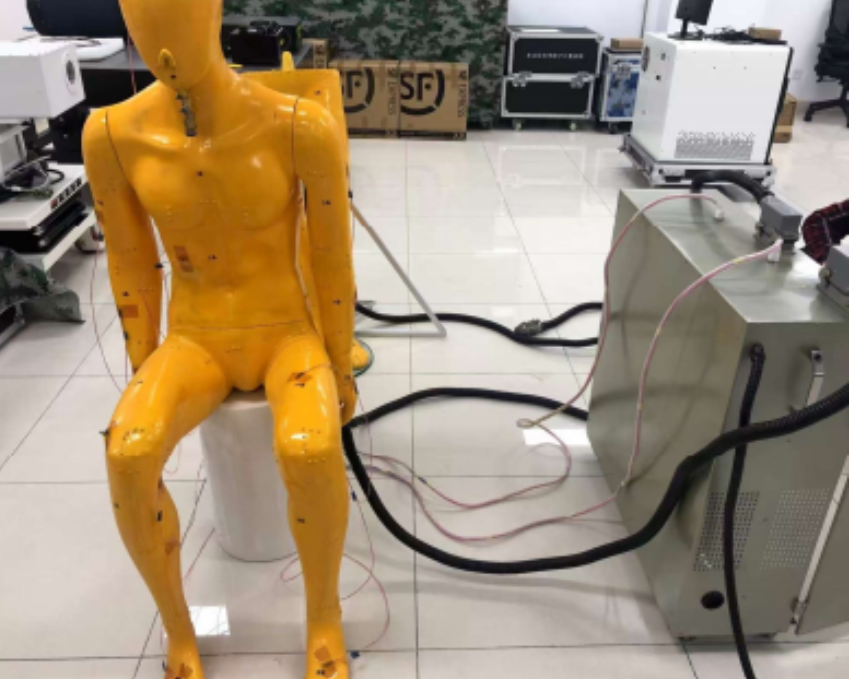
Principle of the Manikin Coughing System Testing
The system uses a pneumatic driving method to precisely simulate the airflow characteristics of human coughing, including key parameters such as initial cough velocity, flow rate, pressure, and duration.
A PID control module is employed to regulate the output airflow, generating a pulsed jet with high initial velocity. This enables aerosol particles to be expelled from a simulated source (such as a connected aerosol container), thereby reproducing the release process of droplets and aerosols during a real human cough.
When used in combination with a thermal manikin or headform, the system can also replicate the influence of human body heat radiation on airflow movement. This allows for a more realistic reproduction of aerosol dispersion pathways, spatial distribution patterns, and mixing behavior with ambient air after coughing, providing reliable experimental data for infectious disease control, ventilation system design, and indoor air quality research.
Experimental Procedure of the Manikin Coughing System
Install and calibrate the pressure sensors, flow meters, and aerosol generator. Set up the coughing system and connect it to a thermal manikin or headform.
Configure the target parameters, including charging pressure, exhalation negative pressure, and cough cycle duration (typically 2–3 seconds). Connect the test specimen to the mouth interface of the simulation system, ensuring a tight seal with no leakage.
Set the initial pressure to +40/−40 cmH₂O, which is suitable for most adult models. Adjust aerosol concentration and particle size distribution to meet relevant testing standards.
Activate the electronic control system and set coughing parameters such as pressure, initial velocity, duration, and mode. Start automatic operation to complete a full cough cycle (inhalation → breath-hold → explosive exhalation).
Verify that the aerosol container and tubing connections are secure. Repeat tests multiple times to obtain statistically valid data (typically ≥5 repetitions).
Conduct the experiment while recording in real time the cough pressure, downstream particle penetration rate, pressure decay curve, airflow velocity, and particulate distribution.
After completion, shut down the system, save all experimental data, and clean the tubing and aerosol container.
Functions and Applications of the Manikin Coughing System
The manikin coughing system is an important experimental device in the fields of indoor air environment, public health, and confined-space safety research. It is primarily used to accurately simulate the high-velocity airflow and aerosol dispersion behavior generated by human coughing. The system can dynamically reproduce the coupled conditions of human respiration, heat release, and coughing, overcoming the limitations of traditional static airflow simulations that lack realism. It therefore provides reliable technical support for multi-disciplinary research and risk assessment and offers significant value across various application scenarios.
In HVAC research and education, the system can be used for indoor air quality evaluation, enabling precise analysis of pollutant exposure risks caused by human respiration and coughing in confined spaces. It also supports studies on cross-transmission mechanisms of airborne infectious diseases and provides data for ventilation system optimization.
In medical and public health research, the system can simulate the dispersion pathways and transmission range of pathogen-laden aerosol particles released during coughing, contributing to the study of airborne disease transmission mechanisms and supporting epidemic prevention, control strategies, and the formulation of public health protection standards.
In occupational safety applications, the system can simulate the dispersion of industrial dust, PM2.5. and harmful gases, enabling accurate assessment of worker exposure risks in industrial environments and assisting enterprises in occupational health evaluation and safety improvements.
In addition, the system is widely applicable to various confined and semi-confined environments, including aerospace cabins, submarine deep-diving systems, and the interiors of automobiles, high-speed trains, and ships. It is used to study indoor air quality and occupant exposure risks, and to optimize vehicle and cabin ventilation and air-conditioning systems.
Furthermore, the equipment supports public health protection studies in densely populated spaces as well as military medical research. It comprehensively covers scientific research, teaching, testing, and protective optimization applications, making it a core experimental device for improving air safety in confined spaces and enhancing public health protection systems.
Maintenance Recommendations for the Manikin Coughing System
The manikin coughing system is an advanced medical training simulator equipped with coughing simulation functionality, or its associated pneumatic/electronic drive modules. Its maintenance primarily focuses on airway component cleaning, airbag integrity inspection, and electronic sensor calibration.
1. Deep Cleaning of Airway and Oro-Nasal Components
After each use, immediately disassemble the oral cavity, pharyngeal, and endotracheal interface components.
Clean the parts using a mild neutral detergent or warm water. The use of strong acids, strong alkalis, or alcohol-based solvents directly on silicone or thermoplastic elastomer skin is strictly prohibited, as these may cause material aging, hardening, or cracking.
After cleaning, rinse thoroughly with clean water. Care must be taken to avoid electronic sensor openings and circuit interfaces to prevent water ingress and short-circuiting.
2. Respiratory Airbag and Mechanical Structure Inspection
Regular replacement of lung airbags:
Airbags are consumable components. If rupture, air leakage, or reduced elasticity is observed, they must be replaced immediately. During replacement, open the chest skin, unscrew the connecting nuts, install the new airbag in the original orientation, and tighten securely.
Valve and tubing inspection:
Ensure that the inhalation and exhalation valves operate smoothly without obstruction from sputum or foreign particles. Check whether the connecting hoses show signs of aging or cracking to prevent air leakage that may affect coughing airflow simulation performance.
Spring and thoracic rebound check:
Prolonged compression may cause fatigue in the thoracic springs. Verify that the chest can rebound and return to its natural position. Do not stack or suspend the manikin, as this may lead to permanent deformation.
3. Electronic System and Functional Calibration
Sensor protection:
Cough sound and airflow pressure sensors are sensitive to dust and humidity. Regularly clean the sensing areas with a dry, soft cloth and keep them dry.
Functional testing:
Perform a full system self-check once per month, including cough sound output, synchronized chest movement, and data feedback accuracy. If sound distortion or motion desynchronization occurs, contact the manufacturer for software calibration or hardware maintenance.
Battery and power supply:
For wireless or portable devices, regularly charge and discharge the battery to maintain battery health. Check whether data cable interfaces are loose to prevent interruptions in data transmission.
4. Storage and Environmental Control
Environmental requirements:
Store the system in a well-ventilated, dry, and dark environment, with a recommended temperature range of 5–35°C. Avoid direct sunlight, which may cause silicone discoloration or embrittlement, and keep away from humid conditions to prevent mold growth.
Packaging protection:
When not in use, the system should be placed flat in a dedicated storage bag or case. A dust cover may be applied to protect the surface and prevent external pressure from damaging facial features or sensors.
Key Considerations for Selecting a Manikin Coughing System
The manikin coughing system is primarily used in indoor air quality research, aerosol dispersion studies, and infectious disease transmission modeling. When selecting such a system, priority should be given to parameter accuracy, system compatibility, and operational safety, rather than medical training functions.
1. Core Performance Parameters
Adjustable range and precision:
Verify whether coughing pressure, initial airflow velocity, and duration cover the full range required by the intended experiments. The stability of the PID control module directly affects data reliability and repeatability.
Flexibility of airflow modes:
The system should support switching between oral exhalation, nasal exhalation, or combined modes, to match different manikin interfaces and experimental scenarios.
Aerosol compatibility:
The system must support external injector-type aerosol generators, ensuring leak-free output of liquid or particulate aerosols. The tubing and connectors should adopt a quick-connect design for convenient replacement of consumables.
2. System Integration and Compatibility
Manikin compatibility:
Confirm whether the interface standards are compatible with existing thermal manikins or headform models, avoiding the need for additional customized adapters.
Environmental simulation capability:
For high-precision thermal convection studies, evaluate whether the system can integrate with manikin temperature control functions to realistically reproduce human thermal plume effects.
3. Safety and Maintenance
Protection mechanisms:
The system must include automatic overpressure relief and electrical short-circuit protection to prevent damage to pneumatic components or safety hazards.
Mobility and deployment:
The base should be equipped with swivel casters with brakes, enabling flexible movement and stable fixation within laboratories or confined environments.
After-sales service and customization:
Prefer suppliers that provide customized solutions, and confirm whether parameter customization and rapid technical support are available.
4. Pitfall Warnings
Distinguish clearly between a “cough simulation machine” and a “CPR manikin”: the former is a pneumatic research instrument, while the latter is a medical training model. Their principles and applications are fundamentally different and should not be confused.
Be cautious of exaggerated specifications. Require suppliers to provide third-party calibration reports, with particular attention to the repeatability error of peak initial velocity and cough duration.
In summary, the manikin coughing system is a highly specialized pneumatic research instrument with significant technological maturity and expanding application potential. In future scientific research and engineering practice, it is expected to play an increasingly important and irreplaceable role in respiratory airflow dynamics studies, aerosol transmission mechanism analysis, and protective equipment performance evaluation.We sincerely welcome researchers and industry partners to engage in further discussion on this topic or share valuable insights and cooperation intentions.
Previous: What is the Filter Flow Resistance Test Bench?
N e x t : What is the high and low temperature test box?
