





What is the high and low temperature test box?
2026/07/01
Share:

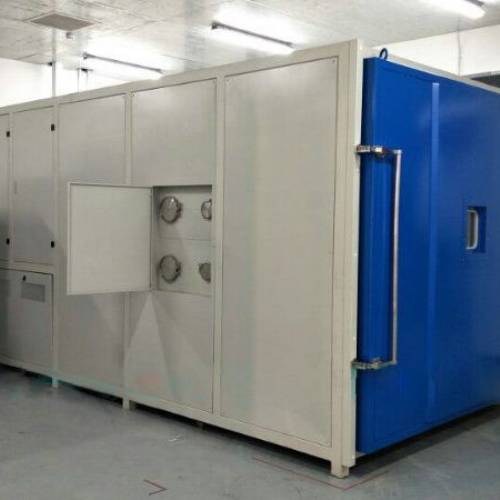
Structural Characteristics of a Walk-In High-Low Temperature and Low-Pressure Test Chamber
A walk-in high-low temperature and low-pressure test chamber is, as the name suggests, designed based on a “walk-in” concept. This means that users can directly enter the chamber to operate and observe tests inside. Compared with traditional bench-top or drawer-type test chambers, this design offers several significant advantages.
1. Spacious internal layout for convenient operation
The internal space of the chamber is typically designed as a large walk-in compartment, capable of accommodating large test samples or multiple samples simultaneously. This is especially practical for enterprises that require batch testing.
2. Robust structure and high safety performance
The walk-in test chamber is manufactured using high-quality materials, providing excellent sealing performance and corrosion resistance. This ensures the stability and safety of the equipment during long-term operation.
3. Advanced control system
It is equipped with a digital control panel that supports multi-parameter synchronous adjustment. Users can set parameters such as temperature, pressure, and humidity according to different testing requirements. Some models also feature remote monitoring and data recording functions, facilitating subsequent analysis.
4. Excellent thermal insulation performance
Since the chamber is used to simulate various environmental conditions, it is designed with a well-structured insulation layer. This effectively reduces energy loss and ensures stable temperature and pressure control.
Core Functions of a Walk-In High-Low Temperature and Low-Pressure Test Chamber
This type of test chamber is equipped with multiple key functions designed to meet complex environmental simulation requirements.
1. Temperature control
It offers a wide temperature range, typically from -70°C to +180°C. Through built-in heating and refrigeration systems, it ensures that test samples operate stably under the set temperature conditions. The heating and cooling rates can be adjusted to simulate different environmental change processes.
2. Pressure regulation
The simulation of low-pressure environments is particularly important, especially for equipment testing in high-altitude regions. The chamber can reduce internal air pressure to several hundred pascals or even lower, simulating high-altitude or thin-air conditions.
3. Humidity control
Some models also support humidity regulation, ranging from low to high humidity conditions to meet different testing requirements. The humidity control system achieves precise adjustment through built-in humidification and dehumidification devices.
4. Multi-environment simulation
A single unit can simultaneously control temperature, pressure, and humidity, providing an integrated solution for diversified environmental testing. For example, it can simulate extreme environments such as space, polar regions, or deserts.
5. Data acquisition and analysis
Equipped with multi-channel sensors, the system monitors environmental parameters in real time and stores data internally or on external storage devices. Users can analyze the data via software to evaluate the environmental adaptability of test samples.
Application Fields of Walk-In High-Low Temperature and Low-Pressure Test Chambers
This type of test chamber is widely used across multiple industries, including but not limited to the following:
1. Electronics and electrical industry
Electronic components, semiconductors, and integrated circuits must undergo environmental durability testing before leaving the factory to verify their performance stability under different temperature and pressure conditions. Walk-in test chambers provide the ability to simulate extreme environments, helping companies identify potential product defects.
2. Aerospace industry
Spacecraft, satellites, missiles, and other equipment are exposed to extreme temperature variations and low-pressure environments during launch and operation. By simulating these conditions in test chambers, the reliability and safety of such equipment can be ensured.
3. Automotive industry
Key components such as electric vehicle batteries and electronic control systems must be tested under various environmental conditions. Walk-in test chambers can simulate high-altitude and extreme temperature environments to evaluate their adaptability and performance stability.
4. New materials research and development
Before new materials are put into practical use, their performance under variable environmental conditions must be verified. Test chambers provide an essential platform for researchers to evaluate environmental resistance and durability.
5. Photovoltaic and new energy industry
Photovoltaic modules, wind power equipment, and other renewable energy systems require environmental durability testing after installation. Walk-in environmental test chambers ensure stable operation under different climatic conditions.
Operation and Maintenance Guidelines for Walk-In High-Low Temperature and Low-Pressure Test Chambers
In addition to understanding the structure and functions of a walk-in high-low temperature and low-pressure test chamber, proper operation and routine maintenance are also essential.
1. Parameter presetting
Before testing, parameters such as temperature, pressure, and humidity should be properly configured according to test standards or requirements. Ensure all settings remain within the safe operating range of the equipment to avoid damage.
2. Sample placement
Samples should be arranged neatly to avoid blocking sensors or interfering with airflow circulation. For samples of different sizes, positions should be reasonably arranged to ensure uniform environmental conditions.
3. Monitoring and adjustment
During the testing process, environmental parameters should be monitored in real time. Adjustments should be made when necessary. If any abnormalities occur, the test should be stopped immediately and the cause investigated.
4. Routine maintenance
The internal chamber and filters should be cleaned regularly, and the condition of sealing rings and sensors should be checked. Ensure that the control system software is kept up to date to reduce the likelihood of malfunctions.
5. Data management
After testing, data should be promptly saved and organized for further analysis and archiving.
Future Development Trends
With continuous technological advancement, walk-in high-low temperature and low-pressure test chambers are also undergoing ongoing optimization.
1. Intelligent control
Future equipment will become more intelligent, supporting artificial intelligence algorithms for parameter optimization and fault prediction, thereby improving testing efficiency and safety.
2. Multi-environment simulation
By integrating multiple environmental factors, more complex simulation environments will be developed to meet increasingly diverse testing requirements. For example, combined environmental testing involving ultraviolet radiation, vibration, and other stress factors.
3. Energy saving and environmental protection
Future designs will place greater emphasis on energy consumption control, adopting high-efficiency refrigeration systems and energy-saving materials to reduce operating costs.
4. Data interconnection
The introduction of Internet of Things (IoT) technology will enable remote monitoring, remote adjustment, and data sharing, significantly improving management efficiency.
5. Customized services
Customized solutions will be provided according to different customer requirements, meeting the testing needs of various industries and scales.
Conclusion
Walk-in high-low temperature and low-pressure test chambers, with their spacious capacity, precise control, and multifunctional capabilities, have become essential tools in environmental simulation testing. They play an irreplaceable role in industries such as electronics, aerospace, automotive, and scientific research. With continuous technological innovation, these systems will play an even more important role in future environmental adaptability testing, providing strong technical support for product development and quality control.
Understanding their structure, functions, and applications helps industry users select and utilize test equipment more effectively, promoting the sustainable development of related industries. We sincerely welcome you to leave comments or contact us directly so that we can provide you with more detailed product information.
Previous: What is the Manikin Coughing System?
N e x t : What is a hydrostatic pressure test?
