





How Does the Cornell Mattress Fatigue Testing Machine Improve Mattress Quality?
2026/07/02
Share:

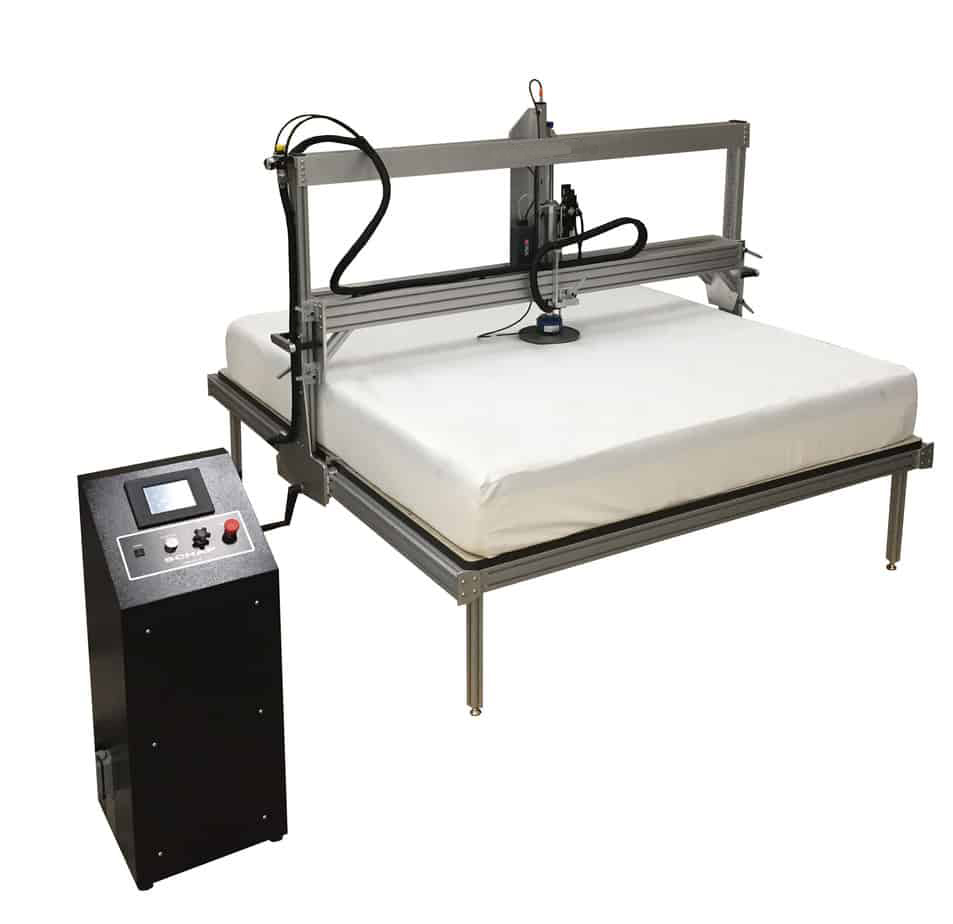
Working Principle and Basic Functions of the Cornell Mattress Fatigue Testing Machine
The core working principle of the mattress fatigue testing machine is to simulate repetitive human movements during sleep, such as lying down, getting up, and turning over. The equipment uses a mechanical structure to reproduce real-life usage behavior in a controlled laboratory environment.
The machine is typically equipped with a dedicated loading head or cyclic loading mechanism, which applies repeated pressure to the surface of the mattress according to preset test programs. Both the load magnitude and motion frequency can be adjusted in accordance with relevant testing standards, allowing simulation of different body weights and various usage scenarios.
During the testing process, the instrument continuously collects key performance indicators such as mattress height variation and support force degradation. These data are used to quantitatively evaluate the durability and structural performance of the mattress.
This testing method accelerates the aging simulation of mattresses, enabling potential quality issues that may occur after long-term use to be identified within a short period. As a result, reliable performance verification can be achieved without waiting for years of actual usage.
Main Test Content and Comparison with Other Testing Technologies
1. Main Test Content
The Cornell Mattress Fatigue Testing Machine is primarily used to evaluate the durability and service life of mattress springs. By simulating long-term usage conditions, the equipment assesses the fatigue characteristics of mattresses under repeated compression, bending, and other mechanical forces. This helps manufacturers determine the quality of spring materials and structural design, ensuring stability and comfort under normal use conditions.
The main testing items include:
1) Spring fatigue performance
Through repeated compression and release of mattress springs, the test simulates long-term deformation during actual use. It evaluates whether the springs will deform, break, or lose their load-bearing capacity due to fatigue.
2) Mattress durability
The machine assesses whether the mattress develops sagging, deformation, or loss of elasticity over extended use, thereby estimating its service life.
3) Interaction between springs and other components
Mattresses contain not only springs but also support layers such as memory foam and sponge. The tester simulates the interaction between springs and these materials under long-term loading conditions to evaluate their combined performance.
4) Comfort evaluation
By simulating sleeping posture and pressure distribution, the system analyzes whether the mattress can still provide proper support and comfort after prolonged use.
2. Comparison with Other Testing Technologies
Cornell Mattress Fatigue Testing Method
This method uses repeated loading cycles, applying a fixed weight or pressure onto the mattress surface to simulate long-term lying and usage. Test cycles are typically set to 50.000. 100.000 cycles or more, evaluating whether springs and materials maintain stable performance under repeated compression.
It may also include vibration or impact testing to simulate external shocks, assessing the mattress’s resistance to dynamic disturbances.
Other Common Testing Technologies in Mattress Evaluation
1) Pressure Mapping Testing
This method uses a sensor array to visualize pressure distribution across the mattress surface. It is particularly effective for evaluating comfort and pressure uniformity. However, it mainly focuses on static conditions rather than long-term durability.
2) Material Laboratory Analysis
This approach uses microscopes or mechanical testing instruments to analyze microscopic changes in fibers, foam, and materials. While it provides detailed material-level insights, it cannot simulate real-world usage scenarios of the full mattress structure.
Advantages and Limitations of the Cornell System
The main advantage of the Cornell Mattress Fatigue Testing Machine lies in its balance between macroscopic simulation and overall performance evaluation. It can replicate long-term usage conditions while providing comprehensive structural performance data.
However, its limitation is that it may not capture subtle micro-level material degradation. Therefore, it is often used in combination with other testing methods to achieve a more complete evaluation.
Summary
Overall, the Cornell testing system plays a central role in mattress durability evaluation, while other technologies are better suited for specific aspects such as comfort analysis or material characterization. Together, they form a complementary testing system that ensures comprehensive mattress quality assessment.
Application Range of the Cornell Mattress Fatigue Testing Machine
1. Overall fatigue performance testing of spring mattresses
The machine performs cyclic loading tests on the entire structure of spring mattresses to evaluate the stability of the spring system, fatigue resistance, and long-term degradation of support performance after extended use.
2. Durability evaluation of foam and latex mattresses
For non-spring mattresses such as full foam or all-latex types, the equipment assesses deformation, resilience, and durability under repeated compression, identifying issues such as sagging, hardening, or loss of elasticity.
3. Long-term compression fatigue testing of hybrid mattresses
Applicable to multi-layer structures such as spring + foam + latex combinations, this test verifies the overall reliability of the mattress under long-term cyclic compression and helps prevent defects such as interlayer separation or localized failure.
4. Dynamic fatigue testing of large foam materials
The equipment can be used to test large blocks of foam, sponge, and latex materials commonly used in mattresses, providing data support for material selection and formulation optimization.
5. Localized fatigue comparison testing of different mattress zones
Targeted testing can be conducted on specific areas such as the head, shoulder, waist, and hip zones to compare durability differences and optimize zoned mattress design.
6. Life simulation testing during mattress R&D stage
During product development, the machine simulates several years of real-world usage in a shortened time frame, helping to identify structural, material, and process issues early, thereby shortening development cycles and improving product lifespan.
7. Factory inspection and quality consistency control
As an essential tool for outgoing inspection and type testing, it is used for batch sampling and quality consistency verification, ensuring that every production batch meets performance standards and remains stable and compliant.
Summary
The Cornell Mattress Fatigue Testing Machine plays a crucial role across product development, material evaluation, and production quality control, making it an indispensable piece of equipment for ensuring mattress durability, comfort, and long-term performance consistency.
Importance of the Cornell Mattress Fatigue Testing Machine
The core importance of the Cornell Mattress Fatigue Testing Machine lies in its role as a “gold standard” verification tool for mattress durability and spring system reliability. It directly determines the support stability and safety baseline of a product throughout its entire service life.
Key Importance Highlights
1. Accurate simulation of real human impact
In accordance with ASTM and other international standards, the machine uses a circular impact head to apply repetitive dynamic loading. This closely replicates real-life conditions such as turning over, lying down, and getting up during sleep. It compensates for the limitation of static pressure tests, which cannot evaluate dynamic fatigue behavior.
2. Quantitative evaluation of spring durability retention
The system focuses on detecting whether the spring structure experiences plastic deformation, fracture, or loss of support force after tens of thousands of cyclic loadings. This ensures that the mattress maintains its original support performance over long-term use and prevents premature sagging.
3. Prediction of product service life
By conducting high-frequency cyclic testing, the machine accelerates long-term usage conditions and provides scientific service life prediction data. This helps manufacturers optimize material selection and structural design while reducing after-sales failure risks.
4. Ensuring market compliance and competitiveness
This test is a mandatory requirement for entering high-end markets such as Europe and the United States. A qualified test report serves not only as a quality certification but also as a key technical indicator distinguishing low-end products from high-quality durable mattresses.
Key Application Value
• Early-stage quality control
Identifies structural weaknesses during production, preventing batch-level quality failures caused by spring fatigue.
• Consumer experience assurance
Eliminates issues such as “mattress collapse after two years,” ensuring consistent comfort and spinal support over long-term use.
• R&D data support
Provides objective fatigue curve data for new spring designs and composite materials, driving continuous technological innovation in the industry.
Conclusion
In summary, the Cornell Mattress Fatigue Testing Machine is a professional and highly practical instrument that provides standardized and reliable durability data for the mattress industry. Its advantages lie in automation, comprehensive testing capability, and objectivity. However, it also has limitations such as high cost and certain testing constraints.Compared with other testing methods, it fills the gap in long-term simulation testing and plays a crucial role in improving product quality and user experience.We sincerely welcome your inquiries or messages so that we can provide more detailed product information and technical support.
Previous: How to test shrinkage of fabric?
N e x t : What is a solid, split-type weighted dummy?
