





What is a walk-in high-temperature aging chamber?
2026/07/06
Share:

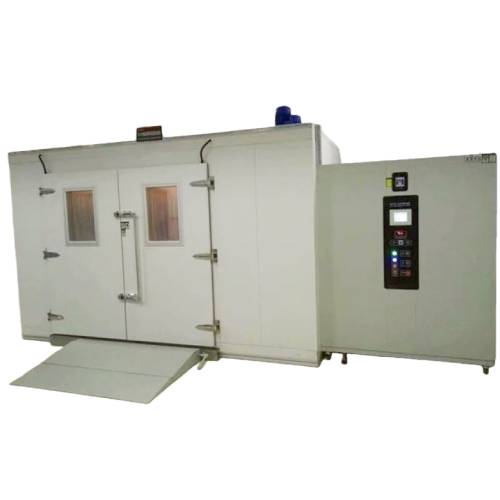
Core Components of a Walk-in High-Temperature Aging Test Chamber
Thermal Insulation Enclosure System:
The enclosure consists of walls (double-layer color steel panels combined with high-temperature-resistant insulation materials such as rock wool or polyurethane) and observation windows (double-layer high-temperature-resistant glass). Its main function is to minimize heat loss, ensure stable temperature differences between the interior and exterior, and prevent overheating of the outer surface. The observation windows allow real-time monitoring of product conditions.
Heating and Temperature Control System:
This system includes heating elements, temperature sensors, PID temperature controllers, and a PLC control system. The distributed heating design ensures uniform temperature distribution inside the chamber. Multi-point sensors continuously monitor temperatures in different zones. The PLC enables programmable control of temperature rise rate, constant temperature duration, and step temperature profiles, with a typical accuracy of ±1°C to ±3°C.
Air Circulation System:
It consists of multiple high-power high-temperature-resistant axial fans arranged symmetrically (top-bottom or left-right) and air guide plates. The system forces internal air circulation, eliminating natural convection limitations such as “hot air rising and cold air sinking,” ensuring uniform temperature around the products and preventing local overheating or temperature dead zones.
Load Simulation System:
This includes electronic load modules, voltage/current monitoring units, and terminal blocks. It is designed for products that must operate under load conditions, simulating real working loads during use. This enables combined testing of “high-temperature environment + real operating conditions,” providing a more realistic evaluation scenario.
Safety Protection System:
The system includes over-temperature protection, overload protection, leakage protection, smoke alarms, emergency exhaust systems, and door interlock protection. It addresses safety risks associated with large-scale high-temperature testing, preventing equipment failure, product combustion, or personnel accidents, and serves as a critical safety safeguard for the chamber.
Auxiliary Function System:
This system includes data recording and monitoring, lighting (high-temperature-resistant LED lamps), power supply interfaces (multiple standard or customized sockets to meet product power requirements), and ventilation ports. Its purpose is to improve operational convenience and data traceability. The data recording function generates temperature curves for test analysis, while multiple power outlets support simultaneous testing of multiple energized products.
Functions of a Walk-in High-Temperature Aging Test Chamber
A walk-in high-temperature aging test chamber is mainly used for long-term endurance testing of electronic and electrical products, automotive components, various materials, and complete finished products (such as air conditioners and communication equipment). It simulates complex real-world environmental conditions to evaluate whether products can operate stably in actual use, how durable they are, and what their service life will be.
The main functions are as follows:
1. Simulation of Extreme Environmental Conditions:
The chamber can simulate temperatures ranging from -70°C to 150°C, enabling both constant high/low-temperature testing and thermal cycling (for example, automotive electronics often require repeated cycling tests between -40°C and 85°C). This helps prevent issues such as solder joint cracking and plastic embrittlement. It can also control humidity to simulate environments such as coastal high-humidity conditions or tropical rainforest climates, allowing detection of problems like PCB corrosion or insulation failure.
When equipped with additional systems such as UV lamps, xenon lamps (for solar radiation simulation), vibration tables, and low-pressure devices, it can further reproduce combined environmental conditions such as sunlight exposure, mechanical vibration, and high-altitude environments, enabling more comprehensive testing.
2. Accelerated Product Aging:
By applying environmental stress such as high temperature and high humidity, the chamber accelerates the aging process of internal materials. This allows latent defects to be revealed in a much shorter time, eliminating the need to wait for years of real-world use to identify problems, and significantly shortening product development and quality inspection cycles.
3. Verification of Complete Product Performance:
For complete systems, the chamber enables continuous long-duration operation during aging tests to observe potential failures such as increased power consumption, rising noise levels, or sudden shutdowns. For example, battery packs in new energy vehicles must undergo high-temperature charge-discharge cycling tests inside the chamber to evaluate operational safety and whether capacity degrades rapidly during use.
Application Industries of Walk-in High-Temperature Aging Test Chambers
1. Electronics & Electrical Industry (Core Application Field)
Test products: PCB boards, power adapters, chargers, LED lighting products, displays, routers, and servers.
Aging purpose:
To detect defects such as poor solder joints, capacitor leakage, and chip performance degradation, ensuring stable operation during long-term power-on conditions (e.g., continuous operation for 24 hours to 7 days).
Typical test conditions:
High-temperature aging: 60°C–85°C with powered operation for 48–168 hours
High-temperature and high-humidity aging: 60°C + 90% RH with powered operation for 72 hours
2. Automotive Electronics Industry
Test products: Automotive infotainment systems, navigation units, sensors (e.g., temperature sensors, radar systems), vehicle chargers, and BMS (Battery Management Systems).
Aging purpose:
To simulate long-term use under harsh conditions such as high-temperature sun exposure (in-vehicle temperatures can exceed 70°C) and humid environments, verifying thermal resistance and operational stability.
Typical test conditions:
Thermal cycling aging: -40°C to 85°C, repeated for 100 cycles
High-temperature vibration combined aging (some chambers can integrate vibration platforms)
3. New Energy Industry
Test products: Lithium batteries, charging piles (EV chargers), and inverters.
Aging purpose:
To screen out defective batteries with rapid capacity degradation or excessive internal resistance, and to verify the charging stability of EV charging equipment under high-temperature conditions.
Special requirements:
Explosion-proof design is required due to risks such as battery swelling or fire. Some systems are also equipped with gas fire suppression systems for safety.
4. Industrial Control Industry
Test products: PLC controllers, frequency converters, industrial displays, and sensors.
Aging purpose:
To ensure long-term stable operation of industrial equipment in harsh environments such as high-temperature workshops and high-dust conditions.
Typical test conditions:
High-temperature dry aging: 80°C–100°C with powered operation for 168 hours
Load-bearing aging: simulates real working load current during equipment operation
The Role of Walk-in High-Temperature Aging Test Chambers in Product Quality Control
1. Working Principle of the Chamber
A walk-in high-temperature aging test chamber uses an advanced temperature control system and heating elements to rapidly raise the internal temperature to a preset value and maintain it for a specified duration. During this process, products are exposed to high-temperature stress, which induces changes in their internal structure and performance.
Key parameters such as temperature and humidity inside the chamber can be precisely adjusted through the control system to meet the testing requirements of different products.
2. Role in Product Quality Control
Evaluation of Product Performance:
High-temperature aging tests simulate harsh environmental conditions that products may encounter during real-world use, allowing manufacturers to evaluate product stability and reliability. This is of great significance for improving product design and enhancing overall quality.
Screening of High-Quality Products:
Under high-temperature conditions, products with poor performance are more likely to fail or malfunction. By comparing test results, manufacturers can identify and select products with superior performance, ensuring higher-quality output for customers.
Optimization of Production Processes:
Through aging tests, companies can identify weak points in the production process. This helps optimize manufacturing techniques and improve overall production efficiency.
As an important tool in product quality control, the walk-in high-temperature aging test chamber plays a vital role in ensuring product stability and reliability. By understanding its working principle and applications in quality control, we can better recognize its importance in product development and manufacturing processes.With continuous technological advancement and expanding application fields, walk-in high-temperature aging test chambers will play an even more significant role in the future, driving ongoing innovation in product quality control technologies.We sincerely welcome your comments or direct inquiries so that we can provide you with more detailed product information.
Previous: What is a solid, split-type weighted dummy?
N e x t : What is a pilling test?
