





What is a seat foam compression hardness tester?
2026/07/20
Share:

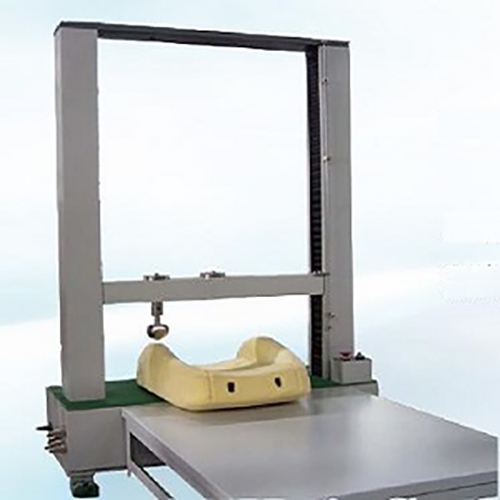
Composition of Automotive Seat Foam Performance Testing Machine
1. The machine is composed of a high-precision servo motor, precision ball screw transmission mechanism, and uniform-speed guide rail system. It features stable downward pressing speed, high transmission accuracy, and smooth operation without jamming. It can achieve low-speed and stable compression, ensuring that flexible foam specimens are not subjected to impact damage and guaranteeing standardized and consistent testing conditions.
2. The equipment adopts a circular flat compression plate specified by national standards. The plate surface is smooth and flat with uniform rigidity. The dimensions, flatness, and surface roughness of the compression plate strictly comply with testing standards. It can apply force evenly to the specimen surface, ensuring uniform compression stress distribution and accurate and reliable test results.
3. The system includes a high-precision force sensor, displacement measurement module, and signal filtering components. It can collect force and displacement data at millisecond-level speed with high detection resolution and minimal error, accurately capturing subtle mechanical performance changes during the foam compression process.
4. The equipment is equipped with a high-strength horizontal testing platform and anti-slip positioning structure. The test platform features excellent flatness and high rigidity, allowing various foam specimens to be placed stably. It effectively prevents specimen slipping, tilting, and uneven force distribution during testing, ensuring test stability and repeatability.
The machine is also equipped with an industrial touch-screen control system, built-in national standard algorithm models, data storage, and report generation modules. It supports parameter customization, fully automatic testing, curve analysis, and data export. With convenient operation and a high level of intelligence, it is suitable for batch quality inspection and scientific research testing applications.
Testing Principles of Automotive Seat Foam Performance Testing Machine
1. Servo Closed-Loop Precise Indentation Mechanical Testing Principle
The static hardness test follows the indentation load mechanical testing principle. A square standard indenter vertically compresses the foam specimen at a uniform speed. According to the preset parameters programmed in the computer, the specimen is compressed to three deformation points specified by national standards: 25%, 40%, and 65% of the original thickness. The force sensor collects the corresponding indentation load values in real time. A higher load value indicates higher foam hardness.
The servo system of the equipment adopts dual closed-loop feedback control of displacement and force, ensuring a constant and stable compression speed. It eliminates the problem of excessively high impact force generated by manual hydraulic equipment, which may cause artificially increased test results.
By calculating the ratio between the 25% indentation load and 65% indentation load, the foam support balance coefficient can be obtained. A reasonable ratio indicates a well-balanced soft and hard structure of the foam: the surface layer is soft and conforms to the human body, while the inner layer is firm enough to support the pelvis and lumbar spine. An excessively high ratio may cause discomfort and pressure pain during prolonged sitting, while an excessively low ratio indicates that the foam is prone to collapse and lose its supporting function.
The entire system can record the loading curve throughout the test process, fully displaying the gradient changes in hardness from the foam surface layer to the internal base material.
2. Energy Loss and Resilience Rate Testing Principle
Resilience performance directly reflects the cushioning and shock absorption capability of foam. This testing machine supports two testing modes: free impact mode and uniform compression-release mode.
The indenter applies pressure to compress the foam to a specified deformation level and then quickly rises. The displacement sensor and force sensor simultaneously capture the energy consumed during compression and the energy released during rebound. The system automatically calculates the resilience rate according to the following formula:
Resilience Rate = Rebound Energy / Compression Energy × 100%
High-resilience foam provides better vibration absorption performance on uneven road surfaces, reducing the feeling of bumps and shocks during driving and riding. Low-resilience slow-recovery foam provides stronger body-fitting and wrapping comfort, and is commonly used in premium seat headrests and side support areas.
The resilience value is a key evaluation criterion for distinguishing between standard rigid foam, high-resilience foam, and slow-rebound memory foam.
3. Reciprocating Fatigue Durability Deformation Testing Principle
This test simulates the long-term compression conditions caused by passengers repeatedly sitting down and standing up. The servo-driven indenter continuously compresses the foam specimen in a reciprocating motion according to a fixed stroke and frequency. The number of cycles can reach hundreds of thousands or even millions of cycles.
After a preset number of cycles, the system automatically pauses and measures the current thickness and indentation hardness of the foam. The fatigue collapse amount and hardness reduction rate are calculated by comparing the results with the initial condition.
Foam produced using poor-quality recycled materials may experience significant thickness reduction and a sharp decrease in hardness after only tens of thousands of cycles, causing the seat to collapse and deform after long-term use. High-quality modified polyurethane foam has lower fatigue degradation, maintaining a stable seating feel even after years of vehicle operation.
Under the high and low temperature combined fatigue testing mode, the equipment can also evaluate the accelerated aging and collapse degree of foam under extreme conditions such as high-temperature sunlight exposure and low-temperature environments.
4. Compression Permanent Deformation and Constant Temperature Aging Testing Principle
The compression permanent deformation test is used to evaluate the irreversible deformation remaining after foam is subjected to long-term compression.
During the test, the specimen is compressed to a specified thickness using a fixture and placed in a high and low temperature chamber for several hours under constant temperature conditions. After removal and cooling under normal conditions, the remaining thickness is measured, and the permanent deformation percentage is calculated.
The interior of a vehicle can become a high-temperature enclosed environment during summer, which accelerates the relaxation of polyurethane molecular chains. Excessive permanent deformation values indicate that the seat foam cannot recover after being compressed in hot conditions, resulting in permanent dents and deformation.
The constant temperature chamber of the equipment can accurately simulate extreme temperature environments inside vehicles and effectively screen foam formulations with excellent temperature resistance and deformation resistance.
5. Intelligent Computer Calculation and Classification Judgment Principle
The dedicated foam analysis software equipped with the machine contains preset internal control standard thresholds from major automotive manufacturers. It can automatically calculate comprehensive parameters including indentation hardness, resilience rate, compression permanent deformation, and fatigue collapse rate, and automatically classify test results as qualified or unqualified.
All loading curves, cycle counts, temperature and humidity conditions, and specimen identification information are securely stored throughout the testing process. The data is protected against unauthorized modification, meeting the requirements of automotive manufacturers' component quality traceability systems.
For batch testing, the system can automatically generate statistical reports, calculate average values and coefficients of variation, and help engineers compare performance differences between different foam formulations and different foaming processes.
Function of the Indentation Hardness Tester for Foam Materials
1. Sponge and foam manufacturers use this equipment for batch sampling inspections to evaluate the indentation hardness and resilience performance of different specifications of foam materials. It helps strictly control the consistency of product hardness grades, preventing low-quality products with uneven hardness, poor resilience, and easy collapse from entering the market, thereby ensuring stable product quality.
2. Manufacturers of household products such as sofas, mattresses, and cushions use indentation hardness testing to select suitable sponge materials. This ensures that household products provide proper support, uniform comfort, and long-term resistance to collapse and deformation, improving user experience and service life.
3. Automotive seat foam, vehicle headliner foam, and armrest cushioning foam require stable support and cushioning performance. The equipment is used for validating the performance of interior foam materials and optimizing foaming processes, ensuring that vehicle interiors maintain excellent resistance to collapse and deformation under long-term pressure, thereby improving overall interior quality and driving comfort.
4. Logistics cushioning foam and shock-resistant packaging sponge materials rely on this equipment to evaluate hardness and compression resilience performance, helping select protective materials that combine flexibility and support. It ensures effective shock absorption during transportation and reduces product damage rates.
Foam material research and development institutions use the equipment to compare the performance differences of sponge materials produced with different formulations, foaming temperatures, and curing processes. It helps optimize raw material ratios and production parameters to develop advanced foam materials with high resilience, excellent durability, and uniform hardness.
5. Laboratories specializing in materials science, light industry engineering, and polymer materials use this equipment to conduct research on the mechanical properties of porous foam materials, optimization of foaming processes, and other related topics. Meanwhile, it can also be used for practical training and teaching purposes to cultivate professional talents in material testing and process development.
Conclusion
In summary, the Sponge Foam Indentation Hardness Testing Machine relies on five core principles: servo-controlled precise displacement compression, force-displacement coupled measurement, dual-direction evaluation based on constant load and fixed deformation, failure identification of porous materials, and intelligent data traceability.The equipment accurately simulates the actual working conditions of sponge foam materials under static compression and rebound recovery processes. It scientifically quantifies key performance parameters including indentation hardness, support performance, resilience capability, and long-term durability stability.It effectively solves the limitations of traditional manual testing methods, such as strong subjectivity, unclear data results, and poor repeatability, providing a more accurate, efficient, and reliable testing solution for foam material quality control and research.We sincerely welcome your inquiries or direct contact with us, so that we can provide more detailed product information and technical support.
Previous: What does a respirator fit tester do?
N e x t : What is a large-area 3D optical surface profilometer?
