





Why is modern safety testing reliant on high-precision test dummy body component
2026/07/28
Share:

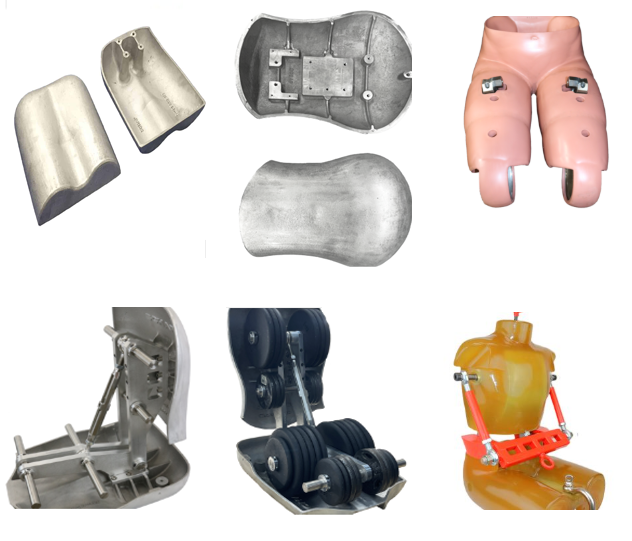
Design Principles of Dummy Body Components: From “Shape Similarity” to “Functional Similarity”
The fundamental design goal of crash test dummy body components has never been simply to replicate human appearance. Instead, the objective is to reproduce the geometric dimensions, mass distribution, and biomechanical response characteristics of specific populations with a 1:1 accuracy.
In the early stages of dummy development, researchers relied heavily on human biomechanical test data. Through anatomical statistics of people with different body sizes and structures, engineers determined the dimensions, weight, and stiffness parameters of each component. The goal was to ensure that the force response of the dummy during a collision closely matched the injury patterns of real human bodies.
Currently, mainstream dummy systems develop body components based on the percentile population standard. For example, the widely used WorldSID 50th percentile side-impact dummy represents the physical characteristics of a 50th percentile adult male, with a height of approximately 175 cm and a weight of around 78 kg. The SID-IIs female side-impact dummy is designed based on a 5th percentile female, with a sitting height of 780 mm and a total weight of 44.12 kg. In addition, there are dedicated child dummies representing 3-year-old, 6-year-old, and 10-year-old children, with body components corresponding to the bone density and muscle distribution characteristics of each age group.
This precise parameter design ensures that crash test dummies are no longer generic “average humans” but accurate representatives of specific population groups with corresponding collision response characteristics.
To achieve high biomechanical fidelity, all dummy body components adopt a modular design concept. Components such as the head, neck, torso, upper limbs, pelvis, and lower limbs can be independently calibrated and quickly assembled to meet different crash test requirements.
For example, the Hybrid III dummy used for frontal impact tests and the WorldSID dummy used for side-impact tests can switch between different test scenarios by replacing torso modules with different rib stiffness characteristics, significantly improving dummy reusability and testing efficiency.
Structural and Functional Details of Core Dummy Body Components
(1) Head and Neck: The First Sensing Unit for Collision Injury
The head is the first part of the dummy to experience collision impact and is the key component for evaluating the risk of traumatic brain injury.
The dummy head shell is typically manufactured from high-strength engineering plastics. Internal metal ballast blocks are integrated to simulate the actual weight distribution of the human skull. Multiple sensor mounting positions are reserved inside the cavity, allowing the installation of 3-axis or even 6-axis acceleration sensors to accurately measure linear and angular acceleration of the head during impact.
The data collected by these sensors provide the fundamental basis for calculating the Head Injury Criterion (HIC), which directly determines the risk level of head injury during a collision.
The neck component is the critical structure connecting the head and torso, and its design directly determines the accuracy of whiplash injury simulation.
The traditional Hybrid III dummy neck uses an aluminum bending column structure combined with rubber discs of different stiffness levels to simulate the bending characteristics of the human cervical spine. This structure can withstand thousands of repeated crash tests while maintaining stable performance.
The latest generation THOR dummy adopts a bio-inspired intervertebral disc structure. Each “cervical vertebra” section is equipped with flexible cushioning components, enabling more realistic reproduction of spinal movement during rear-end collisions, with spinal bending angle errors controlled within 1.5 degrees.
To ensure consistency between tests, neck components are also equipped with dedicated tension adjustment mechanisms. Test engineers can adjust the preload force of the adjustment screws to precisely control neck rotation damping, ensuring identical initial conditions for every test.
(2) Torso: The Core Carrier of Full-Body Injury Data
The torso is the most complex and sensor-intensive part of a dummy body and serves as the key area for evaluating chest and abdominal injuries.
The torso skeleton adopts a composite structure combining metal and polymer materials. The main chest frame is manufactured from high-strength steel, the shoulder blades use lightweight aluminum alloy, and the pelvis is integrally molded from high-strength engineering plastics.
This combination of materials ensures both structural strength and accurate matching of the weight distribution of different human body regions.
The rib components represent one of the most technically challenging parts of dummy design. Early dummy ribs were made from single metal materials and could only simulate simple bending deformation, making it difficult to distinguish between different fracture patterns.
Modern dummy ribs adopt composite structures such as steel exterior with graphite interior, integrating multi-channel displacement sensors. The WorldSID 50th dummy supports 1D, 2D, and 3D rib deformation measurement, enabling precise recording of rib intrusion and deformation speed during collisions. These measurements directly correspond to the risk level of rib fractures in real-world accidents.
The outer layer of the torso is covered with artificial skin made from a composite of rubber, plastic, and foam materials. Its damping characteristics closely match those of human soft tissues, allowing realistic simulation of the cushioning interaction between airbags, seat belts, and human bodies during impacts while reducing measurement errors caused by rigid contact.
The torso interior also integrates numerous ballast weights and adjustment mechanisms. By adding or removing calibration weights at different positions, engineers can ensure that the dummy’s mass distribution fully complies with standard requirements.
For example, a seat belt testing dummy may have a torso mass of 29.7 kg without correction weights. By using different ballast configurations, the total mass error can be controlled within ±1.0 kg, ensuring comparable test results between different laboratories.
(3) Upper Limbs and Hip Components: Safety Verification Through Details
Although upper limb components are not the primary focus of collision injury evaluation, they play an important role in verifying vehicle side protection performance and interior design safety.
Dummy arms typically use a structure consisting of a metal skeleton combined with a polyurethane outer layer. Shoulder and elbow joints are equipped with damping adjustment mechanisms containing friction discs. By tightening adjustment screws at the joints, engineers can precisely control joint resistance, ensuring that arm movement during collisions closely matches human motion.
In side-impact tests, impact force data collected by upper limb sensors can be used to evaluate injury risks caused by door interiors and window frames, helping manufacturers optimize interior soft-contact designs.
Hip and lower limb components are critical structures for evaluating pelvis and leg injuries and represent some of the most mechanically sophisticated parts of the dummy body.
The hip joint, which connects the torso and thigh, consists of components including the hip tube, friction discs, end caps, and tensioner assemblies. By adjusting the preload force of self-locking nuts, engineers can control hip joint rotational friction, ensuring that the dummy remains stable in a seated position without unintended sagging. During collisions, the force transmission path remains consistent with that of the human body.
The thigh component adopts a structure combining a metal square tube and polyurethane outer layer. Internal hip sleeves and knee sleeves ensure connection strength, while external polymer materials simulate the cushioning characteristics of human thigh muscles.
The knee joint serves as the movement hub of the lower limb. It consists of knee sleeves, friction discs, and limiting blocks. By adjusting the tightening force of screws on both sides, engineers can precisely control the friction coefficient between the lower leg and thigh.
The limiting blocks restrict lower leg rotation, ensuring that the lower leg rotates backward from the horizontal position within the symmetrical center plane at a stable angle of 120 degrees, fully complying with the human lower limb movement range.
The lower leg and foot components adopt an integrated design. The foot plate, square tube, and knee joint sleeve are rigidly connected, ensuring accurate transmission of foot impact forces during collisions while also simulating occupant foot injuries caused by vehicle floor intrusion.
This comprehensive design of dummy body components enables crash test dummies to accurately reproduce human biomechanical responses during vehicle collisions, providing reliable data support for automotive safety development, structural optimization, and occupant protection system improvement.
Materials and Manufacturing of Dummy Body Components: Balancing Precision and Durability
Crash test dummy body components have extremely demanding material performance requirements. The selection of each material must simultaneously satisfy three core requirements: biomechanical simulation accuracy, repeatability under repeated testing, and long-term wear resistance.
The core load-bearing components of the dummy skeleton, such as chest plates and aluminum alloy shoulder blades, are manufactured using aerospace-grade metal materials. After undergoing special heat treatment processes, these components can withstand hundreds of severe impact tests without plastic deformation, while maintaining stable mechanical properties.
The outer skin covering used to simulate human muscles and skin is made from specially formulated polyurethane and rubber composite materials. The hardness, elasticity, and damping characteristics of these materials have been calibrated through thousands of tests. They can not only reproduce the cushioning effects of human soft tissues but also avoid problems such as cracking and permanent deformation after repeated impacts.
Relevant testing standards require that the fabric of the dummy covering must achieve a wear resistance of no less than 35.000 friction cycles, ensuring that performance does not significantly degrade during long-term use.
The manufacturing precision requirements of dummy body components have reached the level of precision instruments. Dimensional tolerances of critical connection areas are controlled within 0.1 mm. For example, rib deformation sensor mounting slots and friction disc fitting surfaces at joints must be processed using five-axis CNC machining centers in a single forming process to prevent assembly errors from affecting the overall mechanical response.
Before leaving the factory, each component must undergo independent calibration testing:
The neck component must complete pendulum impact tests to verify torque response under different impact speeds.
The rib components must undergo static compression tests to confirm the relationship between deformation and applied force.
The joint components must complete multiple-cycle rotational tests to ensure consistent damping characteristics.
Only components that pass all calibration procedures are qualified to be assembled into the complete dummy system.
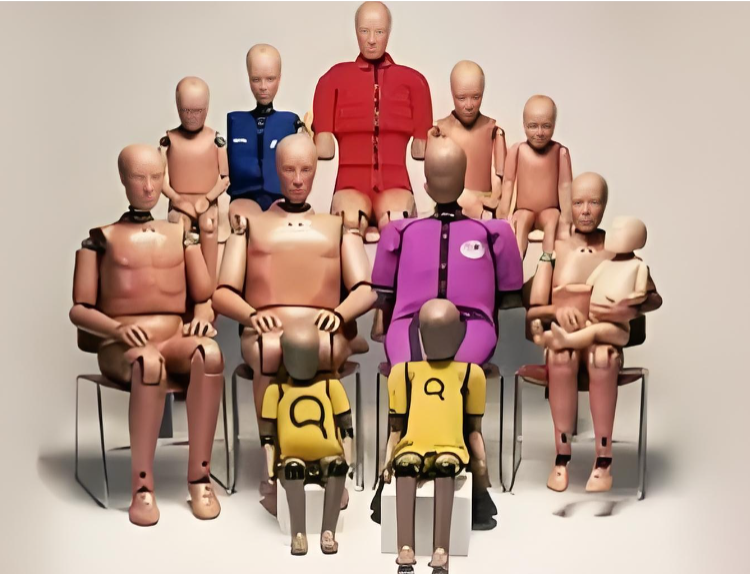
Future Evolution of Dummy Body Components: From “Physical Dummies” to “Physical-Virtual Integration”
With the development of vehicle electrification and intelligent technologies, occupant seating postures are becoming increasingly diverse. Traditional dummy body components designed for standard seated positions can no longer fully cover new collision scenarios, such as zero-gravity seats and rear-seat entertainment configurations.
In the future, dummy body components will continue to evolve toward higher biofidelity and broader population coverage.
For elderly occupants, dedicated dummies will be developed with more fragile skeletal simulation components to reproduce the collision injury characteristics associated with osteoporosis and reduced bone strength in older adults.
For pregnant occupants, dummies with split pelvic structures will be developed to simulate the dual injury risks experienced by both the mother and fetus during collisions.
At the same time, physical dummy body components will be deeply integrated with virtual human models. The THUMS (Total Human Model for Safety) virtual human model developed by Toyota has already demonstrated the ability to accurately reproduce bone density gradients through CT scanning and simulate injuries such as internal bleeding and soft tissue damage, which cannot be directly measured by traditional physical dummies.
In future automotive safety testing systems, physical dummy components will collect fundamental mechanical data from real crash events, while virtual models will use this information to perform more detailed injury simulations. The combination of both approaches will significantly improve the accuracy and efficiency of automotive crash safety development.
Conclusion
From the birth of the first Sierra Sam prototype dummy in 1949 to today’s highly biofidelic dummies equipped with hundreds of sensors, every technological advancement in crash test dummy body components represents engineers’ continuous pursuit of the principle that occupant safety comes first.Although these precision components hidden inside automotive safety laboratories rarely appear in the daily view of ordinary users, they establish the final safety barrier for millions of vehicles on the road through every crash test performed.We sincerely welcome inquiries and discussions. Please feel free to leave a message or contact us directly, and we will provide more detailed product information and technical support.
Previous: How are safety shoes tested?
N e x t : What is an Adiabatic Accelerated Calorimeter?
