





What is a drop test in packaging?
2026/07/29
Share:

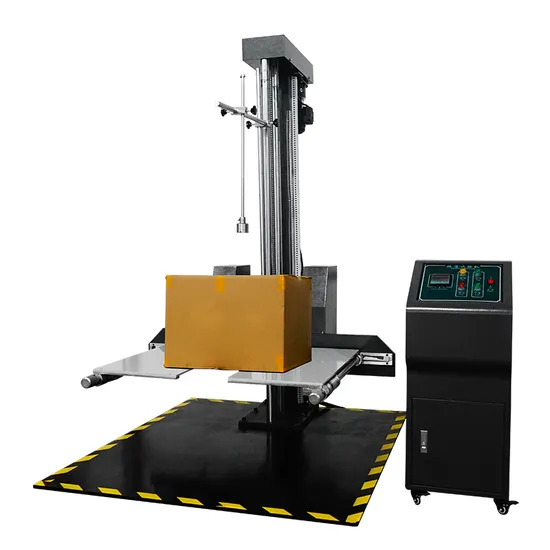
How Does the Zero Drop Tester Achieve Precise Zero-Height Drop Testing
In the field of packaging and transportation testing, the Zero Drop Tester is a key testing device used to evaluate the impact resistance of large packages and heavy products. Compared with traditional drop testers, its greatest feature is the ability to perform free-fall tests from "zero height" to a specified height. So, how does the Zero Drop Tester achieve precise zero-height drop testing? What are the core technologies behind this capability?
1. Breaking Conventional Limits: The Principle of Zero-Height Release
In conventional drop testers, the support arm flips downward and moves away after the sample reaches the preset height, allowing the sample to fall freely. Therefore, traditional equipment cannot perform low-height drop tests within the range of 0–300 mm.
The Zero Drop Tester adopts a completely different operating principle. It uses an "E"-shaped fork that can move downward rapidly as the test specimen support platform. The tested product is placed in a balanced position according to the testing requirements, including the designated face, edge, or corner orientation.
When the test starts, the support platform moves downward at a speed greater than gravitational acceleration. At the moment it reaches the preset drop height, it instantly separates from the test specimen, achieving a free release with "zero initial velocity."
At the same time, the "E"-shaped fork is embedded into the base plate in advance under the action of a high-efficiency shock absorber, ensuring that it does not interfere with the test results.
This method of "active acceleration and separation of the support platform" overcomes the physical limitation of traditional equipment and enables true zero-height drop testing.
2. Precise Control: Multi-Dimensional Protection from Sensors to Intelligent Systems
Achieving a true "zero-height drop" requires extremely high equipment control accuracy. Traditional equipment mainly relies on mechanical structures for control and is easily affected by friction and air resistance, resulting in testing errors.
Modern Zero Drop Testers achieve precise control through three key technologies:
1) High-Precision Height Measurement System
The equipment adopts a high-precision wire displacement encoder combined with a PLC control system to provide real-time feedback of drop height data. The measurement error can be controlled within ±1 mm.
Combined with an automatic height measurement system, the equipment can quickly determine the required drop height, eliminating repeated manual measurements and improving testing efficiency.
2) Reliable Release Mechanism
Current mainstream equipment generally adopts a combination of electromagnetic and pneumatic systems.
The electromagnetic system firmly locks the support platform when powered and achieves rapid release immediately after power interruption, avoiding initial velocity interference caused by mechanical friction.
The pneumatic system provides the acceleration force required for rapid downward movement. Some high-end models adopt a dual-guide rail structure, effectively preventing deviation or derailment during lifting and dropping operations.
3) Intelligent Control Platform
Users can directly set the drop height through an LCD controller or touchscreen, and the system automatically performs the test according to the preset parameters.
The height display adopts a digital display system and is equipped with height tracking functions, ensuring that the actual drop height remains highly consistent with the preset value and minimizing testing errors.
Through the integration of mechanical innovation, precision sensing technology, and intelligent control systems, the Zero Drop Tester achieves highly accurate zero-height drop simulation, providing reliable testing data for the structural safety evaluation of large packaging and heavy products.
Application Scenarios of Zero Drop Tester
The Zero Drop Tester is mainly applied for impact resistance verification of large or heavy packaging products:
1. Industrial Manufacturing and Large Equipment
The equipment is suitable for packaging reliability testing of heavy industrial products such as machine tools and industrial control equipment. It helps ensure the safety and structural integrity of these products during transportation and handling.
2. Home Appliances and Consumer Electronics
The Zero Drop Tester is used for packaging verification of large household appliances such as refrigerators and washing machines, as well as fragile electronic products such as televisions and computers. It evaluates their shock resistance and drop protection capability during handling and transportation.
3. Automotive Components and Aerospace Applications
The equipment helps verify the structural integrity and functional safety of automotive parts and aerospace components under harsh transportation and operating environments, ensuring that products maintain reliable performance after experiencing impact loads.
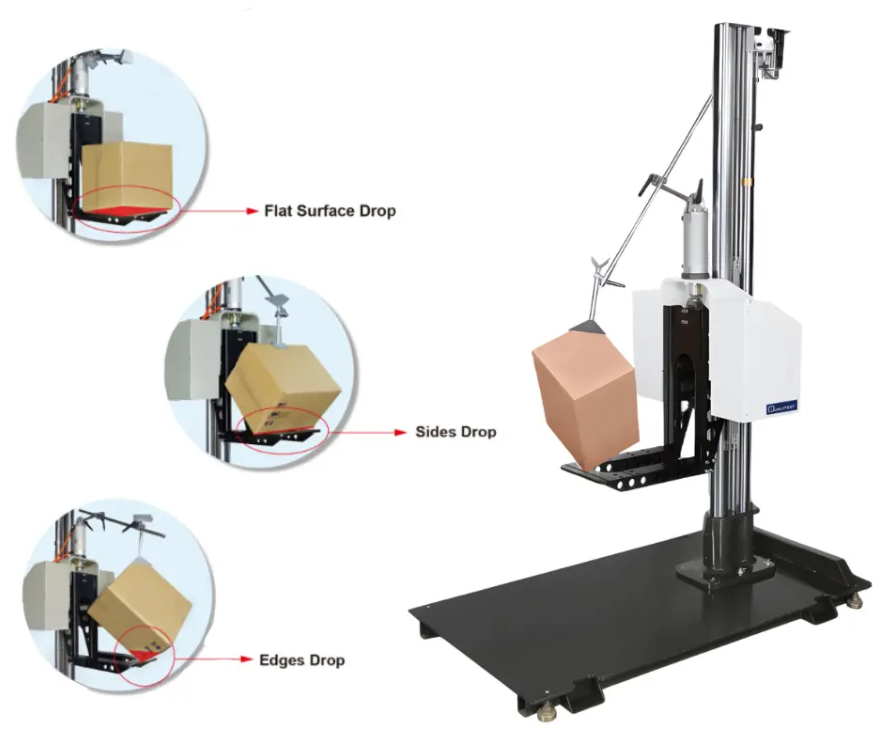
Key Points for Scientific Selection of Zero Drop Tester
Selecting a suitable Zero Drop Tester requires comprehensive consideration of testing requirements, product characteristics, and industry standards. The following are five core factors for equipment selection:
1. Define Testing Requirements
The first step is to determine the basic parameters of the test objects, including product type, weight range, and dimensional specifications. At the same time, the actual application environment should be considered to define the testing objectives — whether to verify the failure limit under a single drop impact or to simulate durability under multiple continuous drops.
For example, express delivery transportation usually focuses on single drop tests within 1 meter, while household appliance logistics may require testing at drop heights exceeding 1.5 meters.
2. Match Key Technical Parameters
According to specific testing requirements, special attention should be paid to important equipment parameters such as load capacity, drop height range (covering the target application scenario, for example, 0.3–1.2 meters for express delivery transportation and 1.5–3 meters for large equipment), and drop angle accuracy.
For example, when testing small electronic products, models with a load capacity of ≤10 kg and height adjustment accuracy of ±1 mm are preferred. For heavy packaging testing, equipment with a load capacity of ≥50 kg and a stable structural design is required.
3. Consider Automation Level and Operating Convenience
Modern drop testers are generally equipped with digital height control systems (for precise adjustment of drop height) and automatic release mechanisms (to reduce errors caused by manual operation).
Some advanced models also support functions such as data recording and secondary rebound protection, which can significantly improve testing efficiency and safety.
Enterprises can select manual, semi-automatic, or fully automatic models according to their testing frequency and personnel allocation.
4. Ensure Compliance with Industry Standards
Different industries have specific requirements for drop testing. During equipment selection, it is essential to confirm that the tester can meet the regulations of the target market and customer testing standards, avoiding delays in product launch caused by unrecognized test results.
5. Evaluate Total Life Cycle Cost
In addition to the purchase price, factors such as equipment energy consumption, maintenance difficulty, calibration intervals (it is recommended to calibrate sensors and release mechanisms at least once a year), and supplier after-sales service capabilities should also be considered.
For laboratories with long-term and high-frequency usage, it is recommended to select models with high stability and easy maintenance to reduce overall operating costs.
Conclusion
In summary, the reason why the Zero Drop Tester can achieve precise zero-height drop testing lies in its innovative "high-speed support platform separation" principle, combined with the coordinated operation of high-precision sensors, intelligent control systems, and precision release mechanisms.With increasingly strict industry standards, the accuracy of Zero Drop Testers will continue to improve, providing more reliable technical support for the reliability verification of large packaging products.For more information about the product, please feel free to contact us directly. We provide detailed product specifications, technical parameters, operating instructions, and customized solution consultations to help you fully understand the performance characteristics and application scenarios of the Zero Drop Tester.Our professional team is always ready to answer your questions and provide personalized technical support and quotation services according to your specific testing requirements.
Previous: What is a kernel device?
N e x t : What is a collapsible hardness tester for sponge foam?
