





What is a collapsible hardness tester for sponge foam?
2026/07/30
Share:

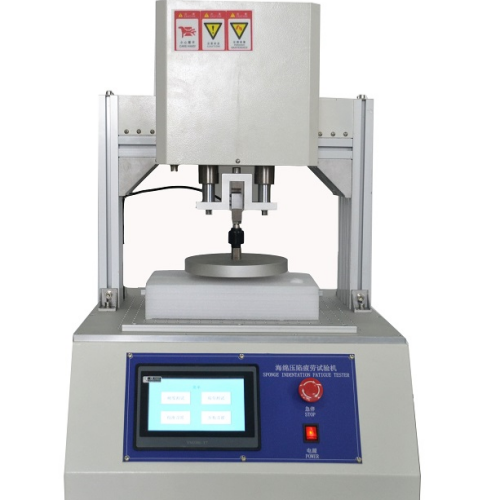
Structural Design of Foam Fatigue Compression Testing Machine
The typical structure of a Foam Fatigue Compression Testing Machine includes the following components:
1. Precision Drive System
The machine adopts a servo motor combined with a high-precision ball screw mechanism to drive the compression plate for vertical downward movement at a constant and stable speed (typically 100 mm/min). This design eliminates speed fluctuations and inconsistent loading issues caused by manual pressing, ensuring accurate and repeatable compression testing.
2. High-Precision Load Sensor
A high-accuracy load sensor is installed above the compression plate to monitor and collect the reactive force generated by the foam material during compression in real time. The sensor provides high sensitivity and can achieve a resolution of 0.1 N or higher, ensuring precise measurement of compression force changes.
3. Displacement Measurement System
The machine uses a precision displacement measurement system, based on technologies such as a grating ruler or encoder, to accurately measure the downward movement distance of the compression plate, namely the foam indentation depth. The measurement accuracy can reach 0.01 mm, ensuring reliable deformation data.
4. Standard Compression Plate and Base
The compression plate is typically a smooth circular flat plate with a diameter of 200 mm (or 250 mm). The edges are rounded to ensure uniform force distribution and prevent localized stress concentration.
The test base is designed with a flat and stable structure to prevent movement or vibration during testing, ensuring consistent test conditions and accurate results.
5. Intelligent Control System
The machine adopts a microcomputer-based intelligent control system that can automatically execute the entire testing procedure. It can monitor test data in real time, generate force-displacement (F-S) curves or stress-strain curves, and automatically calculate key hardness and performance evaluation parameters, providing efficient and accurate analysis of foam material properties.
Main Functions of Foam Fatigue Compression Testing Machine
The Foam Fatigue Compression Testing Machine can meet the diverse testing requirements for foam materials in different industries. Its main functions include the following:
(1) Compression Strength Testing
By applying different levels of compression force, the machine measures the maximum strength that foam materials can withstand during compression. This function is particularly important in the packaging industry, where packaging materials must endure certain levels of squeezing and pressure during transportation to ensure product safety.
(2) Deformation Testing
The machine records the deformation behavior of materials under different compression loads, including compression deformation and recovery deformation. These test results help evaluate the durability, resilience, and service life of foam materials during actual use.
(3) Energy Absorption Testing
Excellent energy absorption capability is one of the key advantages of foam materials. Through energy absorption testing, the machine evaluates material performance under impact or collision conditions, which is especially important for automotive safety design, including applications such as vehicle interior cushioning and impact protection components.
(4) Long-Term Performance Evaluation
By performing long-term cyclic compression tests on foam materials, the machine evaluates changes in material performance during extended service periods. This function is highly valuable for the design, material selection, and durability assessment of construction materials and other long-life applications.
Main Test Items of Foam Fatigue Compression Testing Machine
The core purpose of Indentation Hardness Deflection (IFD) testing is to evaluate the ability of foam materials to resist deformation under compression. The evaluation focuses not only on the amount of force required to compress the foam, but also on the overall support performance, resilience, and comfort characteristics of the material.
1. Indentation Hardness Value (IFD)
The Indentation Hardness Value is the most important evaluation indicator. It refers to the force required to compress a foam specimen to specific percentages of its original thickness, typically 25%, 40%, and 65% compression levels.
25% IFD:
Reflects the initial softness or firmness of the foam material, corresponding to the first-touch feeling when sitting down.
40% IFD:
Represents the medium-level supporting performance of the foam, reflecting the body-enveloping comfort after sitting.
65% IFD:
Indicates the bottom support strength of the foam, showing whether the material provides sufficient support or tends to bottom out under heavy compression.
2. Indentation Hardness Ratio (Compression Support Ratio)
The Indentation Hardness Ratio is usually calculated as the ratio of 65% IFD to 25% IFD.
A higher ratio indicates that the foam has better progressive support performance, providing stronger resistance against excessive compression and being less likely to experience permanent collapse during use.
A lower ratio indicates that the foam is relatively softer but has weaker supporting capability, which may result in insufficient support under higher loads.
3. Hysteresis Loss
Hysteresis loss is evaluated by comparing the area difference between the loading and unloading curves during compression testing.
This parameter reflects the internal energy loss characteristics of the foam material and is directly related to its resilience and recovery speed. A lower hysteresis loss generally indicates better elastic recovery performance and reduced energy dissipation.
4. Comfort Performance Evaluation
By analyzing changes in compression force during the test process, the tester can evaluate whether the foam provides a smooth and linear force response during use.
This helps determine whether the material has undesirable characteristics such as sudden hard points or soft points, providing objective data for optimizing comfort performance in applications such as mattresses, sofas, automotive seats, and other cushioning products.
Through these test items, the Foam Fatigue Compression Testing Machine can comprehensively evaluate the mechanical properties, support performance, durability, and comfort characteristics of foam materials, providing reliable data support for material selection, product development, and quality control.
The “Soft Material Guardian” from Sofas to Insoles
The application of the Foam Indentation Hardness Tester covers almost all industries involving porous elastic materials. It provides accurate performance evaluation for foam products, ensuring optimal comfort, support, durability, and quality consistency.
1. Furniture Manufacturing
Used for hardness testing of foam materials in sofas, mattresses, seat cushions, and back cushions. The tester helps ensure appropriate softness, comfort, and supporting performance, improving product ergonomics and service life.
2. Automotive Industry
Applied for performance evaluation of foam components such as automotive seats, headrests, armrests, and roof liners. The test results are directly related to passenger comfort, cushioning performance, and safety requirements.
3. Footwear and Sporting Goods Industry
Used to evaluate the hardness and resilience performance of foam materials in products such as sports shoe midsoles, yoga mats, helmet liners, and protective cushioning materials, helping manufacturers optimize shock absorption and wearing comfort.
4. Packaging Industry
Applied for compression resistance and cushioning performance testing of protective packaging materials, including EPE pearl cotton, PU foam components, and other cushioning materials. The tester helps verify their ability to absorb impact and protect products during transportation.
5. Medical and Rehabilitation Industry
Used for material performance evaluation of products such as wheelchair cushions, pressure-relief mattresses, orthopedic insoles, and rehabilitation support pads. Testing helps ensure proper support, pressure distribution, and long-term comfort.
6. Research and Quality Control
Widely used in new material development, product performance evaluation, and quality inspection. The tester provides reliable test data for material formulation optimization, production process improvement, and quality management.
From sofas and mattresses to automotive seats, sports equipment, and medical cushioning products, the Foam Indentation Hardness Tester serves as an essential testing solution for evaluating the performance of soft elastic materials, helping manufacturers create products with better comfort, durability, and user experience.
Future Development Trends
With continuous advancements in technology, the Foam Compression Testing Machine is also undergoing continuous innovation and upgrading. Future development trends will mainly focus on the following aspects:
(1) Intelligent Development
With the integration of Internet of Things (IoT) and artificial intelligence technologies, future foam compression testing machines will achieve higher levels of intelligence. The equipment will be capable of automatically analyzing test data, identifying material performance characteristics, and providing intelligent testing recommendations, thereby improving testing efficiency and reducing manual operation requirements.
(2) Multi-Functional Integration
Future testing equipment may integrate more testing capabilities by combining multiple environmental factors, such as thermal performance, humidity effects, and other service conditions, to conduct comprehensive evaluations of foam materials under different application environments. This will further enhance the accuracy and effectiveness of material performance assessment.
(3) Portable Design
To meet testing requirements in different application scenarios, future foam compression testing machines will become more compact, lightweight, and portable. Portable designs will enable on-site testing and provide greater flexibility for quality inspection and material evaluation.
(4) Supporting the Development of Environmentally Friendly Materials
With increasing global awareness of environmental protection and sustainable development, foam compression testing machines will play a more important role in the research and development of new eco-friendly materials. By providing accurate performance evaluation data, these instruments will help manufacturers develop foam materials that better meet sustainability requirements while maintaining excellent mechanical properties.
Conclusion
In summary, the Foam Compression Testing Machine is an essential tool for evaluating the performance of foam materials, with extensive applications across industries including packaging, construction, automotive manufacturing, furniture, and other fields.By understanding its working principles, key functions, application areas, and operational considerations, users can gain a deeper understanding of the importance and practical value of this testing equipment.With continuous technological advancement, foam compression testing machines will continue to evolve toward greater intelligence, multifunctionality, and higher testing precision, providing more efficient and reliable testing solutions for material research, product development, and quality control across various industries.
Previous: What is a drop test in packaging?
N e x t : What is the ignition temperature test?
