





How does the car seat center of gravity measuring tester work?
2026/08/05
Share:

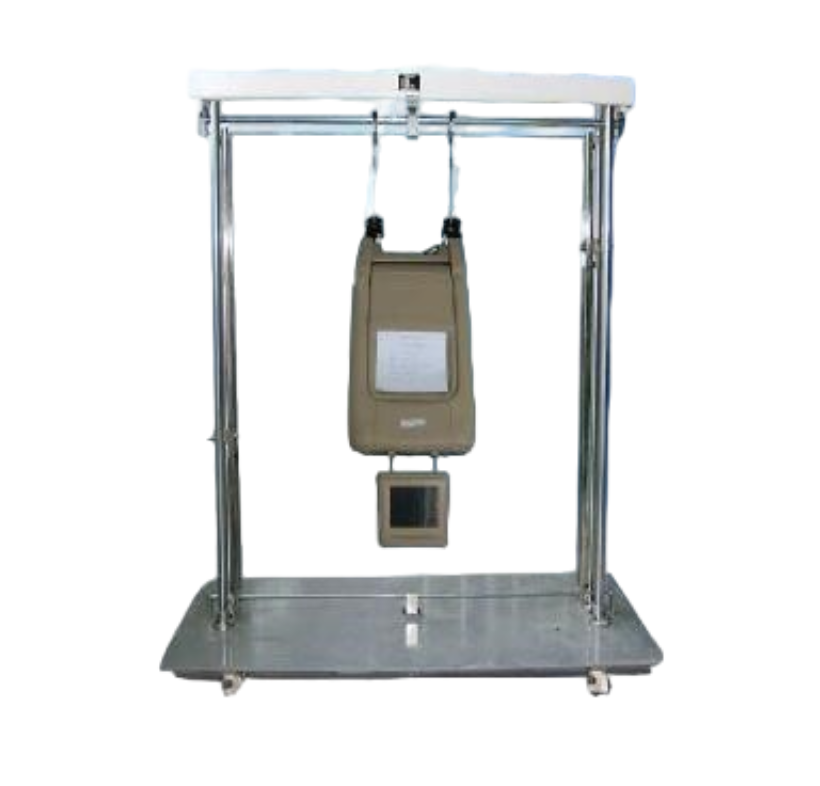
Two Major Measurement Methods of the Automotive Seat Center-of-Gravity Measurement Tester
The Automotive Seat Center-of-Gravity Measurement Tester is a testing device specifically designed for measuring the center of gravity of automotive seats. It is capable of detecting the center of gravity for various types of automotive seats. The test results directly reflect whether the center-of-gravity design of the automotive seat is reasonable and assist in determining the force application points of the seat.
The instrument primarily employs the suspension method (including the hanging method and the horizontal method) for three-dimensional center-of-gravity positioning. Its core principle is to determine the centroid using the intersection point of gravitational vertical lines or horizontal planes. This method is based on the principles of mechanical equilibrium and geometry, and through precise measurement and calculation, it achieves the spatial positioning of the core point of the seat's mass distribution.
The primary measurement methods are described in detail as follows:
Hanging Method (Single-Point Suspension Vertical-Line Method): This method requires the selection of a suitable suspension point on each of the three orthogonal planes, namely the X, Y, and Z planes of the seat. A hook is used to suspend the seat from a single point sequentially, ensuring that the seat comes to a free and static state under the action of gravity. After the seat has become completely stable, marking tape is applied or vertical reference lines are precisely drawn along the plumb direction on the corresponding measurement planes. Ultimately, through spatial geometric calculations, the spatial intersection point of the three vertical lines is determined as the center-of-gravity position of the seat. This method offers intuitive operation and requires relatively simple equipment; however, it is essential to ensure the accuracy and stability of the suspension point selection in each instance.
Horizontal Method (Double-Point Suspension Horizontal-Plane Method): This method requires the selection of two symmetrical or specific points on each of the three planes, namely the X, Y, and Z planes of the seat, for double-point suspension. The method utilizes the principle that when a suspension system reaches equilibrium, the suspended object will automatically adjust itself so that its center of gravity lies directly below the line connecting the suspension points. By using precision instruments or levels, a horizontal tangent line or a horizontal reference plane is drawn within each plane. Likewise, through spatial analytic geometry, the spatial intersection point of the three horizontal planes is identified, and this point represents the seat's center of gravity. This method effectively reduces the random swing errors that may arise from single-point suspension, and the measurement results are generally more stable and accurate. However, it imposes higher requirements on the symmetry of the suspension system and the accuracy of equilibrium judgment.
Three Core Importance Factors of the Automotive Seat Center-of-Gravity Measurement Tester
The Automotive Seat Center-of-Gravity Measurement Tester holds a central position in vehicle safety engineering and quality control. Its importance is primarily reflected in the following three dimensions:
First, it serves as the foundation for ensuring the accuracy of crash test data. In automotive passive safety research and development, whether complying with stringent standards such as ADR 68. UNR 80. or Euro NCAP, the posture, loading, and injury indices of the crash test dummy are highly dependent on the stability of the seat system. The precise determination of the seat's center of gravity can eliminate measurement errors caused by installation deviations or structural deformation, thereby ensuring the controllability of energy transfer paths during dynamic testing and providing a true reflection of occupant protection performance.
Second, it is directly related to the strength verification and optimization of the seat structure. By accurately obtaining center-of-gravity parameters, engineers can utilize finite element analysis and other simulation tools to evaluate the deformation behavior of the seat frame and its attachment points under extreme loading conditions. This helps identify potential structural weaknesses, optimize material selection and connection designs, and ensure that the seat can effectively restrain occupants during frontal, side, and rear-end collisions, thereby reducing the risk of head, chest, and neck injuries.
Third, it represents a critical element in meeting global regulatory compliance requirements. As the occupant protection requirements for buses and passenger vehicles continue to increase across various countries, the performance certification of seats and their restraint systems has become a prerequisite for market access. The objective data provided by the center-of-gravity measurement instrument serves as a direct basis for verifying whether the seat meets strength standards, anchorage requirements, and dynamic performance criteria. It plays an irreplaceable role in ensuring product legality and enhancing the brand's safety reputation.
Precautions for Operating the Automotive Seat Center-of-Gravity Measurement Tester
Environmental Requirements: The test must be conducted indoors in a wind-free environment with a level floor, so as to avoid airflow or vibration interference with the static state of the seat.
Precision Control: The suspension cords must be thin and lightweight to minimize the influence of their own weight on the measurement. The drawing of plumb lines or horizontal reference lines must be performed with high precision, as any error will directly affect the position of the intersection point and thus the final center-of-gravity determination.
Safety Regulations: Overloading is strictly prohibited. During the suspension process, precautions must be taken to prevent the seat from slipping off and causing injury to personnel. Operators are required to wear basic protective equipment during the operation.
Application of Results: The measured center of gravity is used to verify whether the seat design is reasonable and to determine the optimal force application points for restraint systems such as seat belts.
In summary, the Automotive Seat Center-of-Gravity Measurement Tester, as a critical piece of equipment for evaluating the safety and rationality of seat design, has its measurement accuracy and reliability directly linked to the overall safety performance of the vehicle. Therefore, it deserves our continued attention and in-depth study. If you have further interest in the technical specifications, operating procedures, application case studies, or procurement details of this instrument, we are always ready to provide you with comprehensive answers and professional support. Please feel free to contact us directly to obtain more detailed product information and technical documentation.
Previous: What is an automotive wire cross-linking test device?
N e x t : What is the Roof-Mounted Photovoltaic Module Fire Test Apparatus?
