





How does the windshield washer nozzle fatigue testing machine work?
2026/08/07
Share:

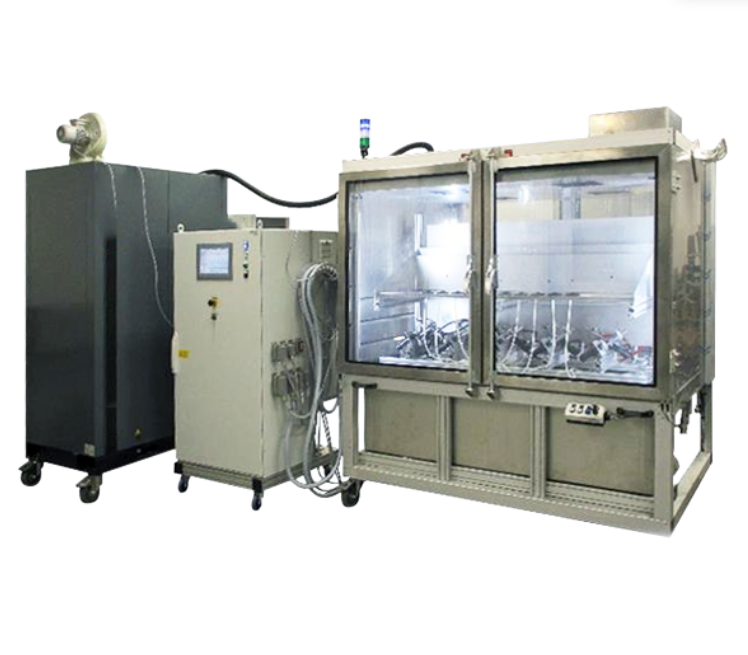
Principle of Automotive Windshield Washer Nozzle Fatigue Testing Machine
The Automotive Windshield Washer Nozzle Fatigue Testing Machine is not simply a “water spraying device”, but a complex testing system integrating fluid dynamics, mechanical automation, environmental simulation, and precision sensing technologies. Its core principle is based on accelerated life testing. In a laboratory environment, the equipment applies high-intensity cyclic loading to simulate various operating conditions that washer nozzles may experience over several years of actual vehicle use.
Fluid Dynamic Simulation and Pressure Pulse Loading
During actual operation, the biggest challenge faced by washer nozzles is not continuous spraying, but frequent “on-off” cycling. Each time the washer switch is activated, the pressure inside the fluid line rapidly rises from 0 to the working peak pressure (typically between 0.1 MPa and 0.5 MPa, while some high-pressure systems can reach 1.5 MPa or even higher). These severe pressure fluctuations generate impact forces on internal components of the nozzle, such as check valves, springs, and sealing elements.
The testing machine uses a high-precision servo pump or pneumatic pressurization system to accurately reproduce these pressure pulses. The equipment can perform fluid loading according to preset waveforms (such as square waves or sine waves), simulating different scenarios including intermittent spraying by the driver and continuous spraying operation. Under high-frequency testing modes, the system can complete dozens or even hundreds of pressure cycles per minute, allowing millions of fatigue damage cycles to be accumulated within a short period. This helps verify the fatigue strength and durability of the nozzle structure.
Mechanical Motion and Vibration Simulation
In addition to internal water pressure, washer nozzles are also subjected to external vibrations during vehicle operation. High-frequency engine vibrations, road impacts, and airflow-induced oscillations may cause loosening of nozzle connections or wear of internal components.
Advanced fatigue testing machines are equipped with multi-axis mechanical arms or vibration platforms, which can apply mechanical vibration with specific frequencies and amplitudes to the mounted nozzles while performing water spraying tests. This fluid-structure coupling testing method can more realistically reproduce the stress conditions experienced by nozzles during vehicle operation, enabling evaluation of sealing performance and structural stability under long-term vibration conditions.
Comprehensive Environmental Stress Screening
Environmental factors are another major cause of washer nozzle failure. In extremely cold northern winters, residual washer fluid may freeze and expand, causing cracks in the nozzle housing. In hot summer conditions, high temperatures inside the engine compartment may accelerate the aging, deformation, and degradation of plastic components.
Technical Innovations of Automotive Windshield Washer Nozzle Fatigue Testing Machine
Modern Automotive Windshield Washer Nozzle Fatigue Testing Machines incorporate multiple innovative technologies based on traditional testing methods, improving testing efficiency, accuracy, and intelligent management capabilities.
1. Intelligent Control System
The equipment adopts a touch-screen human-machine interface (HMI), allowing customized setting of test parameters and supporting the storage of hundreds of test programs. This enables operators to quickly select different testing procedures according to various nozzle models and testing requirements.
2. Remote Monitoring Function
By integrating Internet of Things (IoT) technology, the system enables real-time monitoring of equipment operating status. Test data can be stored and analyzed through cloud platforms, improving data management efficiency and supporting remote equipment diagnostics and maintenance.
3. Energy-Saving and Environmentally Friendly Design
The machine is equipped with a liquid circulation system to recycle and reuse testing fluids, effectively reducing water consumption during the testing process while improving environmental sustainability.
4. Multifunctional Testing Platform
One testing machine can accommodate various types and specifications of washer nozzles. Through quick-change fixtures, the equipment can be easily adapted to different products, improving testing flexibility and reducing the time required for fixture replacement.
How to Use the Automotive Windshield Washer Nozzle Fatigue Testing Machine
Step 1: Test Preparation
Check the sample specifications and applicable testing standards, and confirm that the washer nozzle has no visible damage. Inspect the equipment power supply, water supply, air supply, and pipeline sealing condition. Clean the fixtures and fluid circuits, and replace or filter the test liquid (usually a water-ethanol mixture). Create a new test program on the touch screen and enter relevant information, including sample number, target cycle count, spraying frequency, working pressure, environmental parameters, and other test conditions.
Step 2: Sample Installation and Positioning
Fix the washer nozzle onto the test fixture and tighten the positioning device. Connect the fluid inlet pipeline and ensure there are no loose connections or leakage. Adjust the spraying direction and the position of the data acquisition module to ensure accurate angle control and effective flow measurement.
Step 3: Idle Cycle Calibration
Start the equipment and perform a small number of preliminary cycles to check whether the pressure, flow rate, and response performance meet the requirements. Calibrate the sensors and counting system, and remove air bubbles or leakage points in the pipeline. After confirming that all parameters are stable, proceed with the formal test.
Step 4: Automatic Operation
After activating the automatic operation mode, the equipment will complete the cyclic loading process according to the preset program. Operators should regularly inspect the equipment status, including pressure, leakage, noise, temperature, and other operating conditions, while monitoring the test data curves. During the test, it is strictly prohibited to open the equipment cover, adjust fixtures, or modify critical parameters. In case of abnormal conditions, press the emergency stop button immediately.
Step 5: Shutdown and Data Recording
When the preset number of cycles is reached or the sample fails, the equipment will automatically stop. Record the total number of cycles, failure conditions, and key performance degradation values. Export the test data and generate the test report.
Step 6: Post-Test Maintenance
Turn off the power supply and water supply, drain the remaining liquid from the pipelines, and clean the equipment and fixtures. Remove the tested sample, store it properly according to classification requirements, organize the fixtures, and mark the equipment status for future use.
In summary, the Automotive Windshield Washer Nozzle Fatigue Testing Machine is an essential device for evaluating the performance of automotive windshield washer nozzles. By simulating real operating conditions, it performs fatigue testing to verify product durability and reliability, helping manufacturers improve product quality and ensure driving safety.
Previous: How does a goggles puncture resistance testing machine work?
N e x t : Do you know what a Steam Jet Test Chamber is?
