





How does a goggles puncture resistance testing machine work?
2026/08/06
Share:

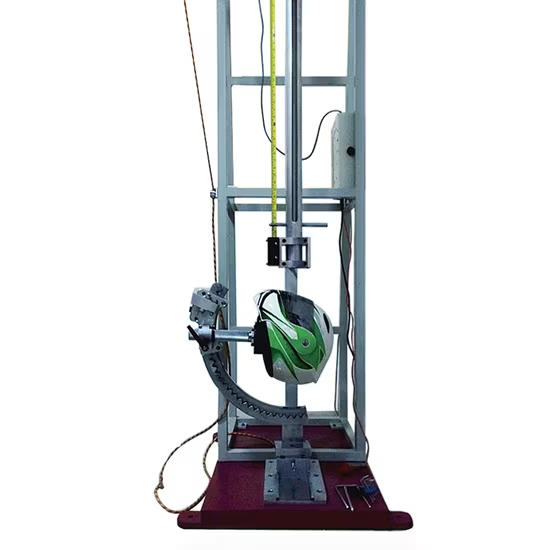
Working Principle and Structural Components of Safety Goggles Penetration Resistance Tester
The Safety Goggles Penetration Resistance Tester is mainly designed based on the principles of kinetic energy impact or constant-speed penetration. It is developed to simulate the actual impact scenarios caused by sharp objects during the use of protective eyewear.
The equipment generally consists of a launching system (or drive system), velocity measurement system, sample fixing fixture, penetration mechanism, and safety protection chamber.
During the testing process, the equipment uses an electric motor, hydraulic drive system, or gravity-driven free-fall mechanism to apply a specified penetrator with a defined geometry (such as a 60° cone) and mass onto the lens surface at a constant speed or with a specified impact energy.
Some advanced models are equipped with force sensors to measure penetration resistance in real time until the lens is penetrated or the specified travel distance is reached. Other systems integrate high-speed imaging technology to capture the impact moment, allowing further analysis of crack propagation patterns and fragment scattering behavior.
The entire test is conducted inside a sealed safety chamber to prevent accidental injury and ensure operator safety during high-energy impact testing.
Complete Operating Procedure of Safety Goggles Penetration Resistance Tester
The penetration resistance test of safety goggles used with safety helmets and protective headgear is a specialized test designed to simulate the impact of sharp objects on goggles. It evaluates the penetration resistance of the goggles and the safety performance after breakage.
The primary purpose of this test is to ensure that protective goggles are not penetrated under accidental impact conditions and that any fragments generated after breakage do not cause secondary injuries to users.
I. Preparation Before Testing
1. Sample and Equipment Inspection
Confirm that the safety goggles to be tested are free from manufacturing defects such as cracks, scratches, or surface damage, and ensure that they are properly installed on the corresponding size safety helmet or headgear according to the requirements of applicable standards.
Check whether the key parameters of the tester meet the testing standard requirements, including:
Penetrator cone angle
Cone tip radius
Drop hammer mass
Impact height
Other relevant test parameters
2. Parameter Setting
Set the impact height according to the applicable testing standard. A commonly specified impact height is 1000 mm ± 5 mm. Some standards specify impact velocity requirements (such as 5.0 m/s), which need to be converted into the corresponding impact height.
Select a suitable headform size (large, medium, or small) according to the sample specifications.
Secure the helmet onto the headform and ensure that the goggles are positioned at the natural wearing angle without additional stretching or compression.
II. Core Testing Procedure
1. Positioning the Penetrator
Manually adjust the penetrator position so that it is vertically aligned with the center area of the goggle lens or the designated testing point specified by the standard, such as the K point on the lens symmetry plane.
Ensure that the bottom of the penetrator is in contact with the goggle surface.
Maintain a clearance of at least 5 mm above the headform to prevent interference between the headform and the impact process.
2. Performing the Impact Test
Use a manual pull-release mechanism or an automatic release device to allow the drop hammer to fall freely from the preset height.
The drop hammer impacts the top of the penetrator, and the penetrator transfers the impact force directly to the goggle lens.
During the impact process, high-speed cameras or force sensors can be used to record relevant impact data, including:
Peak impact force
Goggle deformation
Impact response characteristics
Other dynamic parameters
These data provide a reliable basis for further performance analysis.
3. Sample Condition Evaluation
After the impact test:
First, inspect whether the penetrator has passed through the goggle lens and determine whether the penetrator has contacted the headform or completely penetrated the lens.
If the goggle lens breaks, collect all visible fragments.
Use an angle measuring instrument to evaluate fragment geometry and confirm whether sharp fragments with angles smaller than 60° exist.
Some standards specify that the minimum fragment angle should not be lower than 60° to reduce the risk of secondary injury.
III. Post-Test Processing
1. Data Recording and Sample Retention
Record all test data completely, including:
Impact height
Drop hammer mass
Impact process parameters
Goggle condition after testing
Penetrated / Not penetrated
Fragment condition
Fragment angle measurement results
Organize the data into an official test report.
If the sample fails the test, retain the damaged goggles and all fragments as physical evidence for failure analysis, such as evaluating:
Insufficient material strength
Inadequate lens thickness
Structural design defects
Other potential causes
IV. Equipment Maintenance
1. Penetrator Maintenance
Clean the penetrator tip and remove any remaining lens fragments.
Check whether the cone tip has signs of wear.
If the penetrator tip radius exceeds the standard limit (for example, >0.5 mm), replace the component in time.
2. Calibration and Verification
Regularly calibrate the drop hammer mass and impact height to ensure testing accuracy.
Use standard weights to verify drop hammer mass.
Use a calibrated measuring scale to confirm impact height accuracy and minimize measurement errors.
Through standardized operation, accurate parameter control, and regular maintenance, the Safety Goggles Penetration Resistance Tester can provide reliable evaluation of protective eyewear safety performance and ensure compliance with relevant safety standards.
Application Fields and Value of Safety Goggles Penetration Resistance Tester
The Safety Goggles Penetration Resistance Tester has a wide range of applications and is suitable for various types of eye protection equipment, including industrial safety goggles, welding face shields, ski goggles, shooting goggles, laboratory protective eyewear, and sand-proof goggles.
The equipment is capable of evaluating the penetration resistance and impact performance of various lens materials, including polymers such as polycarbonate and acrylic resin, as well as glass lenses and multi-layer composite lenses.
By accurately quantifying the penetration resistance capability of eye protection products, this tester helps manufacturers optimize material formulations and structural designs, ensuring that products comply with relevant national and international safety standards.
For regulatory authorities and third-party testing laboratories, the equipment serves as an important technical tool for determining product compliance and preventing serious eye injuries caused by lens penetration or breakage. It provides a reliable safety barrier for eye protection in high-risk working environments, including industrial production, construction sites, laboratories, and outdoor operations.
In summary, the Safety Goggles Penetration Resistance Tester features excellent performance, comprehensive functions, and highly accurate testing capabilities. Its precise and reliable test results play a crucial role in ensuring the safety performance of protective eyewear products.As safety requirements for personal protective equipment continue to increase, this testing technology provides strong support for product development, quality inspection, and safety certification. For further information regarding equipment specifications, testing procedures, or application solutions, professional technical consultation can help users better understand the product features and select suitable testing solutions.
Previous: How does a combined salt spray test chamber work?
N e x t : How does the windshield washer nozzle fatigue testing machine work?
