





What is a Dry Microbial Penetration Resistance Tester?
2026/08/11
Share:

Microbial Penetration: The Invisible Threat
In everyday life, many seemingly ordinary situations contain hidden risks of microbial penetration. For example, in hospital operating rooms, surgical gowns and surgical drapes serve as critical protective barriers. Once these protective materials are penetrated by microorganisms, they may increase the risk of postoperative infections and lead to serious health consequences.
According to research, additional medical costs caused by surgical site infections (SSIs) worldwide reach billions of dollars each year, and microbial penetration through surgical protective products is considered one of the important contributing factors. Similarly, in the food industry, if packaging materials cannot effectively block microorganisms, food products may deteriorate during storage and transportation, resulting in economic losses and potential risks to consumer health.
Studies have shown that microorganisms such as bacteria can often be transported by dry organic or inorganic particles, including human skin flakes and dust, allowing them to penetrate various barrier materials. These microorganism-carrying particles act like “invisible hazards”, capable of causing unexpected contamination at critical moments.
Therefore, accurately evaluating the barrier performance of materials against dry-state microbial penetration has become a crucial step in ensuring safety across multiple industries, including medical protection, healthcare, food packaging, and other contamination-sensitive fields. The Dry Microbial Penetration Tester provides scientific testing methods and reliable data support for assessing material protection performance and improving safety standards.
Working Principle of the Dry Microbial Penetration Tester
The Dry Microbial Penetration Tester is an advanced testing instrument that integrates cutting-edge technology with professional design. It is developed and manufactured in strict accordance with authoritative international and national standards, ensuring high accuracy, reliability, and repeatability of test results.
The working principle of the tester is scientific and precise. During testing, the test specimen is securely mounted onto specially designed containers. Five containers are filled with talcum powder contaminated with Bacillus subtilis to simulate microorganism-carrying particles, while another container is filled with uncontaminated talcum powder as a control sample.
The container-supporting system is driven by a pneumatic ball oscillator, which generates 20.800 vibrations per minute with an impact force of 650 N. During the vibration process, talcum powder that penetrates through the test specimen falls completely onto the culture plates placed underneath. After the test, the culture plates are removed and incubated. By counting the colonies that grow, the barrier performance of the material against dry-state microbial penetration can be accurately evaluated.
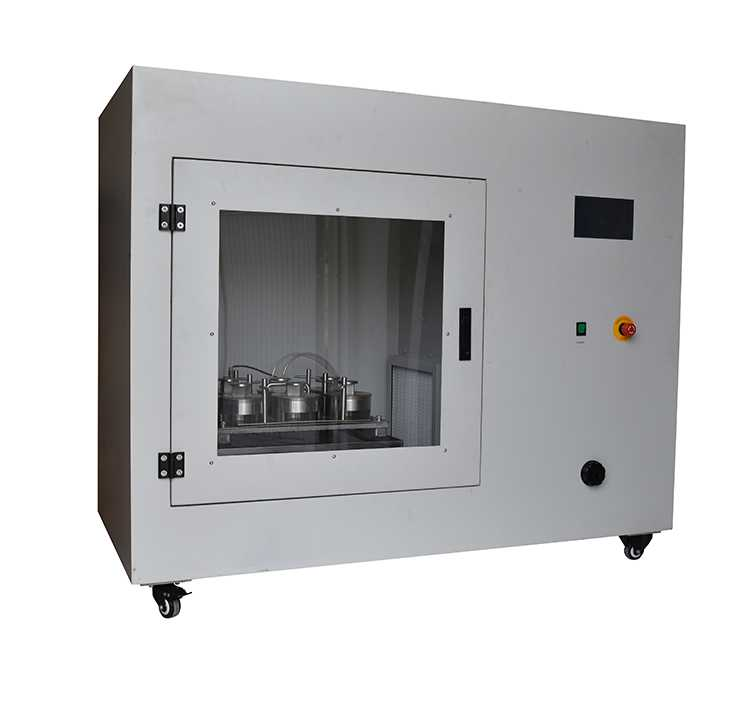
From the perspective of structural composition, the Dry Microbial Penetration Tester mainly consists of a compressed air generation system, testing unit, protection system, and control system.
Air Supply System: Provides a stable airflow source to ensure smooth and consistent operation of the vibration process.
Testing Unit: Performs accurate detection and analysis of microbial penetration through the tested material.
Protection System: Adopts a full-process particle leakage prevention design, equipped with an exhaust ventilation system and high-efficiency inlet/outlet air filtration devices to provide comprehensive protection for operators.
Control System: Utilizes an intelligent touchscreen interface combined with PLC control technology, enabling automated and intelligent test operation with convenient handling and efficient data processing.
Through precise simulation of dry microbial contamination conditions, the instrument provides reliable evaluation data for protective materials and plays an important role in quality control and performance verification of medical protective products, surgical materials, filtration materials, and other microbial barrier applications.
Technical Features of the Dry Microbial Penetration Tester
Intelligent and Efficient Operation Experience
The tester is equipped with a programmable 7-inch color LCD touchscreen, integrating multiple functions including control, monitoring, calculation, and data display. Operators can easily complete various testing procedures through simple touchscreen operations, significantly improving work efficiency.
The instrument also features software parameter calibration and automatic fault detection protection functions, further enhancing equipment stability and reliability. Even under complex working conditions, it ensures smooth and consistent testing performance.
High-Precision Detection Configuration
The instrument adopts high-precision components for critical detection functions. Advanced sensors are used to monitor and precisely control key parameters such as vibration frequency and airflow flow rate in real time, ensuring excellent test stability and consistency.
For example, by accurately controlling the frequency and impact force of the pneumatic ball oscillator, each test can be performed under identical conditions, effectively minimizing measurement errors and improving the reliability of test results.
For microbial colony counting on culture plates, the system adopts advanced image recognition technology combined with professional analysis software, enabling rapid and accurate result evaluation while eliminating potential errors caused by manual counting.
Safe and Reliable Structural Design
Safety is a key consideration throughout the design process. In addition to the previously mentioned protection system, the tester incorporates multiple safety optimization features.
The equipment chamber, test cups, and all testing components are manufactured from SUS316 stainless steel, which provides excellent corrosion resistance. This effectively prevents rust and corrosion caused by environmental factors, extending the service life of the instrument while ensuring the accuracy and repeatability of test results.
The instrument is also equipped with an ultraviolet sterilization system, which disinfects the internal environment before and after testing, further reducing the risk of microbial contamination.
Flexible and Versatile Testing Capability
Considering the different testing requirements of various industries and materials, the Dry Microbial Penetration Tester offers excellent adaptability.
Users can adjust testing parameters such as vibration frequency and test duration to simulate different real-world application conditions. Whether testing surgical gowns and surgical drapes in the medical industry, packaging materials in the food industry, or other materials requiring microbial barrier performance evaluation, the instrument can provide accurate and reliable test results.
In addition, the tester supports switching between multiple testing standards, meeting the requirements of different users and application scenarios.
Wide Applications of the Dry Microbial Penetration Tester
A “Safety Shield” in the Medical Industry
In the medical field, the Dry Microbial Penetration Tester plays a critical role in ensuring the quality and safety of protective products. It is an essential testing instrument for evaluating the microbial barrier performance of medical masks, surgical gowns, surgical drapes, cleanroom garments, and other protective equipment.
Through strict microbial penetration testing, the instrument helps ensure that protective products can effectively prevent microbial intrusion during clinical use, reducing the risk of surgical site infections and occupational exposure among healthcare workers.
For example, during the procurement process of a large tertiary hospital, different brands of surgical gowns were evaluated using microbial penetration testing. The results showed that one brand demonstrated excellent dry-state microbial barrier performance, leading the hospital to select this product and effectively improve infection prevention and control standards in operating rooms.
A “Strong Fortress” for Food Safety
In the food industry, the tester is equally indispensable. It can be used to evaluate the microbial barrier performance of food packaging materials, including packaging sealing effectiveness and protective capability.
By accurately determining whether packaging materials can effectively prevent microbial penetration, manufacturers can ensure food safety and maintain product quality stability throughout the shelf life.
For example, when a well-known food company launched a new snack product, it used the tester to evaluate multiple packaging materials. The company ultimately selected a material with excellent microbial barrier performance, successfully preventing quality issues caused by microbial contamination during market circulation and protecting its brand reputation.
A “Quality Guardian” for Pharmaceutical Manufacturing
For the pharmaceutical industry, product quality and safety are of critical importance. The Dry Microbial Penetration Tester enables strict evaluation of pharmaceutical packaging materials to ensure that medicines remain protected from external microbial contamination during packaging and storage.
This is essential for maintaining drug effectiveness, stability, and patient safety.
For instance, when a pharmaceutical company developed an antibiotic product, the tester was used to evaluate the microbial barrier performance of the packaging bottle material. A potential material defect was identified at an early stage, preventing possible quality risks caused by inadequate packaging protection.
A Powerful Assistant for Research and Quality Inspection
In laboratories and research institutions, the tester provides strong technical support for material development and scientific research. It can be used to evaluate the microbial barrier performance of various innovative materials, helping researchers better understand microbial penetration mechanisms and providing reliable data for material improvement and innovation.
Meanwhile, in third-party testing laboratories and quality supervision organizations, the instrument serves as an important tool for determining whether products comply with microbial barrier performance standards due to its high accuracy and excellent reliability. It contributes to maintaining fair market competition and protecting consumer rights.
In summary, the Dry Microbial Penetration Tester plays an indispensable role across multiple industries through its outstanding performance, wide range of applications, and commitment to safety protection.It acts like a precise “measuring standard” for evaluating the microbial barrier capability of materials, and like a dedicated “guardian” that builds a strong protective barrier for human health and safety.With continuous technological advancement and increasing attention to safety and health, this instrument will continue to contribute to microbial testing fields and support the development of more industries by providing reliable performance evaluation and quality assurance solutions.
Previous: How to test a safety helmet?
N e x t : the last page
