





What is a guidewire tester?
2026/08/11
Share:

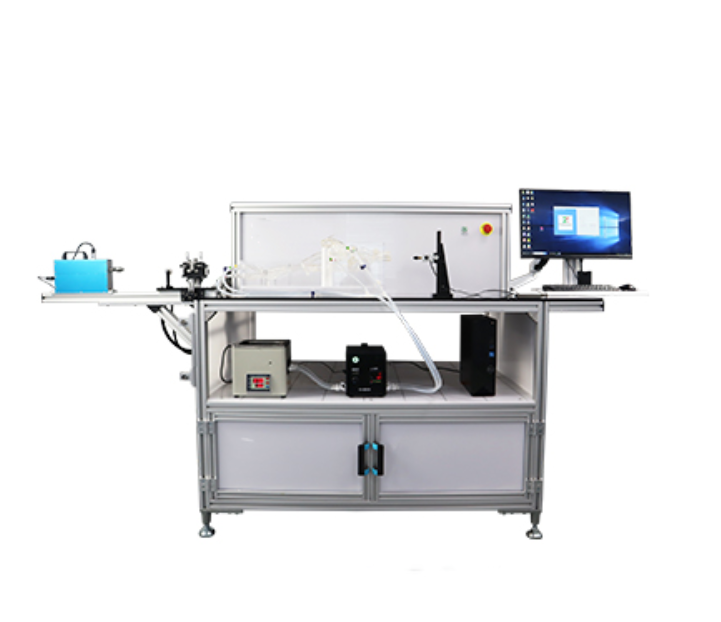
Working Principle of the Guidewire Push Force Tester
The Guidewire Push Force Tester is primarily designed to simulate the advancement process of guidewires inside human blood vessels. It uses high-precision sensors to monitor and record real-time mechanical changes during guidewire movement. The core working principle is based on precision force measurement technology and advanced data acquisition systems.
1. Mechanical Simulation
The instrument uses a servo motor-driven clamping mechanism to apply pushing and pulling movements to the guidewire, simulating the operational forces and handling characteristics experienced by physicians during clinical procedures.
2. Force Data Acquisition
Equipped with a high-sensitivity force sensor, the system can capture extremely small variations in force with high resolution, including:
Push Force
Pull Force
Friction Force
The collected force data enables accurate evaluation of the guidewire’s mechanical performance, such as pushability, resistance, and movement stability.
3. Clinical Environment Simulation
Advanced testing systems are typically equipped with simulated vascular models or constant-temperature water bath fixtures to reproduce realistic vascular conditions, including different:
Vessel diameters
Curvature levels
Lubrication conditions
By simulating various clinical environments, the tester ensures that evaluation results are closer to actual surgical conditions, providing reliable technical data for guidewire design optimization, quality inspection, and performance verification.
Core Technical Functions and Performance Features of the Guidewire Push Force Tester
With the increasing demands for medical device performance evaluation, modern Guidewire Push Force Testers have advanced beyond traditional single-force measurement capabilities, incorporating high precision, automation, and clinical scenario simulation technologies.
1. High-Precision Measurement and Multi-Range Adaptability
The tester adopts high-resolution force sensors to accurately measure the mechanical performance of different types of guidewires, from soft guidewires to ultra-stiff guidewires.
With a wide measurement range, the system can accommodate various guidewire specifications, including different diameters such as 0.014 inch to 0.035 inch, meeting diverse testing requirements for interventional medical devices.
2. Dynamic Resistance Simulation and Clinical Scenario Reproduction
Some advanced systems integrate dynamic resistance simulation technology. Through adjustable-angle simulated vascular models, the tester can reproduce complex anatomical conditions such as:
Tortuous coronary arteries
Calcified lesions
Different vascular pathways
This allows the system to evaluate not only static pushing force but also capture sudden force variations, such as the “jump phenomenon” or abrupt resistance changes when the guidewire passes through lesions.
These detailed mechanical performance data provide valuable insights for guidewire design optimization and product improvement.
3. Automated Testing and Cycle Life Evaluation
The instrument supports fully programmable automated testing. Users can set parameters such as:
Testing speed: 0.1 cm/s–6 cm/s
Push distance: 1–15 cm
Number of test cycles
The system can perform repeated push-pull cycle tests and, combined with big data analysis, establish failure prediction models to evaluate potential risks such as:
Guidewire fracture
Mechanical fatigue
Service life limitations
This helps manufacturers improve product reliability and durability.
4. Quantitative Evaluation of Torque Transmission Efficiency
In addition to axial push force measurement, some integrated systems are equipped with torque testing modules to quantitatively evaluate the synchronization between guidewire tip rotation and handle operation.
This parameter, known as torque response or torque control performance, is a key indicator for assessing guidewire maneuverability and clinical handling performance.
5. Data Traceability and Management System
The tester is equipped with a comprehensive data management system that can:
Automatically record and store test data
Analyze measurement results
Generate detailed test reports
Connect with enterprise MES (Manufacturing Execution System) platforms
This enables complete quality traceability throughout the production process, from raw material inspection to finished product verification, supporting advanced quality management in medical device manufacturing.
The Important Role of the Guidewire Push Force Tester
The Guidewire Push Force Tester is a specialized instrument designed to evaluate the mechanical performance of guidewires during the advancement process. By simulating guidewire movement inside blood vessels, the tester can monitor and record real-time mechanical changes during pushing operations, providing medical device manufacturers with critical performance data.
This instrument plays an essential role throughout the entire lifecycle of medical device development, including research and development, production, and quality control, helping manufacturers improve product reliability, consistency, and clinical performance.
1. Supporting Medical Device Research and Development
During the R&D stage, the Guidewire Push Force Tester enables engineers and researchers to conduct comprehensive performance evaluations of newly developed guidewires.
By simulating guidewire advancement under different conditions, the tester provides detailed mechanical performance data, allowing researchers to determine whether the product meets design requirements.
These test results provide valuable references for optimizing guidewire structures and improving key performance characteristics, such as:
Pushability
Flexibility
Trackability
Mechanical stability
Ultimately, this helps enhance the overall quality and clinical usability of interventional medical devices.
2. Ensuring Production Quality and Consistency
During the manufacturing stage, the Guidewire Push Force Tester helps ensure that each production batch meets established quality requirements.
Through regular testing of manufactured guidewires, manufacturers can quickly identify and address potential quality issues, ensuring product consistency and reliability.
In addition, the tester can be used to optimize manufacturing process parameters, improve production efficiency, and reduce unnecessary production costs while maintaining product quality.
3. Strengthening Quality Control and Market Evaluation
In quality control processes, the Guidewire Push Force Tester plays a critical role in verifying the performance of finished guidewire products.
By conducting strict mechanical performance testing, manufacturers can ensure that products comply with predefined performance standards and regulatory requirements.
The instrument can also be used for competitor product analysis and comparative evaluation, helping manufacturers understand their own product advantages and limitations. These insights support more targeted product improvement strategies and market positioning.
Through accurate mechanical performance evaluation, the Guidewire Push Force Tester provides reliable technical support for improving guidewire safety, optimizing product design, and ensuring the high-quality development of interventional medical devices.
Selection and Usage Recommendations for the Guidewire Push Force Tester
When selecting a Guidewire Push Force Tester, users should focus on the following key factors:
1. Testing Accuracy and Stability
Priority should be given to instruments equipped with high-precision force sensors and stable data acquisition systems. These features ensure excellent test repeatability and reproducibility, providing reliable mechanical performance data for guidewire evaluation.
2. Clinical Scenario Simulation Capability
Based on specific R&D requirements, users should select equipment capable of simulating complex vascular environments, such as:
Curved vessels
Narrowed vascular pathways
Variable resistance conditions
These simulation capabilities enable the generation of more clinically relevant testing data and provide stronger support for guidewire design optimization and performance verification.
3. Software Functions and Expandability
The software system should be evaluated for its ability to:
Customize testing parameters
Perform advanced data analysis
Generate and export test reports
Support future testing standards and requirements
A flexible and expandable software platform helps ensure that the instrument can adapt to evolving testing needs throughout the product development cycle.
4. After-Sales Service and Calibration Support
Users should ensure that the supplier provides comprehensive after-sales service, including:
Technical support
Regular calibration services
Maintenance assistance
Reliable calibration and service support are essential for maintaining long-term measurement accuracy and stable instrument performance.
Conclusion
Overall, the Guidewire Push Force Tester has established a new benchmark in medical device testing through its outstanding stability, advanced measurement technology, and intelligent testing capabilities.It not only provides reliable evaluation methods for medical research and production but also plays an important role in improving the safety, effectiveness, and reliability of interventional medical devices.With the continuous development of the medical device industry, ongoing technological innovation and product improvements will further enhance testing solutions, providing the industry with more advanced, efficient, and reliable performance evaluation equipment and services.
Previous: What is a Dry Microbial Penetration Resistance Tester?
N e x t : the last page
