





What is an adhesion tester?
2026/08/17
Share:

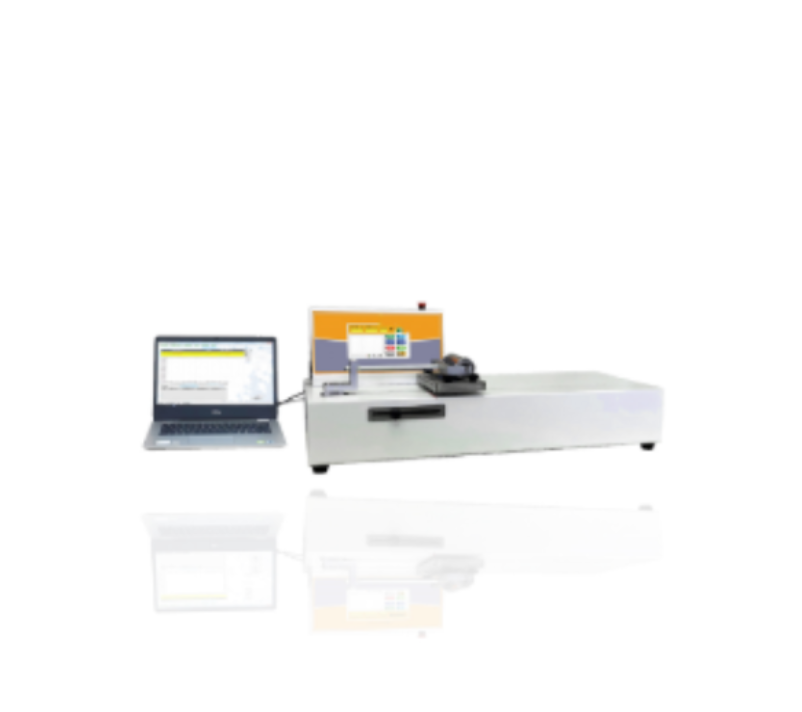
Working Principle of the Adhesion Strength Tester
The Adhesion Strength Tester primarily operates based on conventional tensile or peel testing principles.
During a typical test, the operator first prepares the test specimen according to the applicable standard. The specimen, such as adhesive tape, a coating, or a bonded component, is then evenly and securely attached or fixed between the upper and lower dedicated fixtures of the testing machine.
The instrument then drives its mechanical transmission system, typically consisting of a precision motor, lead screw, or pneumatic cylinder, to apply a tensile or peel force to the specimen at a constant, preset speed. The applied force acts uniformly on the bonded interface, causing the stress on the interface to gradually increase.
A high-precision force sensor inside the instrument continuously monitors and records changes in the applied force throughout the test, while a displacement sensor simultaneously records the movement distance of the fixture. When the applied force exceeds the maximum strength that the bonded interface can withstand, adhesive failure or interfacial separation occurs.
After the test is completed, the instrument can generate a complete force-displacement curve or stress-strain curve and calculate key performance parameters such as maximum adhesion force, average adhesion force, and failure energy. These results provide a scientific and objective evaluation of the bonding performance, adhesion strength, and reliability of the tested material or bonded interface.
How to Use the Adhesion Strength Tester
To ensure the accuracy, repeatability, and reliability of test results, the Adhesion Strength Tester should be operated strictly according to standardized procedures:
1. Specimen Preparation
Select representative, defect-free specimens and cut them to the specified dimensions and shape in accordance with the applicable testing standards, such as ASTM or ISO. Carefully clean the surfaces of both the specimen and the test substrate using an appropriate cleaning agent. Ensure that the surfaces are dry, flat, and free from oil, dust, and other contaminants that could affect adhesion performance.
2. Specimen Installation and Alignment
Accurately attach or place the prepared specimen onto the lower fixture platform of the tester. Align the upper fixture with the specimen and press it onto the designated test area. Ensure that the specimen is flat, properly centered, and securely positioned, with no bubbles, wrinkles, or localized stress concentrations in the test area, so that the applied force is distributed uniformly.
3. Test Parameter Setting
According to the test objective and material characteristics, precisely set the required test parameters through the instrument's control software or control panel. These parameters typically include the test mode, tensile or peel speed, test termination conditions, and data sampling frequency.
4. Test Start and Process Monitoring
After confirming that all settings are correct, press the Start button to begin the test. The instrument will automatically operate according to the preset program. During the test, the operator should monitor whether the testing process runs smoothly and whether the specimen exhibits the expected failure mode.
5. Data Acquisition, Analysis, and Reporting
During the test, the instrument automatically and continuously records force and displacement data. After completion, the software immediately calculates and displays key test results, such as peak force, average force, and test curves. The data can then be further analyzed, and a standardized test report containing the test conditions and results can be generated for record keeping, quality control, or engineering decision-making.
Advantages of the Adhesion Strength Tester
The Adhesion Strength Tester has become an essential tool in industrial testing and research and development due to the following key advantages:
1. Easy Operation and High Level of Automation
Modern Adhesion Strength Testers are typically equipped with user-friendly touchscreen interfaces or computer-based control software, allowing the testing process to be highly automated. From parameter setting and test execution to data analysis and report generation, most procedures can be completed automatically. This significantly reduces operator skill requirements, minimizes human error, and lowers labor input.
2. High Measurement Accuracy and Excellent Repeatability
The instrument uses high-resolution force sensors and precision mechanical structures to provide accurate force measurement across a wide range, from micro-newtons (µN) to several kilonewtons (kN), depending on the instrument configuration. Combined with standardized operating procedures (SOPs), it can provide highly repeatable and reproducible test results, offering reliable data for quality comparison, product evaluation, and process optimization.
3. Extremely Wide Range of Applications
The tester offers flexible configurations and can accommodate different testing methods and material types by using interchangeable fixtures and test heads. It can be used not only for common pressure-sensitive adhesive tapes, labels, and self-adhesive materials, but also for evaluating the adhesion of coatings to substrates, interlaminar bonding strength of composite materials, bonding strength of sealants, adhesion of medical dressings, and the bonding reliability of miniature structures in electronic components. Its applications therefore extend from everyday consumer products to advanced high-tech industries.
Application Example of the Adhesion Strength Tester
In the highly demanding pharmaceutical and medical industry, the Adhesion Strength Tester also plays an essential role. For example, when developing new medical adhesives for surgical wound closure or tissue repair, researchers need to accurately determine the adhesive strength of the adhesive to different biological tissues under simulated physiological conditions.
The Adhesion Strength Tester can simulate actual loading conditions and provide accurate, quantitative data on adhesive force, failure mode, and bonding durability. These data are key indicators for evaluating the biocompatibility, effectiveness, and safety of medical adhesives and can directly affect their suitability for clinical applications.
Based on the test results, medical and pharmaceutical companies can optimize adhesive formulations and coating processes, helping ensure that the final product can bond reliably and consistently to the target tissue and achieve the intended therapeutic performance. Such testing data can also support the product's compliance with applicable regulatory requirements.
Conclusion
In summary, the Adhesion Strength Tester is a fundamental and essential instrument for evaluating the interfacial bonding performance of materials in modern industry and scientific research. Its combination of easy operation, high measurement accuracy, excellent repeatability, and broad applicability makes it a trusted testing instrument across industries ranging from traditional manufacturing to emerging fields such as biomedicine, medical products, electronics, and advanced packaging.By gaining a thorough understanding of its working principles, standardized operating procedures, and applications in different testing scenarios, engineers and technical personnel can make more effective use of the instrument. This not only improves product quality, consistency, and reliability, but also supports process optimization and technological advancement, ultimately strengthening a company's competitiveness in new material applications and product innovation.
Previous: What is a High Temperature Thermal Conductivity Tester?
N e x t : the last page
