





How Does Paper Surface Roughness Affect Printing Quality and Performance?
2026/08/20
Share:

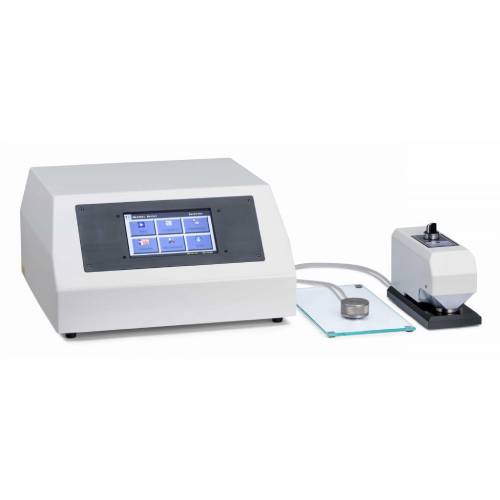
Working Principle of Paper Roughness and Air Permeability Tester
A standard specimen with a diameter of approximately 60 mm is placed flat on the test platform. A dedicated measuring head with an effective test area of 10 cm² presses the specimen tightly under a constant pressure of 100 kPa (normally), simulating the actual compression condition of paper during use.
The instrument is equipped with a precision air pump and flow control system, which supplies constant-pressure, clean and dry air into the gap between the measuring head and the paper surface. Due to the microscopic uneven structure of the paper surface, tiny gaps are formed between the measuring head and the specimen. Air escapes through these gaps. The rougher the surface, the larger the gaps and the greater the air leakage; the smoother the surface, the lower the air leakage.
A high-precision flow sensor continuously detects the leakage airflow in real time. The system converts the measured airflow value into a roughness index according to the standard calculation formula, or directly displays the result in micrometers (μm). The instrument can automatically evaluate whether the paper smoothness meets the specified requirements.
The electronic flow meter accurately measures the volume of air passing through the specimen per unit time (mL/min). The measured value is directly defined as the air permeability. A higher airflow rate indicates higher paper porosity and better air permeability performance.
Applications of Paper Roughness and Air Permeability Tester
Raw Paper Quality Evaluation and Process Optimization
The tester is used to measure the roughness and air permeability of base paper produced from wood pulp, recycled pulp, and coated pulp. It helps optimize pulping, papermaking, and calendering process parameters. During production, random inspections can be performed to monitor the influence of calendering, coating, and drying processes on paper surface properties and pore structure, helping manufacturers adjust equipment parameters in time and maintain batch-to-batch product consistency.
Quality Control of Printing Paper and Packaging Materials
It performs comprehensive testing of cultural paper, packaging paper, and paperboard to ensure products meet customer requirements and industry standards, preventing defective products from entering the market. Roughness data can also assist printing companies in selecting suitable papers for offset printing, gravure printing, and flexographic printing. Excessive roughness may cause ink accumulation and unclear dot reproduction, while excessively smooth surfaces may lead to ink smearing and print-through issues.
Printing Performance Simulation and Functional Paper Testing
The instrument supports roughness testing under simulated printing pressure (1000–2000 kPa) with PPS mode, enabling accurate prediction of actual printing performance and optimization of ink formulations and printing pressure. It can evaluate the smoothness and air permeability of food packaging paper and cigarette packaging paper, ensuring clear printing patterns, uniform colors, and meeting moisture-proof and oxygen-barrier packaging requirements.
Barrier Material and Industrial Paper Testing
The tester can evaluate the air permeability of greaseproof paper, aluminum foil laminated paper, and vacuum packaging paper to ensure their oxygen and moisture barrier performance meets requirements, helping extend product shelf life. It can also test the air permeability of cement bag paper, kraft paper, and corrugated base paper to ensure smooth air release during automatic filling processes and prevent powder backflow.
Filter Materials and Functional Paper Performance Evaluation
It is suitable for testing key performance characteristics of filter paper (air/liquid filtration), battery separator paper, thermal paper, and insulating paper. Filter paper requires appropriate air permeability to achieve efficient filtration, while insulating paper requires low air permeability to ensure electrical safety. The instrument can also be used for quality arbitration, import and export inspection, industry standard compliance verification, and enterprise certification processes.
Material Research and Product Development
The tester helps analyze the relationship between paper fiber structure, pore distribution, coating processes, roughness, and air permeability. During the development of environmentally friendly paper, bio-based paper, functional coated paper, and composite fiber materials, it provides accurate evaluation of surface characteristics and penetration performance to accelerate product improvement and innovation.
Process Improvement and Automotive Material Testing
It can evaluate the performance improvement effects of advanced calendering, coating, and sizing technologies, providing reliable data support for process upgrades. The instrument is also suitable for testing the air permeability of filter media used in automotive air filters and fuel filters, ensuring a balance between filtration efficiency and airflow resistance. In addition, it can measure the roughness and air permeability of automotive interior composite boards and headliner materials to meet requirements for surface feel, sound absorption, and moisture resistance.
Core Importance of Paper Roughness and Air Permeability Tester2
The TMI Paper Roughness and Air Permeability Tester is a critical quality control instrument for the paper manufacturing, printing, and packaging industries. It plays an essential role in production process control, cost optimization, and compliance assurance by providing accurate and reliable measurement data.
1. Quantitative Surface Quality Evaluation and Elimination of Subjective Errors
The instrument replaces traditional manual evaluation methods based on touch and experience, eliminating inconsistencies caused by different judgment standards. It enables paper surface roughness to be accurately quantified, recorded, and traced, reducing rework rates and customer complaints.
2. Direct Evaluation of Printing Performance
The test results provide valuable references for predicting ink adhesion performance. In practical applications, the expected ink film thickness is approximately 2–2.5 times the roughness value, providing quantitative guidance for controlling ink layer uniformity and preventing unclear printing dots.
3. Adaptation to Different Printing Processes
The tester can simulate actual printing pressures according to different printing methods, including offset printing, letterpress printing, and gravure printing, ensuring the suitability and compatibility of various paper materials for different printing applications.
4. Comprehensive Testing Capability for Various Paper Grades
It is suitable for a wide range of paper materials, including newsprint, kraft paper, and corrugated board. For medium- and high-roughness papers, it provides stable and accurate measurements, overcoming the limitations of conventional smoothness testers.
Conclusion
With its high measurement accuracy, wide material compatibility, and advanced process simulation capabilities, the TMI Paper Roughness and Air Permeability Tester demonstrates outstanding value in paper quality control, material research, and product development. It provides reliable technical support for improving paper performance, optimizing production processes, and ensuring product consistency. Detailed technical specifications, application examples, and customized solutions are available upon request.
Previous: What is an adhesion tester?
N e x t : the last page
