





How Does a Digital Display Electronic Ink Viscosity Meter Work?
2026/08/24
Share:

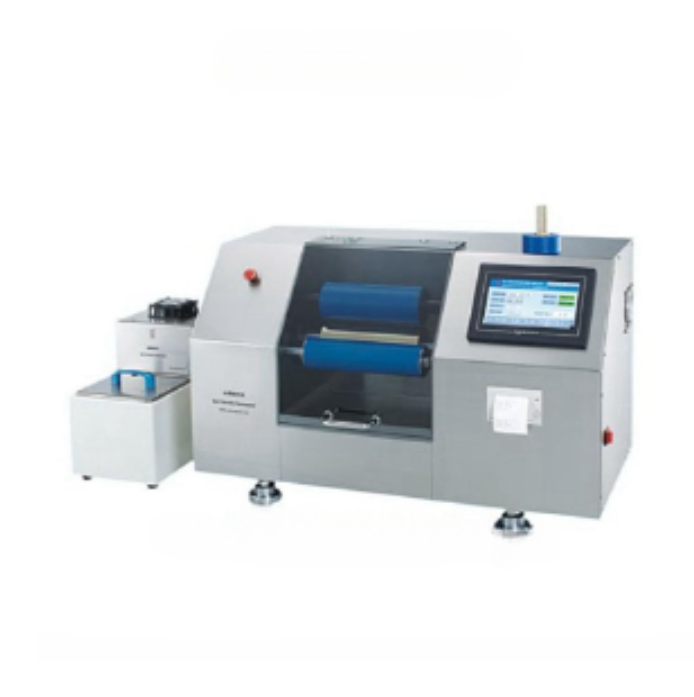
Principle and Structural Features of the Digital Electronic Ink Tack Tester
Working Principle
The Digital Electronic Ink Tack Tester operates primarily on the two-roll separation method.
Under precisely controlled temperature conditions, the test ink is evenly applied between a high-speed rotating copper roller and an upper pressure roller to form a thin and uniform ink film. When the two rollers rapidly separate at a preset speed, the cohesive force of the ink generates a maximum separating force, which represents the ink tack force.
This force is detected by a precision bending-beam sensor or roller force-measuring system and converted into a corresponding electrical signal. The signal is then transmitted to a microcomputer processing unit, where it is processed and calibrated before the final result is displayed directly on the digital display as an ink tack value.
Essentially, the instrument does not measure the absolute viscosity of the fluid. Instead, it measures the dynamic adhesion and separation behavior of ink as a non-Newtonian fluid under specific shear rates and separation conditions. This behavior closely resembles the actual separation process between ink rollers in a printing press, making the test results more meaningful for process control and optimization.
Structural Features
1. Constant-Temperature Circulation System
The instrument incorporates an independent water tank, high-efficiency circulating water pump, and precision heating module to provide accurate temperature control during testing. Temperature control accuracy can typically reach within ±0.5°C. This system maintains stable temperature conditions throughout the test and effectively minimizes the influence of ambient temperature fluctuations on tack measurement results.
2. High-Precision Drive and Leveling System
The main shaft of the copper roller is precisely machined and assembled, with its horizontal alignment strictly controlled to ensure testing accuracy. The drive system uses a multi-speed motor and integrates automatic acceleration and ink-distribution functions. Some high-end models also feature real-time speed compensation to automatically correct minor speed deviations caused by load changes, ensuring consistent linear speed during each test.
3. Digital Display and Control
The instrument is equipped with a high-resolution LCD display for direct and real-time viewing of key parameters such as the ink tack value and instantaneous copper-roller speed. The operating interface supports convenient automatic zero calibration, while built-in algorithms perform error analysis and control of repeated measurements to ensure high measurement repeatability and accuracy.
4. Heavy-Duty Mechanical Construction
The instrument features a robust and stable mechanical structure, with a typical weight of 70–132 kg. It should be securely installed on a dedicated vibration-isolation work platform to minimize interference from external vibration. The structure incorporates a buffering device, low-speed cleaning mode, and comprehensive safety protection, ensuring stable and durable operation while improving operational safety.
5. Application-Specific Measurement Principle
It should be noted that the Digital Electronic Ink Tack Tester differs fundamentally from general-purpose rotational viscometers, such as the NDJ series, in both measurement principle and application purpose.
The instrument provides a relative tack index, which more directly reflects the transfer and separation characteristics of ink during printing. Therefore, its test data can more accurately correspond to actual quality-control requirements in offset printing and other major printing processes.
Core Advantages of the Digital Electronic Ink Tack Tester
Compared with traditional ink tack testers, the Digital Electronic Ink Tack Tester offers three main advantages: high-precision control, automated operation, and reliable test data.
First, the instrument adopts advanced intelligent industrial control components, such as a PLC controller, touchscreen, and servo motor drive, enabling precise display of the instantaneous copper-roller speed and water-tank temperature. The servo system minimizes speed deviations, typically keeping them within 1 rpm, and can automatically adjust test conditions that do not meet preset requirements. This ensures stable testing conditions and significantly improves the accuracy and repeatability of test results.
Second, the instrument provides highly user-friendly automatic measurement functions. Users can select either automatic or manual operation modes. During testing, manual adjustment of the engagement and disengagement between the test roller and ink-distributing roller is not required. The instrument automatically completes the ink distribution, acceleration, and measurement processes, greatly reducing operating difficulty and human error.
Finally, the instrument provides convenient data management and calibration functions. Some models are equipped with an RS-232 interface or support connection to an external PC for data acquisition, facilitating quality monitoring and analysis. Sensor calibration is also straightforward, and the tack values can be correlated with those obtained from instruments of other brands, ensuring inter-instrument consistency and comparability.
Operation and Maintenance Recommendations for the Digital Electronic Ink Tack Tester
To ensure the reliability of measurement data, operators should pay attention to the following points:
Level Calibration:
Adjust the worktable to a level position before use and ensure that the horizontal error of the main shaft and copper roller is within the allowable range.
Temperature Preheating:
Turn on the constant-temperature system in advance before testing. Start the test only after the water temperature reaches the preset value and remains stable.
Regular Cleaning:
After testing, clean the copper roller and baffle using the low-speed cleaning function or manually to prevent residual ink from drying and affecting the accuracy of subsequent tests.
Data Recording:
Some models provide data output interfaces that can be connected to a printer or computer for data storage and analysis. It is recommended to maintain complete test records to facilitate traceability and analysis of the causes of quality fluctuations.
Conclusion
With its high precision, automation, and intelligent control, the Digital Electronic Ink Tack Tester provides a scientific method for quality control in the printing industry. Proper understanding and operation of the equipment can not only improve the overall quality of printed products but also effectively reduce production costs, making it an important technical tool for modern printing companies to enhance their competitiveness.
Previous: What Is a Shock Absorption and Cushioning Tester Used For?
N e x t : the last page
