





How to Test Coating Adhesion Strength?
2026/08/26
Share:

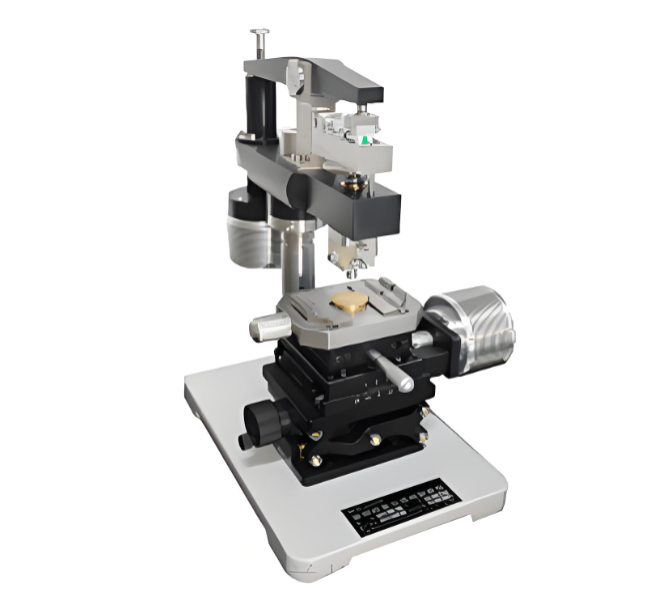
Working Principle and Technical Core
The Automatic Coating Adhesion Scratch Tester is based on tribological and mechanical principles. Through a computer-controlled mechanical system, a probe with a specific geometric shape (usually a diamond conical indenter or spherical indenter) is used to scratch the coating surface under a constant or gradually increasing load.Compared with traditional manual testing methods, the automatic scratch tester integrates acoustic emission technology, friction force measurement technology, and high-precision sensors, enabling real-time detection of signals generated at the moment of coating failure.During the scratching process, as the applied load increases or the scratch depth becomes greater, microcracks gradually develop at the coating-substrate interface until complete coating delamination occurs. The instrument determines the critical load by monitoring changes in the following key parameters:
1. Acoustic Emission Signal
When the coating cracks or fails, specific acoustic wave signals are generated. The instrument can automatically detect these sudden signal changes and identify the failure point accurately.
2. Friction Force Variation
Before and after coating delamination, the friction coefficient between the indenter and the surface changes significantly. By monitoring friction force variations, the instrument can assist in determining the critical failure load of the coating.
3. Optical Observation
Some advanced models are equipped with high-resolution microscopes or image recognition systems to record scratch morphology in real time, providing additional support for analyzing coating failure modes.This multi-parameter synchronous monitoring system eliminates subjective errors caused by manual observation and ensures the objectivity, accuracy, and repeatability of test results.
Features of the Automatic Coating Adhesion Scratch Tester
1. Progressive Load Scratch Testing for Accurate Failure Point Detection
The core advantage of this equipment lies in overcoming the limitations of traditional fixed-load testing methods by adopting a progressive load (increasing load) scratch testing mechanism.During testing, a diamond probe moves across the coating surface at a constant speed while the vertical load gradually increases linearly from a minimum value to the preset maximum load. Through a single measurement, the instrument can accurately identify the critical load points corresponding to different coating failure stages, including initial micro-cracking, partial delamination, and complete coating debonding.
2. Multi-Dimensional Failure Analysis Through Advanced Sensor Integration
Modern scratch testers are equipped with acoustic emission sensors, friction force sensors, and high-precision depth sensors. These sensors can capture elastic waves released during coating fracture and sudden changes in friction coefficient in real time.Through this multi-sensor detection system, the instrument achieves multi-dimensional cross-validation of the coating failure process, improving the accuracy and reliability of adhesion evaluation.
3. High-Resolution Imaging for Precise Scratch Morphology and Failure Mechanism Analysis
To accurately identify scratch morphology and coating failure mechanisms, high-end scratch testers integrate high-resolution video microscopes and polarized light filters.Under interference contrast mode, operators can easily distinguish different failure mechanisms, such as brittle fracture, plastic deformation, and interfacial delamination.The equipment also adopts a unique synchronized panoramic imaging system, enabling complete synchronization between all sensor signals and high-resolution panoramic images during the scratching process. This ensures that every abnormal point on the test curve can be precisely correlated with the actual morphology of the scratch surface.
4. Intelligent Software Control and Highly Repeatable Testing Performance
Modern Automatic Coating Adhesion Scratch Testers are generally equipped with optimized operating software, supporting one-click automatic operation and multi-track programmed measurements.The system can automatically determine critical loads and generate comprehensive test reports containing friction coefficient curves, acoustic emission signals, and scratch depth data.Whether testing ultra-hard thin films with thicknesses below 1 μm (nano-scratch mode) or hard coatings thicker than 1 μm (micro-scratch/high-load scratch mode), the instrument ensures highly repeatable and objective test results through excellent sensor linearity and a closed-loop active load feedback system.
Main Testing Methods and Application Scenarios
According to industry standards and practical testing requirements, the Automatic Coating Adhesion Scratch Tester mainly supports the following testing modes:
1. Constant Load Scratch Test
Under a fixed load, the instrument performs single or multiple scratching operations. The scratch width and coating peeling condition are observed using an optical microscope to evaluate the coating’s scratch resistance and adhesion level through qualitative or semi-quantitative analysis.This method is commonly used as a supplementary analysis method for cross-cut adhesion tests in accordance with standards such as ISO 2409 and ASTM D3359.
2. Progressive Load Scratch Test
In this method, the applied load increases linearly with time or scratching distance until coating failure occurs. The technique can directly determine the critical load value at which coating delamination begins.It is particularly suitable for quantitative analysis of the bonding strength of hard thin films, ceramic coatings, and multi-layer composite coating systems, providing accurate evaluation of coating-substrate adhesion performance.
3. Reciprocating Wear Test
This method simulates repeated friction conditions during actual service and evaluates the coating’s wear resistance life and long-term adhesion stability under cyclic mechanical stress.The Automatic Coating Adhesion Scratch Tester technology is widely used in various industries, including:
Automotive coatings — evaluating paint adhesion, protective coatings, and surface treatment performance of vehicle components.
Aerospace — analyzing the bonding strength and durability of advanced protective coatings under extreme conditions.
Electronic and electrical products — testing adhesion performance of functional films, protective layers, and surface coatings.
Building materials — evaluating the durability and adhesion of architectural coatings and protective layers.
Medical devices — assessing the adhesion reliability of functional coatings on medical instruments and implants.
Automation Advantages and Data Value
Compared with traditional manual cross-cut testers or pull-off adhesion testers, the Automatic Coating Adhesion Scratch Tester offers significant technological advantages:
High Precision and Excellent Repeatability
The instrument uses computer programming to precisely control the loading rate and scratching speed. The load accuracy can reach the 0.3 N level, ensuring consistent and reliable test results among different batches of samples.
Intelligent Data Processing
The built-in software can automatically collect key data such as load force, displacement, and acoustic emission signals, generate dynamic test curves, and use algorithms to automatically eliminate invalid data and calculate the critical load value. This greatly reduces the time required for data analysis and improves testing efficiency.
Wide Material Compatibility
The tester is suitable for a wide range of materials, including metals, ceramics, plastics, and rubber substrates. Whether testing soft paint coatings or hard PVD (Physical Vapor Deposition) coatings, effective evaluation can be achieved by adjusting the indenter type and load range according to different material characteristics.
Conclusion
The Automatic Coating Adhesion Scratch Tester is not only a standard piece of equipment in quality control laboratories but also an essential analytical tool during coating research and development.By quantitatively measuring the bonding strength between coatings and substrates, the instrument helps engineers quickly identify coating formulation defects, optimize surface treatment processes, and improve the overall reliability and service life of products.With the further integration of artificial intelligence and image recognition technologies, future automatic scratch testers will become increasingly intelligent, providing more accurate and efficient solutions for material surface engineering.
Previous: Why Is Liquid Testing Important for Auto Wires?
N e x t : the last page
