





Why Should Plastic Products Undergo Scratch Testing?
2026/08/28
Share:

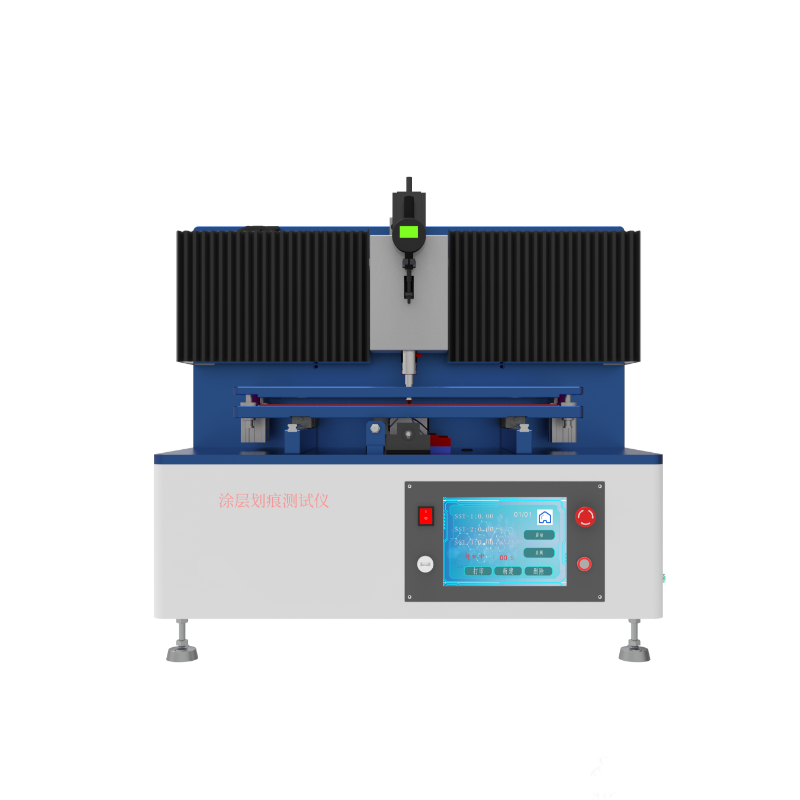
Working Principle and Technical Mechanism
The Plastic Scratch Tester operates based on the principle of contact mechanical testing and mainly consists of three core modules: the loading system, motion system, and detection system.
1. Loading Methods
Depending on the applicable testing standard, two main loading modes are available:
Constant Load Method:
The vertical pressure is maintained at a constant level throughout the test, while the stylus moves across the specimen surface at a constant speed. This method is commonly used to simulate scratching behavior under a specified load.
Progressive Load Method (Linear Loading):
During the scratching process, the normal load increases linearly with time or distance. A single test can provide data covering the entire process from elastic deformation and plastic deformation to complete failure of the material. This method can accurately determine the “critical load,” defined as the minimum force at which unacceptable damage occurs on the material surface.
2. Stylus and Indenter
The instrument uses an indenter with a specific geometry and high hardness as the scratching tool. Common indenter materials include diamond, tungsten carbide, and hardened steel. Available geometries include hemispherical, conical, and Rockwell C diamond indenters.The radius of curvature of the indenter, such as 0.5 mm or 1 mm, can be customized according to testing requirements to simulate scratching sources with different degrees of sharpness.
3. Data Acquisition and Analysis
Modern Plastic Scratch Testers integrate high-precision force sensors, displacement sensors, and optical observation systems.
Mechanical Signals:
Normal force (vertical pressure) and tangential force (friction force) are recorded in real time.
Acoustic Signals:
Some high-end instruments are equipped with acoustic emission sensors. When the coating fractures or the substrate cracks, specific-frequency acoustic signals are generated, which can be used to accurately identify the failure point.
Surface Morphology Analysis:
After testing, optical microscopes, laser scanning confocal microscopes, or three-dimensional surface profilometers are typically used to precisely measure the microscopic morphology, depth, and width of the scratch, as well as material accumulation (pile-up) around the scratch.
Importance of the Plastic Scratch Tester
The Plastic Scratch Tester plays an indispensable role in materials science, quality control, and product development, with its importance mainly reflected in the following key aspects:
First, it is a key tool for quantitatively evaluating material surface properties. Plastics and their coatings are highly susceptible to friction and mechanical forces during daily use, transportation, and installation. By simulating scratching behavior under real-world conditions, the instrument can scientifically determine the scratch resistance, abrasion resistance, and adhesion strength between coatings and substrates. These quantitative or qualitative evaluations provide an objective basis for determining whether materials meet durability requirements and avoid the subjective errors associated with visual inspection alone.
Second, the instrument is an important means of ensuring product appearance quality and market competitiveness. For automotive interiors, appliance housings, electronic products, furniture, engineered wood panels, and other plastic products, surface appearance directly influences consumers' purchasing decisions. The Scratch Tester can accurately measure changes in gloss, color difference, and microscopic surface morphology after scratching, helping manufacturers optimize material formulations and surface treatment processes. This enables the production of products with better wear resistance and appearance, extends service life, and enhances brand image.
Finally, it plays a key role in standardized testing and compliance certification. In accordance with applicable domestic and international standards, the Scratch Tester can provide repeatable and high-precision test data. This not only helps companies establish standardized quality control systems but also meets stringent market access requirements in industries such as automotive and construction, providing authoritative technical support for product export and market circulation.
Equipment Selection and Technology Trends
With the development of materials science, Plastic Scratch Testers are evolving toward higher precision, greater intelligence, and multifunctionality.
High-Precision Servo Control:
Servo motors and ball screws are used to achieve nanometer-level displacement control and micro-Newton-level load resolution, ensuring high repeatability of testing.
Automation and Intelligence:
Equipped with a touchscreen human-machine interface, the instrument supports test condition storage, automatic calibration, and automatic data generation. Some instruments feature a “teaching function” for quickly setting complex test paths.
Multi-Dimensional Sensing Integration:
High-end models not only measure mechanical parameters but also integrate modules such as atomic force microscopes and laser interferometers, enabling comprehensive characterization ranging from macroscopic scratches to microscopic changes in molecular structure.
Environmental Adaptability:
Since the properties of plastics are significantly affected by temperature and humidity, some specialized test chambers can control the temperature and humidity of the testing environment to simulate material performance under extreme climatic conditions.
Conclusion
The Plastic Scratch Tester is not merely a tool for testing the physical properties of materials, but also a bridge connecting material formulation design with the end-user experience of finished products. Through scientific and standardized scratch testing, manufacturers can optimize plastic formulations and improve surface treatment processes, thereby enhancing product market competitiveness and brand reputation. In today's pursuit of high-quality appearance and long-term durability, mastering and effectively applying plastic scratch testing technology is essential for plastic processing companies and related industry-chain enterprises.
Previous: What is a Geotextile wear tester?
N e x t : the last page
