





What is the cut-resistant glove test?
2026/08/28
Share:

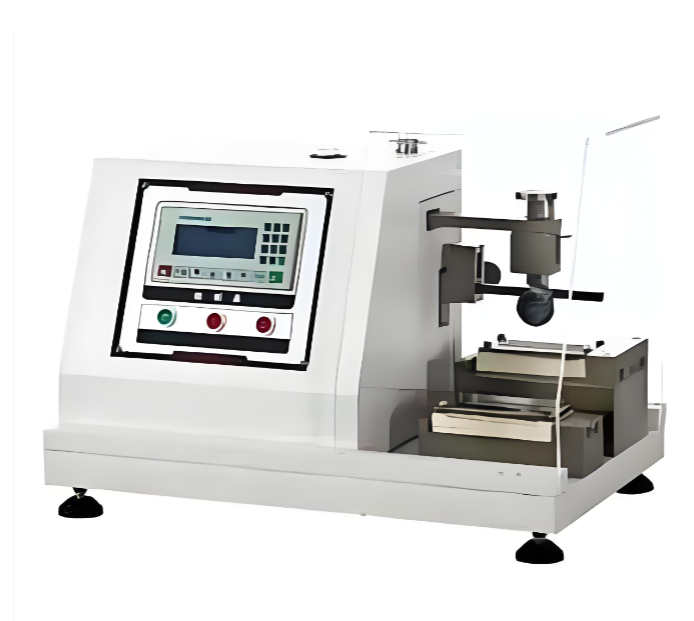
Working Principle and Operating Modes of the Glove Cut Resistance Tester
The core principle of the Glove Cut Resistance Tester is to drive a standardized blade along a specified path to cut a securely mounted test specimen under a constant vertical load. The cut resistance of the material is determined by detecting a penetration signal or measuring the force required to cut through the specimen. Depending on the applicable testing standard, the instrument generally operates in two main modes:
1. Rotary Circular Blade Method
The test specimen is securely and evenly clamped onto a curved or flat test fixture.
A standardized circular blade moves back and forth in a straight line under a constant low load (e.g., 5 N) while simultaneously rotating in the opposite direction.
The cutting process continues cyclically until the blade cuts completely through the specimen. The test may be automatically stopped when the electrical circuit is completed upon penetration, or when a preset maximum number of cycles is reached.
The number of cycles required to cut through the specimen, together with calibration against a standard reference material, is used to calculate the cut resistance index, which can then be used for performance classification.
2. Straight-Edge Linear Cutting Method
The test specimen is stretched and securely fixed on an arc-shaped support platform using pneumatic or mechanical clamps.
A standardized straight-edge blade moves forward at a constant speed along a single linear path under a constant vertical force applied through adjustable weights.
The system monitors the cutting resistance or displacement in real time. When the blade completes the specified stroke and cuts through the specimen, the critical cutting force applied at that point is recorded.
If the specimen is not cut through, multiple tests are conducted using different loads, and the results are fitted to determine the minimum force required to just cut through a 20 mm length. This value is then used as the cut resistance indicator.
Application Scenarios of the Glove Cut Resistance Tester
Industrial Protection
In mechanical manufacturing workshops, workers operating machine tools or handling metal components are highly susceptible to cut injuries to their hands caused by sharp edges, corners, and metal chips. By using a Glove Cut Resistance Tester to evaluate and select high-performance protective gloves, companies can significantly reduce the risk of hand injuries and improve workplace safety.
Security and Protective Equipment Industry
Police cut-resistant gloves require a high level of cut resistance to provide effective protection in demanding operational environments. The gloves can be evaluated using a professional testing instrument through different test methods, including linear cutting tests to simulate knife penetration, impact cutting tests to simulate axe strikes, and dynamic friction cutting tests to simulate contact with sharp objects during climbing or similar activities.
Through testing and performance optimization, police cut-resistant gloves featuring a composite structure of aramid fibers and ultra-hard ceramic plates can be developed and evaluated against applicable protective equipment standards. Such testing helps verify the gloves' ability to withstand repeated attacks from sharp objects and provides enhanced protection for law enforcement personnel during operations.
Core Value of the Glove Cut Resistance Tester in Personal Protective Equipment
1. Converting Subjective Perception into Objective Data
The performance of cut-resistant gloves cannot be judged solely by experience or feel. Gloves manufactured from different materials, such as high-performance polyethylene fibers, aramid fibers, and steel-wire blended materials, and produced using different manufacturing processes can have significant differences in cut resistance.
The Glove Cut Resistance Tester uses standardized testing procedures to simulate the cutting action of sharp blades on glove materials, transforming the otherwise vague concept of "cut resistance" into quantifiable, measurable, and scientifically comparable data.
The instrument typically operates in accordance with applicable international and national standards. Under a constant or increasing load, it records the number of cycles or the force required for the blade to cut through the test specimen. The resulting objective data eliminates subjective bias associated with manual evaluation and provides solid technical evidence of the actual protective performance of the gloves.
2. Accurately Classifying Protection Levels and Guiding Proper Product Selection
Different working environments have very different requirements for protective performance. Basic material handling may require only a certain level of protection, while metal cutting or glass handling may require a higher level of cut protection.
The Glove Cut Resistance Tester is an important testing instrument for evaluating and classifying the cut resistance performance of protective gloves.
The cut resistance index or force value obtained from testing can be used to determine the applicable protection level according to the relevant testing standard. This not only helps manufacturers define product positioning more accurately, but also provides purchasers and end users with a clear basis for product selection.
Using gloves with an appropriate protection level in high-risk environments can help reduce occupational injuries caused by insufficient protection. At the same time, avoiding unnecessary overprotection can help maintain operational flexibility and prevent unnecessary resource consumption.
3. Strengthening Quality Control and Building a Bridge of Trust
For manufacturers, the Glove Cut Resistance Tester is an important part of product development and quality control. During raw material selection, manufacturing process optimization, and finished-product inspection, the data generated by the tester can help identify material defects or process limitations, thereby improving product consistency and reliability.
For third-party testing laboratories and market supervision authorities, the instrument provides an effective means of conducting impartial performance evaluations and identifying misleading or unsupported product claims.
Independent and accurate test reports not only provide technical support for compliance assessment and certification, but also help establish consumer confidence in the protective performance of products, ensuring that products entering the market provide the level of protection they claim to offer.
Conclusion
In conclusion, the Glove Cut Resistance Tester is more than just a precision instrument in a laboratory. It is also an important part of the industrial safety system.Through scientific and rigorous testing methods, it helps verify that cut-resistant gloves can provide the intended level of protection when it matters most. Giving proper attention to and standardizing the use of cut resistance testing equipment is not only a demonstration of respect for workers' safety and well-being, but also an essential requirement for promoting the high-quality development of the personal protective equipment industry.
Previous: Why Choose a Fully Automatic High-Temperature Specific Heat Capacity Tester?
N e x t : the last page
