





What is a simulated transport vibration test machine used for?
2026/09/04
Share:

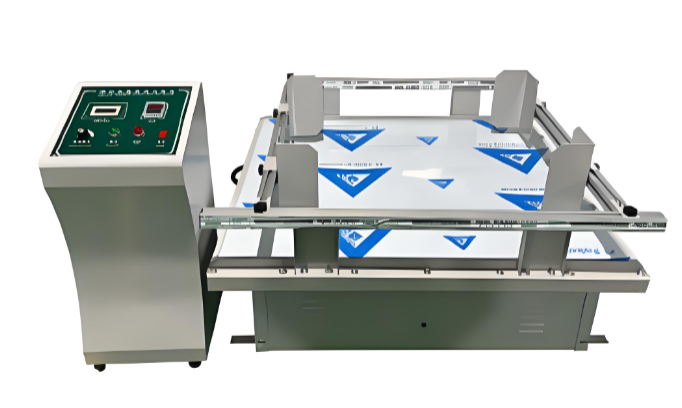
Core Principle of the Simulated Transportation Vibration Table
The core mission of the Simulated Transportation Vibration Table is to “reproduce the vibration characteristics of real road transportation on a 1:1 basis.” Its technological evolution has progressed from single mechanical drive systems to intelligent closed-loop control. Traditional mechanical vibration tables primarily use the centrifugal force generated by the rotation of an eccentric shaft to drive the test table. This structure is simple, provides high thrust, and is relatively low in cost, making it suitable for low-frequency fatigue testing and commonly used for basic packaging tests. However, its waveform quality is relatively limited, making it difficult to simulate complex random vibrations. The new generation of high-end Simulated Transportation Vibration Tables adopts more advanced control logic. Based on extensive real-world measurement databases collected from road transportation, the equipment uses multi-channel distributed acceleration sensors to collect data in real time and employs closed-loop feedback algorithms to dynamically correct the output of the drive motor.
Simulated transportation vibration testing is generally based on the operating principle of a vibration table (vibration testing machine). The vibration table can generate vibrations at various frequencies and amplitudes to simulate the vibration environments that products may encounter during actual transportation. During the test, the product is securely fixed on the vibration table and tested according to a predetermined vibration profile. By monitoring and analyzing the product’s response throughout the test, its performance under transportation conditions can be evaluated. This technology ensures that vibration frequency deviation is controlled within ±0.1 Hz and vibration uniformity remains above 98%, effectively eliminating the parameter drift problems associated with traditional equipment.
Industry Applications of the Simulated Transportation Vibration Table
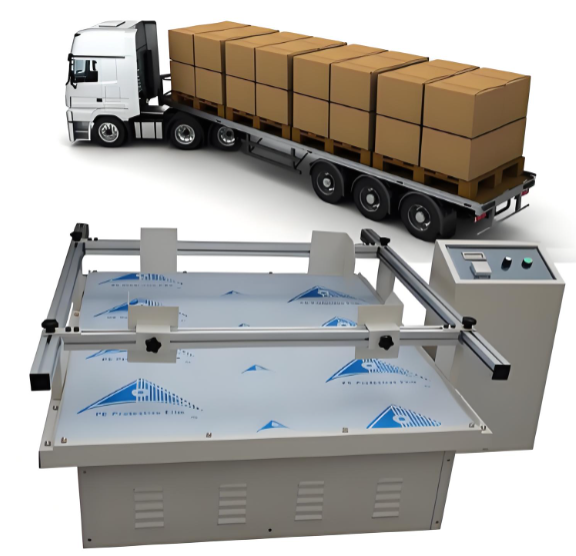
The Simulated Transportation Vibration Table has been widely adopted across multiple key industries and is gradually becoming an essential “major test” that products must pass before being officially launched. This equipment plays an irreplaceable role in ensuring product quality and transportation safety.
In the new energy vehicle industry, power batteries, motors, and electronic control systems are highly sensitive to vibration environments, and even minor abnormalities may lead to serious performance issues. Through long-duration random vibration testing, companies can systematically verify the reliability and stability of battery module mounting structures, effectively preventing safety hazards such as internal cell short circuits or housing leakage caused by continuous vibration and jolting during transportation. This provides a solid safety barrier for new energy vehicles throughout the transportation process and offers strong support for overall vehicle reliability.
In the consumer electronics industry, precision devices such as smartphones and laptops also need to undergo rigorous vibration testing to verify their structural integrity. High-precision compact Simulated Transportation Vibration Tables can realistically reproduce the complex vibration environment experienced during thousands of kilometers of express delivery transportation, ensuring that small internal components such as hard drives and camera modules do not become loose or displaced during prolonged vibration. This effectively reduces the risk of products being damaged upon arrival, while significantly improving customer experience and brand reputation.
In the packaging and logistics industry, the Simulated Transportation Vibration Table has become an important tool for optimizing packaging solutions. R&D personnel can compare the vibration resistance of different cushioning materials, thicknesses, and packaging configurations under vibration conditions to quickly identify the most cost-effective packaging design. This not only significantly reduces the breakage rate of fragile products such as glassware and precision instruments during long-distance transportation, but also enables the reasonable reduction of cushioning materials while maintaining product safety. As a result, it promotes the practical implementation and wider adoption of green logistics throughout the supply chain, achieving a win-win outcome in terms of both economic and environmental benefits.
Technical Challenges and Future Trends
Although the technology is becoming increasingly mature, table resonance remains a key factor affecting testing accuracy. When the excitation frequency approaches the natural frequency of the test table, resonance amplification may occur, causing the specimen to be subjected to excessive stress. At present, the industry employs a combination of measures, including increasing the thickness of the test table, applying constrained damping layers, and installing dynamic vibration absorbers, to significantly reduce the resonance peak amplification factor and ensure the authenticity of test data.
Looking ahead, Simulated Transportation Vibration Tables are developing toward greater intelligence and integration. Combined environmental vibration test systems integrate temperature, humidity, and vibration to simulate more extreme real-world environments. Models equipped with high-definition high-speed cameras can clearly capture the failure process of internal components through slow-motion analysis. With the integration of big data technology, the equipment will not only perform tests but also predict product performance during actual transportation, providing a scientific basis for product design.
Overall, with its ability to highly reproduce and accurately replicate real transportation environments, the Simulated Transportation Vibration Table serves as an invisible barrier that silently safeguards the safe delivery of every product from the production line to the end user. It is not only the final rigorous test that products must undergo before leaving the factory, but also an important foundation for enterprises to fulfill their quality commitments and earn market trust. As a benchmark for industrial reliability, it uses scientific data and rigorous testing to evaluate the structural strength and performance stability of products under complex road conditions and during long-distance transportation, establishing a clear and objective standard for manufacturing quality. At the same time, it serves as a solid foundation for the high-quality development of Chinese manufacturing. In the transition from a “major manufacturing country” to a “manufacturing powerhouse,” it is precisely a range of sophisticated testing instruments such as these that support Chinese products in moving more confidently and steadily into global markets.
Previous: What is a high-temperature creep testing machine?
N e x t : What is a battery slurry resistance tester?
