





Mask Respiratory Resistance Tester,EN 12941
2026/01/19
Share:

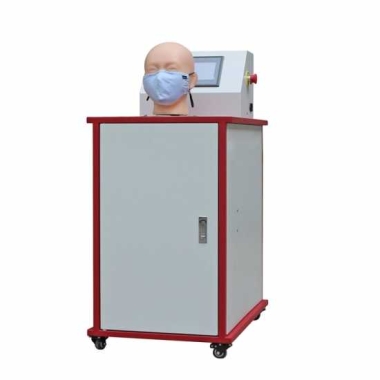
The Mask Respiratory Resistance Tester is a specialized instrument designed to measure the inhalation resistance and exhalation resistance of masks under specified conditions. It is not only crucial for product compliance with regulatory requirements but also directly related to user comfort during wear.
This article provides an in-depth discussion of this topic from multiple perspectives, including basic definitions, principles and standards, instrument structure, testing procedures, data analysis, and application fields, combined with practical examples and relevant standard requirements.
What Is a Mask Respiratory Resistance Tester?
A Mask Respiratory Resistance Tester is a device used to measure the inhalation resistance and exhalation resistance generated when a mask is worn. The instrument creates a controlled airflow that passes through a mask mounted on a standardized headform, then measures the pressure difference across the mask to quantify its respiratory resistance performance.
It is important to note that respiratory resistance differs from filtration efficiency. Filtration efficiency reflects the mask’s ability to block particle penetration, whereas respiratory resistance measures the airflow resistance encountered during breathing. A higher resistance value indicates greater difficulty in breathing through the mask. Excessive respiratory resistance can cause discomfort or breathing difficulty, making this parameter critical in mask design and regulatory compliance.
Significance and Influencing Factors of Respiratory Resistance
1. Definition of Respiratory Resistance
Respiratory resistance refers to the resistance encountered by airflow as it passes through mask filter materials, including:
Inhalation resistance, and
Exhalation resistance.
Higher resistance means greater breathing effort, typically reflected by an increased pressure difference across the mask.
Different mask standards in China, Europe, and the United States specify different limits for respiratory resistance, often measured at a fixed airflow rate such as 85 L/min. Lower resistance values generally provide a more comfortable wearing experience, especially during prolonged use.
2. Factors Affecting Respiratory Resistance
Respiratory resistance is influenced by multiple factors, including:
Filter material thickness and fiber density: Denser materials generally provide higher filtration efficiency but also increase airflow resistance.
Mask structure: Cup-shaped and flat-fold masks exhibit different resistance characteristics.
Fit and sealing with the face or headform: Poor fit may alter airflow patterns and affect test results.
There is typically a trade-off between filtration efficiency and respiratory resistance—higher filtration performance often leads to higher breathing resistance. Therefore, mask design must balance protection and comfort.
Relevant Standards
Mask respiratory resistance testing must comply with national or international standards that define testing conditions, airflow rates, and acceptable resistance limits.
1. Chinese Standards
GB 2626-2006/2019: Respiratory protective devices—filtering half masks for protection against particles, specifying inhalation and exhalation resistance limits.
GB/T 32610-2016: Technical specification for daily protective masks, defining test methods and acceptance criteria for respiratory resistance.
GB 19083-2010 and YY 0469-2011: Standards for medical protective masks and surgical masks, also specifying resistance limits.
Most of these standards require testing at a constant airflow rate, typically 85 ± 1 L/min.
2. International Standards
EN 149 (Europe): Specifies respiratory resistance requirements for filtering facepiece respirators.
NIOSH 42 CFR Part 84 (USA): Defines performance requirements for respirators, including breathing resistance limits.
Other international standards such as ASTM may also be referenced depending on application markets.
Despite regional differences, the fundamental goal remains the same: ensuring that respiratory resistance does not exceed prescribed limits under specified airflow conditions.
Instrument Structure and Working Principle
1. Basic Components
A typical Mask Respiratory Resistance Tester consists of:
Standard headform: Used to mount the mask and simulate real wearing conditions.
Air supply system: Typically a vacuum pump or air compressor generating stable airflow.
Flow control and measurement system: Controls and monitors airflow through the mask.
Pressure sensors and differential manometer: Measure pressure difference across the mask.
Data acquisition and display system: Records and presents test results in real time.
These components work together to precisely measure inhalation and exhalation resistance under controlled conditions.
2. Working Principle
The core principle is to pass a constant airflow through a mask mounted on a standard headform and measure the resulting pressure difference. The general process includes:
Securely mounting the mask onto the headform.
Setting a specified airflow rate, commonly 85 L/min.
Driving airflow through the mask using a pump.
Measuring the pressure difference across the mask.
This pressure difference—often called Delta P (ΔP)—represents the mask’s respiratory resistance. Higher ΔP values indicate greater resistance and more difficult breathing.
Testing Procedure
The general test workflow includes:
Sample preparation: Prepare mask samples according to standard specifications.
Instrument setup: Initialize the device and set airflow parameters (e.g., 85 L/min).
Testing: Measure both inhalation and exhalation resistance while continuously recording pressure data.
Data analysis: Compare results with standard limits and generate a test report.
Applications
The Mask Respiratory Resistance Tester is widely used in:
Product development: Evaluating how materials and designs affect breathability.
Quality control: Ensuring batch consistency in manufacturing.
Regulatory compliance testing: Supporting certification and market approval.
Third-party testing laboratories: Providing independent verification and test reports.
Development Trends
1. Balancing Protection and Comfort
Improving filtration efficiency often increases respiratory resistance, so ongoing innovation focuses on developing materials and structures that maintain high protection while reducing breathing difficulty.
2. Advancements in Testing Technology
Future testing may move beyond static constant-flow methods toward dynamic breathing simulations, better reflecting real-world wearing conditions. Such developments aim to improve accuracy and relevance in mask performance evaluation.
The Mask Respiratory Resistance Tester is an essential instrument for evaluating mask performance. By measuring inhalation and exhalation resistance under controlled airflow conditions, it provides critical data for product designers, manufacturers, testing agencies, and regulators to assess comfort and compliance.
This article has provided a systematic overview of its definition, principles, standards, structure, testing procedures, applications, and future trends. As testing technologies and regulatory frameworks continue to evolve, respiratory resistance testing will play an increasingly important role in ensuring both safety and comfort in protective equipment.
Previous: Dry microbial penetration resistance tester,ISO 22612
N e x t : What are the methods of flammability testing?
