





Battery impact tester,IEC 62133
2026/01/26
Share:

Background and Significance
Battery Safety Challenges
Batteries—particularly lithium-ion batteries—offer outstanding advantages in energy density and performance, but they also present potential safety risks. Under extreme conditions or abuse scenarios, batteries may experience internal short circuits, thermal runaway, fire, or even explosion, posing serious threats to personnel, equipment, and the environment. Battery impact testing is intended to identify these potential hazards and provide experimental data that support design optimization and the development of effective safety control measures.
Development of International Safety Standards
To standardize lithium battery safety evaluation, multiple international testing standards have been established, including UN 38.3. UL 1642. and IEC 62133. Mechanical abuse testing is a core component of these standards and specifically requires batteries to be subjected to impact forces to simulate accidental collisions during transportation or use. Impact testing enables assessment of mechanical stability and identification of potential safety risks under extreme impact conditions.
Working Principle
Equipment Configuration
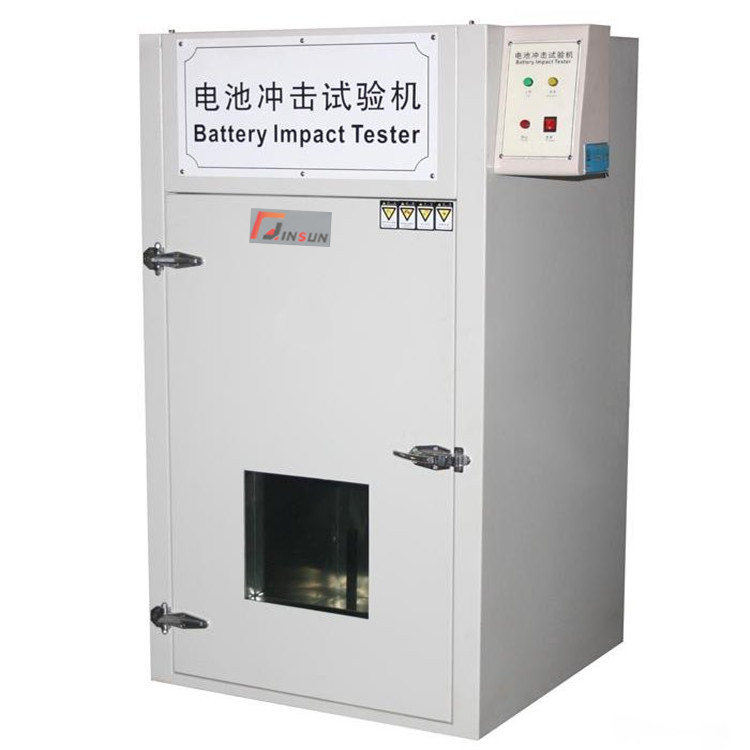
A battery impact tester typically consists of a test platform, a weight-lifting mechanism, an impact release system, positioning fixtures, and a control system. Common configuration features include:
Impact weight (mass): A standardized mass (for example, 9.1 kg ± 0.46 kg) used as the source of impact energy.
Impact rod (cross bar): A steel bar, commonly with a diameter of 15.8 mm, positioned horizontally on top of the battery to transmit the impact force.
Height adjustment mechanism: Allows the weight to be raised to a specified height (such as 610 mm or 1000 mm) before free fall.
Safety protection: Observation windows and protective enclosures are typically provided to ensure safe and controlled testing.
Operating Principle
Before testing, the battery sample is placed at the center of a flat test platform, with a standard steel rod positioned horizontally on its surface. The weight is lifted to the specified height and then released, falling vertically under gravity to strike the rod. The impact force is transferred through the rod to the battery surface, simulating the instantaneous mechanical load that may occur during transportation or accidental drops. By controlling the impact mass, drop height, and system rigidity, different impact severities can be accurately reproduced and evaluated.
Battery Impact Test Standards and Requirements
1. UN 38.3 Standard
UN 38.3. part of the United Nations Recommendations on the Transport of Dangerous Goods, is widely adopted worldwide for battery transportation safety assessment. It requires batteries to pass a series of tests prior to shipment, including altitude simulation, thermal cycling, vibration, impact, and short-circuit testing. The impact test focuses on a battery’s ability to withstand mechanical shocks during transportation, ensuring that it does not ignite, explode, or suffer structural failure under realistic transport conditions.
2. UL 1642 Standard
UL 1642 is a U.S. safety standard for lithium batteries that includes various abuse tests, such as impact testing. The standard clearly defines test conditions, sample preparation, impact height, and the number of impacts. Test results are used to determine whether a battery meets established safety criteria.
3. IEC 62133 Standard
IEC 62133 is an international safety standard issued by the International Electrotechnical Commission for rechargeable batteries. It requires batteries to maintain safety under mechanical stresses such as impact, compression, and thermal abuse. By standardizing test procedures, this standard helps manufacturers improve product design and quality control, enhancing safety for both consumer and industrial batteries.
Typical Test Procedure
Battery impact testing is a precise engineering test that must be conducted strictly according to standardized procedures to ensure accuracy and repeatability. A typical test process includes the following steps:
1. Sample Preparation
Before testing, the battery is charged to the specified state (often fully charged or as defined by the standard). The sample is inspected to ensure there is no visible damage. For different battery formats—cylindrical, prismatic, or pouch—the orientation must comply with standard requirements to ensure consistent impact direction.
2. Impact Rod Positioning
A steel rod of standard diameter is placed across the center of the battery surface and secured firmly, ensuring that it is parallel to the base of the test platform. For batteries with different shapes, the orientation may be adjusted to meet multi-directional test requirements.
3. Weight Lifting and Release
The impact weight is raised to the specified height (for example, 610 ± 25 mm or higher) and released via the control system, allowing it to fall freely and strike the rod. Typically, only one impact is applied per sample, and a new battery is used for each test to avoid interference from prior damage.
4. Post-Impact Observation and Recording
After the impact, the battery is observed for at least six hours to check for fire, explosion, casing rupture, leakage, or other hazardous conditions. Voltage, temperature changes, and other relevant parameters are recorded to evaluate the battery’s safety performance.
Technical Features and Development Trends
With the increasing importance of battery safety testing, modern battery impact testers have seen significant advancements in both technical capability and automation:
1. Automated Control Systems
Modern testers are equipped with digital control systems that precisely manage drop height, impact count, and timing intervals, enabling automated test execution and reducing human error.
2. Customizable Test Parameters
To accommodate different battery types, standards, and R&D requirements, testers support adjustable impact heights and weights, providing greater flexibility and broader applicability.
3. Data Acquisition and Analysis
Many systems integrate data acquisition modules that record impact force, acceleration, acceleration curves, and temperature changes in real time. These quantitative data provide engineers with deeper insight for battery design optimization.
Application Areas
Battery impact testers are widely used across multiple stages of the battery lifecycle:
1. Battery Design and Development
During the design phase, impact testing helps evaluate material selection, structural strength, and packaging methods, providing reliable data for iterative improvement.
2. Quality Control
In manufacturing, impact testing serves as a quality control measure to verify that batteries meet safety requirements, improving product consistency and market credibility.
3. Safety Certification and Regulatory Compliance
Impact testing is a mandatory component of safety certification, transportation inspection, and compliance with global standards such as UN 38.3. Test reports play a critical role in regulatory review and market access.
4. Education and Research
Universities, laboratories, and research institutions use battery impact testers for safety education and research, supporting talent development and advancing fundamental studies in battery technology.
Safety and Future Outlook
Importance of Battery Safety
As batteries become increasingly integrated into daily life, their potential risks have drawn widespread attention. Impact testing is a crucial element of battery safety assessment, strengthening safety management at the source and providing scientific evidence to protect consumers and application environments.
Opportunities from Technological Advancement
With the rapid growth of new energy technologies, battery safety testing continues to evolve. In the future, battery impact testers may be integrated with virtual simulation, big data analysis, and artificial intelligence to achieve more efficient and precise safety evaluation. Meanwhile, testing standards are expected to further evolve to accommodate emerging battery materials and application scenarios.
In summary, the battery impact tester plays a vital role in battery research, manufacturing, and certification. By simulating real-world mechanical impact scenarios, it effectively evaluates battery safety under extreme mechanical abuse conditions, helping engineers improve product reliability and ensuring compliance with strict international safety standards. As battery technology advances and safety requirements continue to rise, battery impact testers will remain an irreplaceable component of the battery safety evaluation system, safeguarding the sustainable development of green energy technologies.
Previous: Horizontal Flammability Tester,ISO 3795
N e x t : Wire Torsion and Winding Tester,ISO 9649:1990
