





Filter Media Tester G508
2026/02/25
Share:

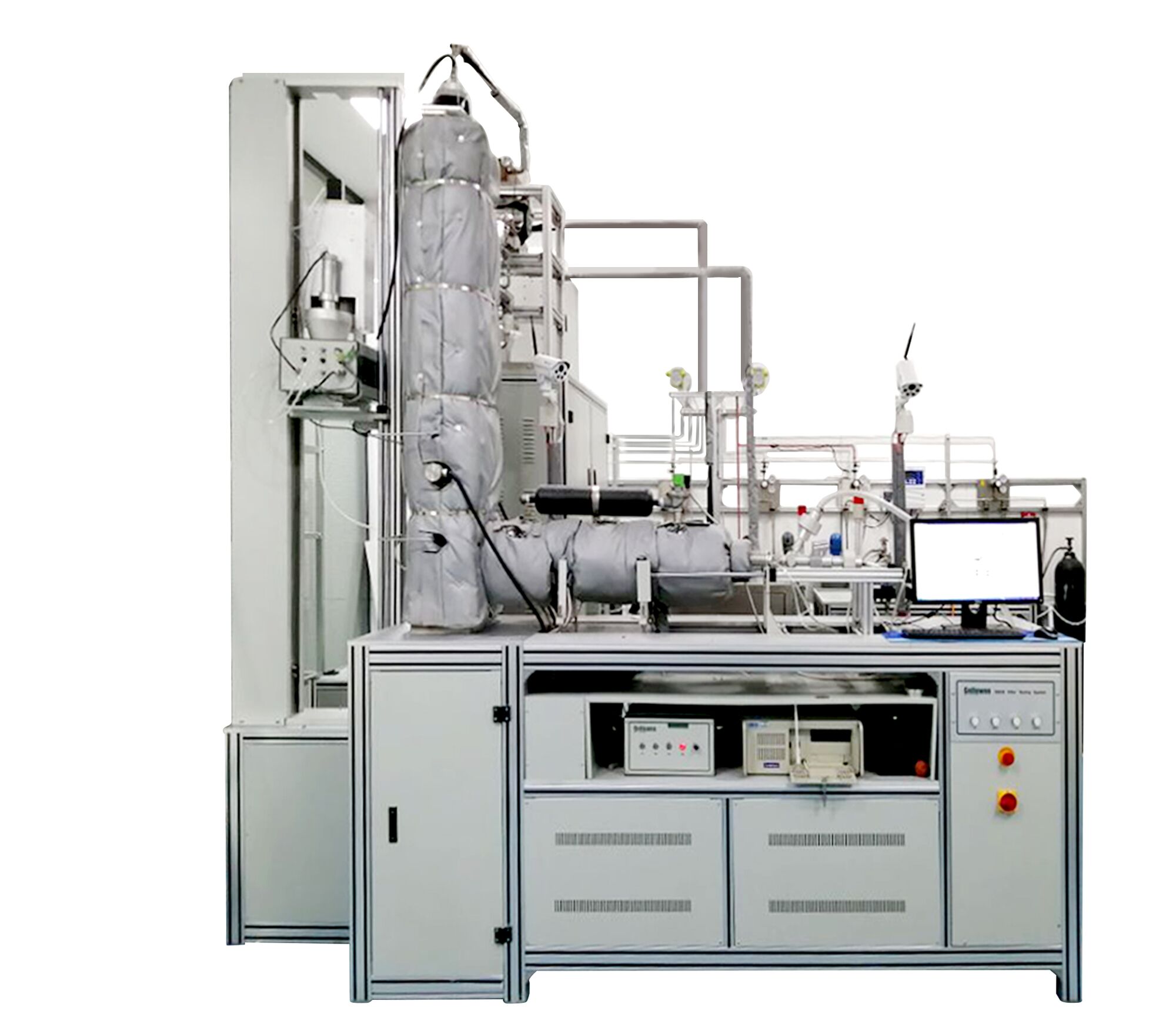
In practical applications, the tester can simulate the real operating conditions of filter materials in baghouse dust collectors, air purifiers, respiratory protective devices, and other equipment. Through standardized testing procedures, it analyzes performance trends and stability over time. Test results typically include pressure drop curves, filtration and cleaning cycles, and the amount of dust penetrating the filter media. These data serve as important references for evaluating filter quality and service life.
Basic Structure and Working Principle
A filter media performance tester generally consists of the following main components:
Aerosol Generation System
This system generates aerosol particles with known concentration and particle size distribution inside the test channel to simulate contaminated air. Common aerosol sources include saline nebulizers (such as NaCl solution) or oil-based aerosol generators.
Sampling and Detection System
A real-time sampling system uses particle counters or light-scattering particle detectors to measure particle concentrations before and after the filter media, enabling calculation of filtration efficiency. High-precision particle counters are critical for accurate measurements.
Pressure and Flow Sensors
During filtration testing, the pressure difference (pressure drop) across the filter media and the airflow rate passing through it must be measured. These parameters reflect the resistance characteristics of the filter. Pressure sensors typically cover ranges from several hundred to thousands of millibars, with accuracy up to 0.3% or higher.
Control and Display System
Modern testers are equipped with touchscreen control interfaces and integrated data acquisition systems. These systems display test parameters in real time and enable programmed control of the experimental process, improving repeatability and measurement accuracy.
Key Performance Indicators
The main performance indicators measured by a filter media tester include:
Filtration Efficiency
This refers to the percentage of particles of a specific size that are captured by the filter media. Higher efficiency indicates better particle interception capability and is a critical parameter for high-performance filtration materials. Efficiency is usually expressed as a percentage, such as 95%, 99.99%, or even higher.
Pressure Drop
Pressure drop represents the pressure loss caused when air passes through the filter media. It reflects airflow resistance characteristics. A lower pressure drop indicates less airflow obstruction, which helps reduce fan energy consumption. The trend of pressure drop over time can also be used to estimate filter service life.
Airflow Resistance
Airflow resistance is the gas resistance calculated per unit area and unit flow velocity. It is one of the standard parameters used to evaluate the air permeability of filter media.
Standards and Industry Specifications
Filter media performance testing is typically conducted in accordance with international and national standards that specify testing conditions, sample preparation, and data presentation methods. Common reference standards include:
ISO 11057 – Air quality – Test method for filtration performance of cleanable filter media
ASTM D6830 – Standard test method for determining pressure drop and performance of filter media
VDI 3926 – Evaluation of cleanable filter media
GB/T 6719 – Technical requirements for baghouse dust collectors
JIS Z 8909-1 – Test methods for dust collection filter media
These standards ensure that test results obtained from different equipment and laboratories are comparable, facilitating consistent interpretation across the industry.
Application Scenarios
Filter media performance testers are widely used in multiple industries:
Environmental and Air Purification
They are used to evaluate the capture efficiency of filter materials for PM2.5. PM10. and other particle sizes in air purification equipment, as well as performance changes after aging.
Dust Removal and Industrial Filtration Systems
They support quality control of filter bags and industrial dust collector materials, helping manufacturers ensure stable operation and regulatory compliance.
Personal Protective Equipment
In the field of masks and respiratory protective equipment, performance testing verifies whether filter materials meet relevant standards (such as medical protective mask standards), ensuring effective user protection.
Research and Material Development
During the development of new filtration materials, testers serve as research tools to assess how material structure, fiber arrangement, thickness, and other parameters affect filtration performance.
Test Methods and Operational Procedures
A typical filter media testing process includes the following steps:
Sample Preparation: The filter media is cut into specified size and shape according to standard requirements. The sample must be flat, wrinkle-free, and securely fixed in the holder.
Condition Setting: Set airflow rate, aerosol concentration, temperature, humidity, and other test parameters.
Pre-Stabilization: Allow the system to reach steady-state conditions, including the aerosol generator and airflow system.
Data Acquisition: Begin recording airflow rate, pressure differential, and particle counts.
Data Analysis: Calculate filtration efficiency, pressure drop curves, and other performance indicators based on collected data, and generate a test report.
Cleaning and Maintenance: After testing, clean the equipment and perform necessary maintenance.
Possible Meaning of “Without Vertical Duct” Design
Although there is no publicly detailed description of a “G508 Without Vertical Duct” product, industry terminology allows for reasonable interpretation:
“Without Vertical Duct” may indicate that the tester adopts an airflow path design different from traditional vertical contaminated air ducts. The internal airflow channel may be horizontal or oriented differently, potentially reducing the influence of gravity-induced particle sedimentation and improving test consistency.
It may also imply a more compact structure with a smaller footprint, making it suitable for laboratory installation.
Such a design could optimize sample clamping, cleaning paths, and flow uniformity adjustments.
This structural modification may address user requirements related to equipment size, sampling direction consistency, and operational convenience. However, specific technical details should ultimately be confirmed based on the actual instrument manual.
In summary, the Filter Media Performance Tester is a precision instrument used to evaluate filtration efficiency and airflow resistance of filter media. It plays a vital role in air purification, industrial dust removal, and respiratory protection material testing. By integrating aerosol generation systems, pressure and flow sensors, and real-time sampling detection, it enables accurate measurement of material performance changes, supporting quality control and research and development. Testing procedures are conducted strictly in accordance with international and national standards to ensure data reliability and comparability. As for the designation “G508 (Without Vertical Duct),” although detailed technical specifications are limited, the name suggests a structural innovation aimed at improving adaptability and equipment integration compared to traditional designs.
Previous: General Ventilation And Air Filter Test System
N e x t : Automated HEPA/ULPA Filter Scanning Test System, EN 1822-4
