





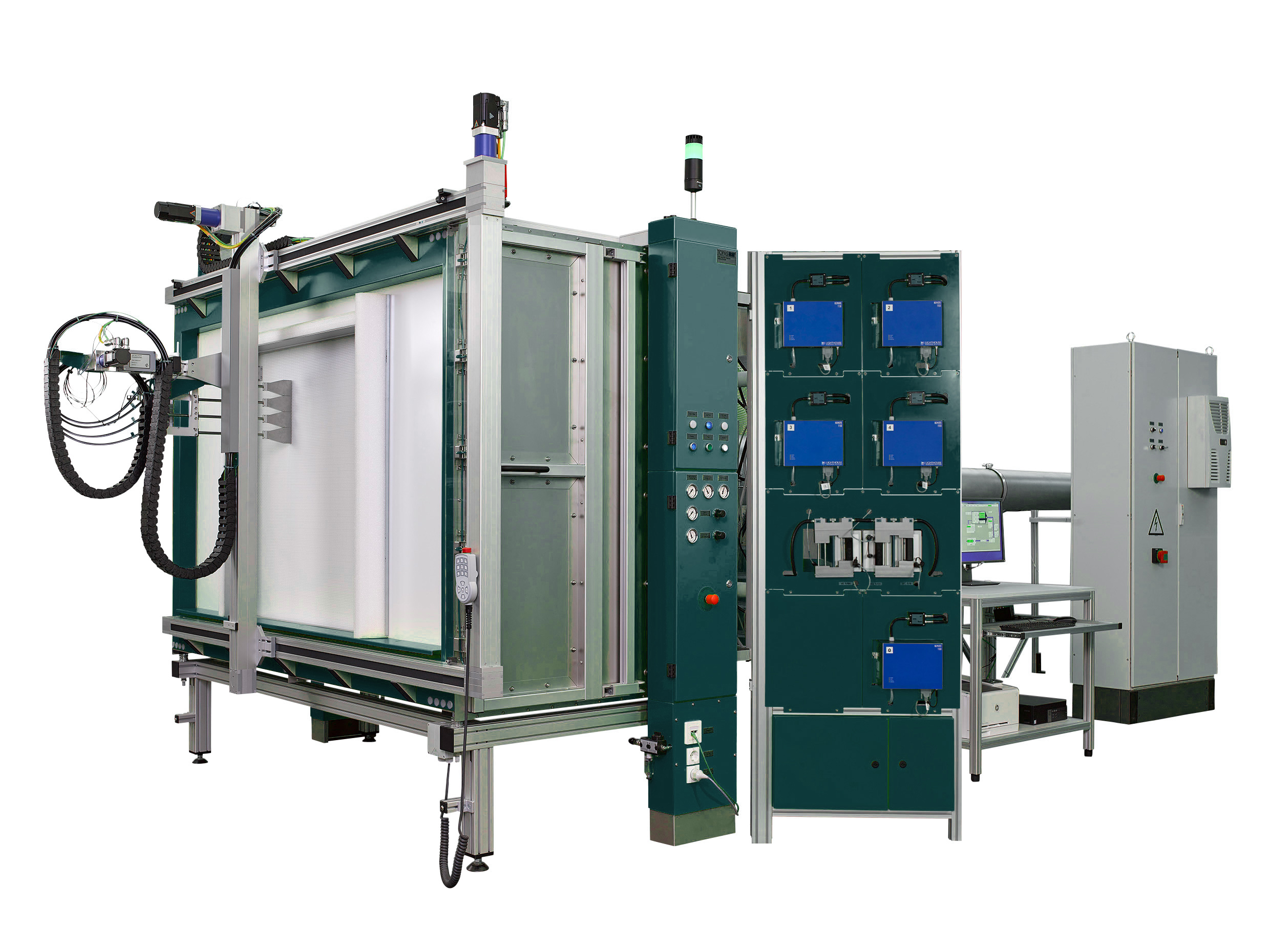
Automated HEPA/ULPA Filter Scanning Test System, EN 1822-4
2026/02/25
Share:

Importance and Background of Filter Testing
HEPA and ULPA filters are widely used in clean environments to capture airborne particles efficiently. In applications such as cleanrooms, hospital operating rooms, laboratories, aerospace manufacturing, and semiconductor chip production, particle control requirements are extremely stringent. Contaminants in these environments typically range from submicron to several micrometers in size. Without proper filtration and monitoring, they can easily lead to product defects or biological safety risks. Therefore, comprehensive performance testing of every high-efficiency filter is a fundamental prerequisite for ensuring reliable system operation.
Since HEPA filters are theoretically required to capture more than 99.95% of particles—and ULPA filters even higher—the standard procedures and equipment used for testing must provide high precision and strong consistency. Otherwise, test results may become heavily dependent on operator skill, reducing reliability and reproducibility. Traditional manual scanning test methods suffer from low efficiency, higher error rates, and strong reliance on manual operation. As a result, automated high-efficiency filter scanning test systems have become an industry trend.
Definition and Core Functions of the Automated Scanning Test System
An Automated HEPA/ULPA Filter Scanning Test System is a technical device designed to perform automated testing of local efficiency, overall efficiency, pressure drop performance, and leak detection in accordance with international standards. The system integrates airflow control, aerosol generation, particle counting detection, automatic scanning mechanisms, data acquisition, analysis, and software control into a unified platform. It enables standardized testing procedures for each filter unit.
The automated system is primarily designed to:
Automatically generate airflow under standard test conditions;
Evenly apply test aerosols across the filter media;
Automatically scan the surface of the filter;
Detect particle penetration at different positions of the filter media in real time;
Generate inspection reports, including efficiency curves, leak location maps, and statistical data;
Integrate with databases to store historical records, produce standardized reports, and enable product traceability.
Such systems significantly improve testing efficiency while eliminating much of the manual error associated with traditional methods. This enhances repeatability and traceability, making them suitable for research and development, in-line production testing, and acceptance verification.
Standards Governing Automated Scanning Test Systems
Automated HEPA/ULPA Filter Scanning Test Systems typically operate in accordance with the following international and regional standards:
EN 1822 (European Standard): This series defines the classification, test methods, inspection procedures, and acceptance criteria for high-efficiency air filters. In particular, EN 1822-4 specifies scanning methods for detecting local leaks, while EN 1822-5 specifies overall efficiency testing methods.
ISO 29463 (International Standard): This series internationalizes the EN 1822 standards, covering filter efficiency testing, scan leak detection, and overall efficiency evaluation.
GB/T 6165: A Chinese national standard specifying performance test methods for high-efficiency air filters, including efficiency and resistance testing.
IEST-RP-CC007: An industry-recommended practice providing guidance for factory HEPA/ULPA particle counter efficiency testing, including equipment requirements, aerosol characteristics, and sampling procedures.
These standards provide unified benchmarks for filter manufacturing and testing, facilitating technical communication, product comparison, and certification across regions.
Components of the Automated Scanning Test System
An Automated HEPA/ULPA Filter Scanning Test System consists of several key modules that work together to ensure precise testing.
Air Supply System
The system includes a controllable airflow source, such as a fan or compressed air supply, to generate stable and adjustable test flow rates. This simulates real operating airflow conditions. Flow meters monitor and control volumetric flow rates to ensure compliance with standard requirements.
Aerosol Generation and Distribution System
HEPA/ULPA filter testing requires challenge aerosols with specific particle size distributions, such as DEHS or PSL (polystyrene latex spheres). The aerosol generator introduces standardized particles into the test airflow, creating a controlled upstream concentration.
Filter Mounting and Scanning Mechanism
The filter sample is secured within a dedicated frame or test chamber. An automated scanning system—typically equipped with linear drive mechanisms or robotic arms—moves the sampling probe across the filter surface to achieve full coverage detection.
Particle Counting Detection System
On the downstream side, a particle counter—commonly based on light scattering or condensation particle counting—samples and records the size and quantity of particles that penetrate the filter. Some systems are equipped with multiple channels or probes to improve efficiency and coverage.
Control and Data Analysis Software
The automated system integrates PLC (Programmable Logic Controller) hardware with PC-based software to complete parameter configuration, scan path planning, data acquisition, statistical analysis, and report generation. The system typically provides a user-friendly interface, real-time graphical display, and report export functions.
Detailed Testing Procedure
A standard testing procedure using an Automated HEPA/ULPA Filter Scanning Test System typically includes the following steps:
Filter Installation and Preparation
Technicians install the filter into a designated adapter or fixture, ensuring flatness and airtight sealing to prevent artificial leakage. Test conditions such as target airflow, temperature, and humidity are configured.
Setting Aerosol and Airflow Conditions
The system activates the airflow supply and aerosol generation modules to establish a stable upstream aerosol concentration. Flow meters and pressure sensors continuously monitor system conditions.
Automatic Scanning and Data Acquisition
Once initiated, the scanning mechanism moves the probe along a predefined path, covering the entire filter surface. The detection system continuously collects downstream particle data and compares it with upstream concentrations to determine efficiency and identify leaks.
Data Analysis and Report Generation
The software processes collected data and generates comprehensive reports, including spatial distribution maps of filter efficiency, leak location diagrams, overall efficiency metrics, and pressure drop values. Report formats comply with standards such as EN 1822 or ISO 29463 and support export and printing.
Technical Advantages of Automated Test Systems
Compared with manual inspection methods, automated HEPA/ULPA filter scanning systems offer significant advantages:
High Efficiency
Automated scanning eliminates the need for manual probe movement, significantly reducing testing time per filter and increasing production throughput.
High Consistency and Accuracy
Standardized algorithms and mechanical control reduce human error, improving repeatability and reliability of test results.
Data Management and Traceability
Automatically generated reports, database storage, and historical record functions facilitate traceability and quality analysis, particularly in batch production environments.
Visualization and Intelligent Analysis
Systems typically feature real-time graphical interfaces displaying scan progress and test curves. Some support three-dimensional visualization and leak localization maps, improving result interpretation and process optimization.
Application Fields and Development Trends
Automated scanning test systems are widely used in:
Cleanrooms and Microelectronics Manufacturing: Verifying the performance of clean filtration components to ensure compliance with ISO and cleanliness grade requirements.
Pharmaceutical and Biosafety Applications: Ensuring HEPA filters meet biosafety interface requirements and prevent contamination spread.
Air Purification Equipment Quality Control: Integrating testing equipment into production lines for in-line verification of HEPA modules.
Research and Material Development: Supporting performance validation and evaluation of advanced filtration materials.
Future development trends include higher levels of automation, improved testing precision, expanded applicability, and enhanced data analytics capabilities. Emerging technologies such as artificial intelligence may assist in leak pattern recognition and further enhance automated production-line testing capabilities.
In conclusion, the Automated HEPA/ULPA Filter Scanning Test System represents a significant advancement in high-efficiency filter testing technology. Through highly automated data acquisition and processing workflows, it improves testing efficiency, accuracy, and mechanical consistency. By integrating aerosol generation technology, particle counting detection, mechanical scanning mechanisms, and intelligent analysis software, the system ensures that high-efficiency filters meet stringent international standards. It is not only a critical quality control tool but also an essential technological support driving the industry toward higher cleanliness levels and stricter safety standards.
Previous: Filter Media Tester G508
N e x t : What are the methods of filter integrity test?
