





What is the flooring radiant panel test?
2026/05/07
Share:

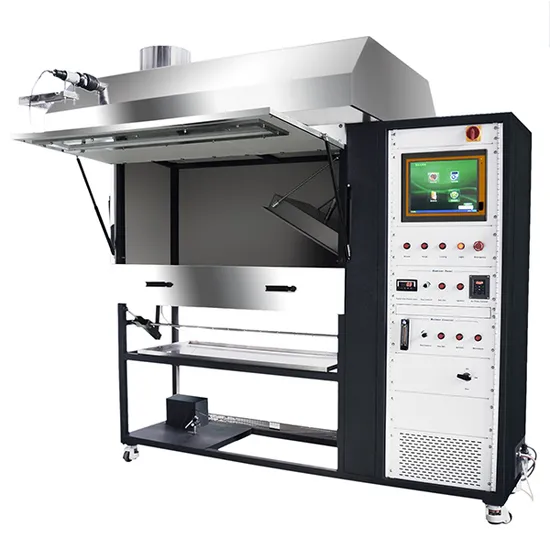
Functions and Applications of the Flooring Radiant Panel Test Apparatus
The Flooring Radiant Panel Test Apparatus is a specialized scientific instrument used to evaluate the combustion performance of flooring materials under controlled radiant heat and flame exposure conditions. It is widely applied in the fields of building materials, fire protection, and safety standards testing.
Main Functions
Determination of Critical Radiant Flux
Measures the minimum energy level at which a flooring material can sustain combustion under radiant heat exposure.
Simulation of Real Fire Scenarios
Reproduces the reaction of flooring materials under actual fire conditions through the combined action of a radiant heat panel and an ignition flame.
Measurement of Smoke Density and Light Transmittance
Evaluates the concentration of smoke generated during combustion and its impact on visibility.
Automatic Data Recording and Analysis
Automatically generates curves and records for parameters such as heat flux, temperature, light transmittance, and smoke density over time.
Core Applications
Compliance with International Testing Standards
Suitable for a variety of internationally recognized flooring fire performance standards, including International Organization for Standardization (ISO), ASTM International (ASTM), and National Fire Protection Association (NFPA).
Material Classification and Fire Rating
Provides a basis for fire safety classification of flooring materials such as carpets, rubber flooring, vinyl flooring, cork flooring, and wooden flooring.
Research, Development, and Quality Control
Used for new material development, product improvement, and pre-delivery verification of fire safety performance.
Material Selection for High-Risk Facilities
Supplies reliable fire performance data for buildings with high fire protection requirements, including airports, subway systems, hospitals, and other public facilities.
Applicable Industries for the Flooring Radiant Panel Test Apparatus
The Flooring Radiant Panel Test Apparatus is a specialized instrument used to evaluate the combustion performance of flooring materials under controlled radiant heat conditions. The equipment mainly performs testing in accordance with international standards such as International Organization for Standardization (ISO), ASTM International (ASTM), and National Fire Protection Association (NFPA), and is used to determine the Critical Radiant Flux of materials for fire safety classification.
Applicable Industries
Construction and Building Materials Industry
Used for testing the combustion characteristics of flooring materials such as ceramic floor tiles, wooden flooring, PVC flooring, rubber flooring, and carpets to ensure compliance with building fire protection regulations.
Fire Protection and Safety Certification Industry
Provides testing data for fire product certification and fire resistance classification of building materials, including flame-retardant rating evaluations such as the Chinese B1 fire protection standard.
Quality Inspection and Research Institutions
Widely used by third-party testing laboratories, universities, and research institutes for combustion performance research and verification of compliance with relevant standards.
Manufacturing and Quality Control Industry
Flooring and carpet manufacturers use the equipment for product development, performance optimization, and factory quality control inspections.
New Energy and Automotive Component Testing (Indirect Applications)
Certain testing principles of the apparatus can also be applied to evaluate the thermal response characteristics of vehicle interior flooring materials or materials surrounding battery packs, typically in combination with other environmental simulation systems.
Technical Features of the Flooring Radiant Panel Test Apparatus
The Flooring Radiant Panel Test Apparatus is a specialized instrument used to evaluate the combustion performance of flooring materials under controlled radiant heat and flame conditions. It is widely applied in fire safety testing for building materials and flooring products. Its main technical features are as follows:
Test Chamber Structure
The apparatus adopts a stainless steel front-opening door design, making cleaning and specimen replacement convenient.
The inner wall of the chamber is constructed from calcium silicate board, providing excellent high-temperature resistance and corrosion resistance.
Radiant Heat Source
Equipped with a 300 mm × 450 mm porous ceramic radiant panel.
The radiant panel is installed at a 30° inclination angle to provide a stable and controllable heat flux environment.
Combustion System
Uses a T-shaped porous burner to apply the pilot flame.
Flame height is adjustable through a needle valve.
Propane flow is precisely controlled by a mass flow controller.
Optical Measurement System
The light source is an incandescent lamp with a color temperature of 2900 ± 100 K.
The receiver adopts a silicon photocell detector.
A shutter system is included for 0% and 100% calibration.
The system can automatically calculate and generate smoke density curves and light transmittance curves.
Standard Specimen and Auxiliary Components
The standard backing board is an uncoated calcium silicate board with:
Thickness: 20 ± 1 mm
Density: 850 ± 100 kg/m³
Dimensions: 1050 mm × 250 mm
An auxiliary ignition burner is positioned beneath the specimen in accordance with standard ignition location requirements.
Control System and Software
Equipped with smoke density DAQ testing software.
Real-time display of parameters such as:
Radiant heat flux
Smoke density
Light transmittance
Supports one-button automatic calibration and a five-level calibration system to improve testing repeatability and accuracy.
Gas and Airflow System
Uses imported Japanese flow controllers for precise propane flow regulation.
Equipped with an air blower and Venturi mixer to supply mixed combustion gas.
Equipment Specifications
Test unit dimensions: approximately 1.4 m (L) × 1.0 m (W) × 2.2 m (H)
Control cabinet dimensions: 600 mm × 750 mm × 1600 mm
Weight: approximately 350 kg
Power supply: AC220V ±10%, 50 Hz
Main Applications
The apparatus is primarily used to test the Critical Radiant Flux of flooring materials such as:
Carpets
Wooden flooring
Rubber flooring
Plastic flooring
Cork flooring
Coated flooring materials
The test results are used to evaluate flame spread characteristics and fire propagation behavior under fire conditions.
Operating Procedure of the Flooring Radiant Panel Test Apparatus
The Flooring Radiant Panel Test Apparatus is used to evaluate the combustion performance and flame spread characteristics of flooring materials under controlled radiant heat conditions. Testing is mainly conducted in accordance with international standards such as International Organization for Standardization (ISO), ASTM International (ASTM), and National Fire Protection Association (NFPA).
Pre-Test Preparation
Equipment Calibration and Inspection
Confirm that the radiant heat source (typically a 300 mm × 450 mm porous ceramic radiant panel inclined at 30°) is operating properly.
Calibrate the heat flux meter and thermocouples (K-type, stainless steel sheathed).
Use a standard calibration board for system verification:
Thickness: 20 ± 1 mm
Density: 850 ± 100 kg/m³
Dimensions: 1050 mm × 250 mm
Material: uncoated calcium silicate board
Environmental Setup
The exhaust airflow speed should be controlled at (2.5 ± 0.2) m/s.
Exhaust capacity should be maintained at (39–85) m³/min under 25°C conditions.
The testing chamber temperature must remain stable.
Preheating for approximately 1 hour is usually required to ensure the radiant panel blackbody temperature reaches the specified range (typically 480–530°C).
Specimen Installation
Mount the flooring specimen (such as carpet, wooden flooring, or resilient flooring) onto the stainless steel specimen holder with dimensions of 1140 mm × 320 mm.
For carpet specimens, the pile surface should be brushed to restore its natural condition.
Rigid materials should be secured using steel clamping strips.
Test Operation Procedure
Preheating Stage
Close the test chamber door.
Ignite the radiant panel and preheat the system for approximately 1 hour.
Begin testing after the blackbody temperature and chamber temperature become stable.
Ignition and Exposure
Move the specimen into the test chamber.
Close the chamber door within 3 seconds and start the timer.
Ignite the specimen using an igniter with a diameter of 0.7 mm positioned at least 50 mm from the specimen surface.
After the flame contacts the specimen for 5 minutes, move the igniter to a distance of 50 mm and extinguish it.
Data Acquisition
Continuously record:
Flame spread distance
Flame spread time
Critical Radiant Flux (CRF, unit: kW/m²)
The optical measurement system automatically calculates the light transmittance curve for evaluating smoke generation behavior.
Termination Conditions
If the flame does not spread beyond the specified distance (typically 1.5 meters) within 5 minutes, the test is terminated and classified as “low flame spread.”
Otherwise, record the maximum flame spread distance and the corresponding time.
Post-Test Procedures
Remove the specimen and specimen holder.
Clean components such as thermocouples and the radiant panel.
Verify equipment status before the next test, including:
Temperature stability
Airflow speed
Calibration board readings
Generate a final test report containing:
Critical Radiant Flux (CRF)
Flame spread behavior
Smoke generation characteristics
Material fire classification results.
Importance of the Flooring Radiant Panel Test Apparatus
The Flooring Radiant Panel Test Apparatus plays a vital role in the evaluation of fire performance for building materials. Its importance is mainly reflected in the following aspects:
Simulation of Real Fire Scenarios
The apparatus uses a radiant heat source to simulate the thermal exposure conditions experienced by flooring materials during actual fires. This allows a more realistic evaluation of flame spread behavior under real fire conditions, especially for flooring materials used in high-risk areas such as shopping malls, hospitals, subway stations, airports, and other public facilities.
Compensation for the Limitations of Small Flame Tests
Traditional small ignition source tests (such as cigarette ignition or small flame ignition tests) can evaluate the ease of ignition of materials, but they cannot accurately predict flame spread behavior over larger surface areas.
Radiant panel testing has shown that some materials may perform well in small flame tests but still exhibit rapid flame propagation under radiant heat conditions. Therefore, the Flooring Radiant Panel Test Apparatus provides a more comprehensive and reliable assessment of fire performance.
Compliance with International Standards
The equipment is designed in accordance with internationally recognized standards such as:
International Organization for Standardization (ISO)
ASTM International (ASTM)
National Fire Protection Association (NFPA)
It is widely used for determining the Critical Radiant Flux (CRF) of flooring materials and serves as an essential testing instrument for product export certification and construction project acceptance inspections.
Supporting Material Selection for High-Risk Facilities
The test results clearly distinguish the flame spread characteristics of different materials under radiant heat conditions. These data provide important support for:
Building code development
Fire protection engineering design
Material safety classification
The apparatus is particularly recommended for evaluating flooring materials used in densely populated or evacuation-sensitive environments.
High Repeatability and Standardization
The equipment incorporates:
Standardized radiant panels
Calibrated heat flux meters
Automatic optical measurement systems
Precision temperature control systems
These features ensure consistent testing conditions and significantly improve the comparability, repeatability, and reliability of test results.
In summary, the Flooring Radiant Panel Test Apparatus is not only a core experimental tool for evaluating and researching the fire performance of various flooring materials, but also an indispensable instrument for ensuring building fire safety and maintaining compliance with domestic and international fire safety regulations and standards.We sincerely welcome experts, partners, and interested professionals to leave a message or contact us directly at any time. We would be pleased to provide you with more comprehensive technical documentation, application cases, and professional support services.
Previous: What does it mean to be a crash test dummy?
N e x t : What is the Comprehensive Engine Oil Filter Test Bench?
