





What is a shoe tester?
2026/05/08
Share:

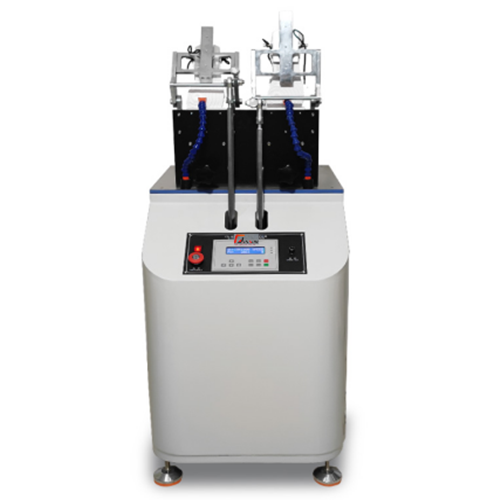
Functions and Applications of the Shoes Bending Tester
The Shoes Bending Tester is a specialized testing device used to evaluate the flexing resistance and durability of finished footwear under simulated walking conditions. It is widely applied in footwear research and development, quality control, and compliance verification with industry standards.
Main Functions
Simulating forefoot bending during walking:
Through a mechanical transmission system, the tester repeatedly bends shoes at preset angles and frequencies, accurately reproducing the biomechanical movement experienced during actual wear.
Multi-station batch testing:
Most machines are equipped with four testing stations, allowing multiple pairs of shoes to be tested simultaneously and significantly improving testing efficiency.
Flexible parameter adjustment:
The equipment supports adjustable bending angles (such as 0°–90°) and bending speeds (such as 0–150 cycles/minute), making it suitable for different shoe types and testing standards.
Automatic counting and monitoring:
A 6-digit LCD electronic counter and HMI control system are commonly included, enabling preset cycle counts (such as 50.000 cycles) and real-time monitoring of the testing process.
Safety protection design:
Most models feature a transparent protective cover with an electronic interlock system. The machine automatically stops when the cover is opened, ensuring operator safety.
Water penetration detection function (for certain models):
Some versions, such as shoe waterproof flexing testers, can perform bending tests in water and automatically detect leakage, making them suitable for evaluating waterproof performance.
Core Applications
Evaluating sole fatigue resistance and service life:
By simulating tens of thousands of flexing cycles equivalent to several months or even a year of wear, the tester helps determine whether the outsole will crack or whether the upper and sole will separate.
Verifying the strength of uppers, sole materials, and bonding areas:
The machine evaluates the reliability of welts, adhesive layers, stitching, and other structural components under repeated stress conditions.
Compliance with international and industry standards:
Mainstream equipment supports standards such as ISO, SATRA, HG/T, GB/T, and QB/T.
Supporting testing of various footwear types:
Suitable for sports shoes, work shoes, children’s shoes, women’s shoes, men’s shoes, boots, and more, covering different shoe sizes ranging from U.S. children’s size 12 to adult size 13.
Assisting R&D and quality improvement:
Provides valuable testing data for material selection and structural design optimization, helping manufacturers improve footwear durability and overall product quality.
Industries Applicable to the Shoes Bending Tester
The Shoes Bending Tester is mainly used to evaluate the durability, flex fatigue resistance, and structural integrity of footwear and shoe materials under repeated bending conditions. The industries where this equipment is widely applied include:
Footwear Manufacturing Industry
Used for flexing resistance tests on finished footwear such as sports shoes, casual shoes, safety shoes, children’s shoes, and work shoes, ensuring products comply with domestic and international standards such as GB/T, ISO, and SATRA.
Footwear Material Research and Production
Applied to performance evaluation of outsole and upper materials including rubber, EVA, PU, leather, and textile composite materials. The tester helps assess flex fatigue resistance, cracking, and sole separation performance.
Third-Party Testing and Certification Institutions
Provides authoritative testing services in accordance with ISO, EN, ASTM, GB, and other standards for product certification, trade arbitration, and technical quality supervision.
Safety and Protective Equipment Industry
Used for evaluating the flexing performance of safety shoes and protective boots to ensure compliance with mandatory standards such as EN and GB.
Research Institutes and University Laboratories
Supports durability studies of new materials and manufacturing technologies under dynamic flexing conditions, contributing to innovation in footwear engineering and material science.
By simulating the repeated bending actions experienced during actual wear, the Shoes Bending Tester quantitatively measures the flex resistance of materials and finished products, making it an essential tool for footwear quality control and product development.
Technical Features of the Shoes Bending Tester
The Shoes Bending Tester is a key testing instrument used to evaluate the durability and material performance of finished footwear under simulated walking conditions. Its main technical features are as follows:
Core Technical Features
Adjustable bending angle:
Supports angle adjustment within a range of 0°–90°, while some models support a maximum bending angle of 45°, meeting the requirements of standards such as SATRA and ISO.
Adjustable flexing frequency:
The testing speed is typically adjustable from 0–150 cycles per minute (cpm), allowing different testing conditions for various footwear types.
Multi-station design:
Most machines are equipped with four independent testing stations, enabling multiple pairs of shoes to be tested simultaneously and greatly improving testing efficiency.
High-precision control system:
Adopts an HMI touchscreen or LED integrated control panel, supporting parameter setting, real-time operation monitoring, and data recording.
Safety protection mechanism:
Equipped with a transparent protective cover featuring an electronic interlock system. The machine automatically stops when the cover is opened, ensuring operator safety.
Strong standards compatibility:
Mainstream models comply with multiple international and national standards such as ISO, SATRA, and HG/T, ensuring internationally recognized and comparable test data.
Durable materials and structure:
Key components are commonly made of stainless steel or corrosion-resistant aluminum materials, ensuring long-term stable operation and equipment durability.
Electronic counting function:
Features a 6-digit LCD counter with a counting range up to 0–999.999 cycles, enabling accurate recording of test progress and cycle numbers.
Shoes Bending Tester Usage Steps
When using a Shoes Bending Tester, the appropriate equipment should be selected according to the testing object (finished shoes or sole materials) and the applicable testing standard. Standard operating procedures should also be strictly followed.
Types of Applicable Equipment
Finished Shoe Flexing Tester
Used for testing complete footwear. It simulates the forefoot bending action during walking to evaluate properties such as upper-to-sole bonding strength and outsole fatigue resistance.
Sole Flexing Resistance Tester
Used for testing outsole materials such as rubber or PU. Test specimens usually require pre-cut notches before testing to evaluate crack resistance under repeated flexing.
Operating Procedure (Taking Finished Shoe Testing as an Example)
Specimen Preparation
Finished shoes should be conditioned for at least 4 hours in an environment of (23±2)°C.
Clean the outsole thoroughly to ensure there is no dust or foreign matter.
Specimen Installation
Fix the shoe securely onto the testing station, ensuring that the natural flexing line aligns with the machine’s bending axis.
Use appropriately sized clamps or fixtures to secure the toe and heel sections and prevent specimen displacement during testing.
Parameter Setting
Bending Angle
Common settings include 30°, 45°, 50°, 60°, and 90°. The selected angle should comply with the relevant testing standard or product requirement.
Testing Speed
The standard testing speed is typically:
100±5 cpm (cycles per minute), or
140±10 cpm,
depending on the applicable standard.
Number of Cycles
The test is generally set to 50.000 cycles to simulate long-term wearing conditions.
Start the Test
Close the safety cover before starting the machine.
The tester will begin continuous flexing automatically.
During the test, periodic inspections may be carried out (for example, every 500 cycles) to ensure the specimen remains properly fixed without shifting.
Result Evaluation
After the preset number of cycles is completed, the machine stops automatically.
Inspect the shoe for damage such as outsole cracking, sole separation, or upper failure.
Typical acceptance criteria include:
No visible cracks,
No sole separation,
Or crack lengths remaining within allowable limits specified by the standard.
Key Precautions
Safety Protection
The equipment should be fitted with an electronic interlock safety cover. Opening the cover should automatically stop the machine to protect the operator.
Standards Compatibility
Ensure the tester complies with the standards required by the target market, such as ISO, SATRA, GB/T, or ASTM standards.
Environmental Control
Certain tests must be conducted under dry or wet conditions. Wet flexing tests may require a water reservoir system to keep the outsole continuously moist during testing.
Importance of the Shoes Bending Tester
The importance of the Shoes Bending Tester is mainly reflected in its comprehensive evaluation of footwear durability, comfort, safety, and compliance.
1. Ensuring Product Durability and Service Life
Simulating real wearing conditions
By repeatedly flexing finished shoes or outsole materials, the tester simulates the bending movement experienced in the forefoot area during walking or running. This helps predict potential risks such as cracking, sole separation, or material fatigue after tens of thousands of flexing cycles.
Quantifying flex resistance performance
The tester can measure key indicators such as crack length, degree of adhesive failure, and crack propagation speed, ensuring that outsole materials—especially rubber and EVA—maintain structural integrity during long-term use.
2. Improving Wearing Comfort and Athletic Performance
Matching foot biomechanics
Excessively high or low outsole flexibility can negatively affect walking gait. Through flexing tests, manufacturers can optimize outsole stiffness to better coordinate with the natural movement of the foot arch, reducing muscle fatigue and joint stress.
Supporting customized footwear design
The testing data provides valuable support for designing footwear for special foot conditions such as high arches or flat feet, contributing to the development of functional shoes including athletic footwear and rehabilitation shoes.
3. Ensuring Product Safety and Market Compliance
Compliance with international and domestic standards
Mainstream testers are compatible with authoritative standards such as SATRA, ISO, GB/T, and EN. They are essential testing tools for obtaining third-party certifications such as SGS and for entering international markets including Europe and North America.
Reducing quality risks
The equipment helps identify manufacturing defects such as adhesive failure or uneven vulcanization before mass production, minimizing after-sales disputes and product recall risks.
4. Supporting R&D Innovation and Market Competitiveness
Driving material and structural optimization
The tester provides durability validation for advanced polymer materials and innovative midsole structures such as carbon plates and air cushioning systems, accelerating the development of high-performance footwear.
Enhancing brand credibility
Authoritative flexing test reports serve as important references for consumers purchasing professional footwear such as safety shoes and athletic running shoes.
In summary, the Shoes Bending Tester is not only a critical quality inspection and control instrument, but also a vital bridge connecting biomechanics research, advanced material science, and real consumer experience. It plays an indispensable role in evaluating footwear durability, comfort, and safety, thereby improving product competitiveness and providing reliable protection for users.We sincerely welcome you to leave a message or contact us directly for more comprehensive technical information and customized testing solutions.
Previous: What is the down proof test method?
N e x t : What is a Bus Seat Tester?
