





What is the cantilever test for stiffness?
2026/05/15
Share:

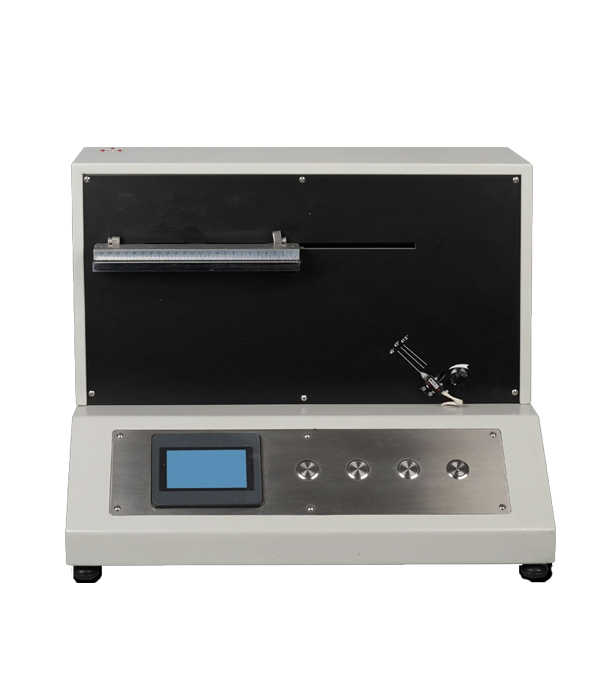
Functions of the Cantilever Fabric Stiffness Tester
The Cantilever Fabric Stiffness Tester is a specialized instrument used to determine the flexural properties of textile materials. Its core function is to measure the stiffness of fabrics under bending deformation based on the cantilever method principle.
Main Functions
Measurement of Bending Length (C):
Measures the length of fabric extension when the free end of the sample sags to a specified angle. A higher value indicates greater fabric stiffness.
Calculation of Flexural Rigidity:
Evaluates the material’s resistance to bending deformation, reflecting its overall stiffness performance.
Determination of Flexural Modulus:
Measures the rigidity characteristics of the material within the elastic deformation range.
Multi-Angle Adjustment Support:
The test angle can be set to 41°30′, 43°, or 45°, allowing adaptation to different material properties and testing requirements.
Non-Contact Measurement:
Uses an infrared beam to form an “invisible inclined plane,” avoiding mechanical friction interference and improving measurement accuracy.
Applicable Industries of the Cantilever Fabric Stiffness Tester
The Cantilever Fabric Stiffness Tester is a specialized instrument used to evaluate the resistance of flexible materials to bending deformation. Its core principle is based on the cantilever beam method, which quantifies fabric stiffness (i.e., flexural rigidity or bending modulus) by measuring the bending length or required moment at a specific angle. Its main application areas include:
Textile Industry:
Suitable for stiffness testing of woven fabrics, knitted fabrics, nonwoven fabrics, and coated textiles made from cotton, wool, silk, linen, and synthetic fibers. It is used to evaluate fabric crispness, drape, and softness.
Paper and Packaging Materials:
Used for measuring the stiffness of paper, cardboard, and carton materials to ensure formability and load-bearing performance in printing and packaging applications.
Leather and Film Materials:
Applicable for testing the bending performance of flexible sheet materials such as leather, plastic films, and food packaging films.
Nonwoven Material Research:
Advanced cantilever testing systems are widely used in the mechanical analysis of nonwoven fabrics, especially for studying “snap” behavior and elastic recovery that are difficult to measure using traditional methods.
Composite Materials and Industrial Fabrics:
Used for stiffness evaluation of special functional materials such as air filtration fabrics, protective clothing textiles, and geotextiles.
Cantilever Fabric Stiffness Tester Operation Process
The operation of a Cantilever Fabric Stiffness Tester generally involves a series of standardized steps to ensure accuracy and repeatability. The following is a basic operating procedure applicable to most such testing equipment:
1. Preparation
Check the equipment: Ensure the tester is in proper working condition, with all components correctly installed and securely fixed.
Clean the fabric: Make sure the fabric surface is clean and free from dust or impurities to avoid affecting test results.
Prepare the sample: Prepare fabric specimens according to test requirements, ensuring that the size and shape meet the standard specifications.
2. Sample Installation
Place the fabric: Lay the fabric flat on the supporting platform of the tester, ensuring the edges are aligned and the sample is not twisted.
Fix the sample: Secure the fabric using clamps or fixing devices to prevent movement or deformation during testing.
3. Test Parameter Setup
Select test mode: Choose the appropriate testing mode according to requirements (e.g., bending, stiffness measurement, etc.).
Set parameters: Input or select test parameters such as loading rate, maximum load, and test duration.
Calibrate the equipment: Perform calibration if required to ensure measurement accuracy.
4. Start Testing
Initiate the test: Start the test program, allowing the device to apply load to the fabric.
Monitor response: Observe the real-time deformation behavior of the fabric, such as bending or failure.
Record data: Use the built-in system or external software to record load and displacement data.
5. Result Analysis
Export data: Transfer the collected data to a computer or analysis software after testing.
Data processing: Use professional material testing software to analyze results and calculate parameters such as stress–strain curves and stiffness.
Evaluate performance: Assess whether the fabric meets design or specification requirements based on the analysis results.
6. Cleaning and Maintenance
Clean the equipment: Remove fabric residues, especially any remaining fibers on the testing fixtures.
Routine maintenance: Regularly inspect and maintain the equipment to ensure long-term stable operation.
Important Notes
Safety operation: Always follow safety guidelines, especially when dealing with high loads.
Environmental conditions: Temperature and humidity may affect test results and should be controlled.
Professional training: If unfamiliar with the operation, seek guidance or training from qualified personnel.
By following these steps, the Cantilever Fabric Stiffness Tester can be effectively used to evaluate fabric stiffness and bending performance.
Importance of the Cantilever Fabric Stiffness Tester
The Cantilever Fabric Stiffness Tester (inclined-plane cantilever method fabric stiffness tester) is a core instrument for evaluating the mechanical properties of textile materials. Its importance spans the entire lifecycle of product quality control, R&D innovation, production management, and market application. By quantitatively measuring bending length, flexural rigidity, and flexural modulus, it provides objective and accurate physical parameters for textile engineering.
1. Core Tool for Quality Control and Standardization
Fabric stiffness is a key mechanical index that defines the rigidity and flexibility of textile materials. The tester strictly complies with international and domestic standards such as GB/T 18318. ASTM, and ZB standards, transforming traditional subjective hand-feel evaluation into repeatable and traceable quantitative data. By accurately measuring bending length and flexural rigidity, manufacturers can effectively detect batch-to-batch variations, ensure compliance with industry specifications and customer requirements, and provide authoritative support for third-party testing and quality supervision.
2. Scientific Basis for Product Development and Process Optimization
During new material development and structural design stages, the instrument provides clear performance feedback for R&D teams. By comparing the effects of different fiber types, yarn densities, fabric structures, and finishing processes on stiffness, engineers can precisely identify process bottlenecks and optimize formulations and manufacturing procedures. Derived parameters such as flexural modulus further reveal the internal mechanism of resistance to deformation, accelerating the development cycle of high-value-added textiles.
3. Key Support for Consumer Experience and Market Expansion
As consumer demand for comfort in apparel and home textiles continues to rise, fabric softness and drape have become key purchasing factors. The tester helps bridge the gap between objective data and subjective tactile perception, enabling enterprises to better match consumer preferences. Stable control of fabric stiffness not only improves wearing comfort and perceived quality but also enhances brand competitiveness in the high-end textile market.
4. Real-Time Production Monitoring and Stability Control
In mass production environments, regular stiffness testing is essential for maintaining process stability. The instrument quickly reflects the impact of dyeing, finishing, and shaping processes on mechanical properties, allowing operators to adjust equipment parameters and chemical formulations in real time. This proactive quality control approach effectively reduces defect rates and rework costs while ensuring consistency in large-scale production.
5. Enabler of Technological Advancement and Measurement Precision
Modern fully automated stiffness testers have overcome the limitations of traditional mechanical inclined planes by adopting infrared photoelectric “invisible incline” systems and automatic lifting mechanisms, enabling non-contact measurement. Adjustable test angles and high-resolution data acquisition systems (accuracy up to ±1%) eliminate visual errors and sample distortion. Compared with early-stage equipment, modern systems offer significantly improved stability and data reliability, representing the trend toward intelligent and high-precision textile testing instruments.
6. Cross-Material Characterization and Academic Research Platform
The application scope of the instrument extends beyond woven and knitted fabrics to include nonwovens, coated textiles, paper, leather, and polymer films. For complex mechanical behaviors such as elastic recovery in nonwoven materials, the cantilever method provides a fundamental analytical framework. Universities, research institutes, and testing laboratories rely on this equipment to study constitutive relationships of materials, continuously advancing textile mechanics theory and testing methodologies.
In summary, the Cantilever Fabric Stiffness Tester is not only an essential tool for quality management in textile enterprises but also a critical bridge connecting material science, process engineering, and end-user experience. Its comprehensive value in standardized testing, R&D support, production control, and technological innovation establishes its indispensable role in the high-quality development of the modern textile industry.We sincerely welcome your inquiries or direct contact so that we can provide more detailed product information and technical support tailored to your needs.
Previous: What is a Geosynthetics Vertical Penetration Tester?
N e x t : What is a Bally type flexometer?
