





What is a shoe thermal insulation tester?
2026/07/10
Share:

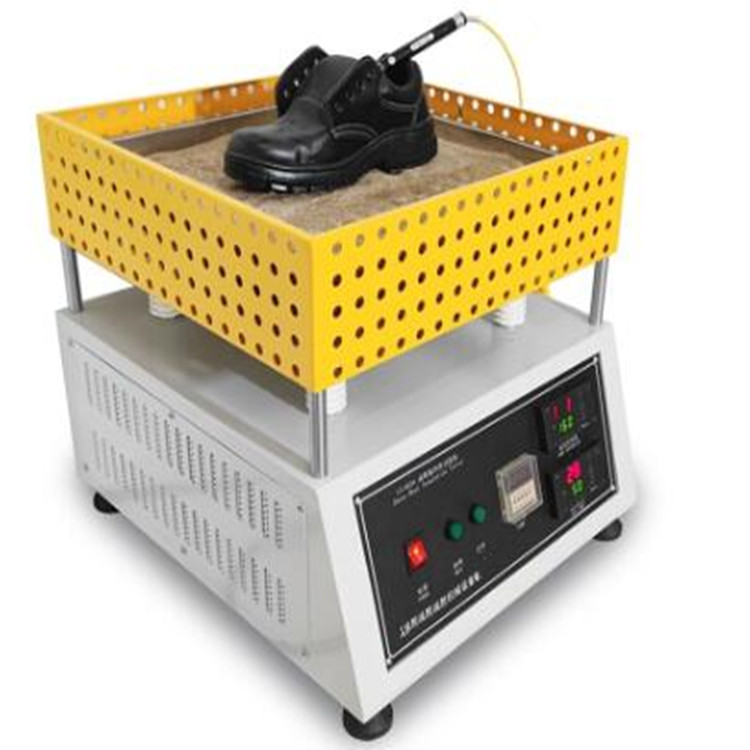
Working Principle of the Shoes Thermal Insulation Tester
The Shoes Thermal Insulation Tester simulates a high-temperature environment through a sand bath heating method and uses built-in temperature probes to monitor the temperature rise inside the footwear. The thermal insulation performance is evaluated based on the temperature variation inside the shoe within a specified testing period.
The finished footwear is placed on an automatically temperature-controlled heating plate, and the surface is covered with sand heated to the preset temperature. The sand layer completely covers the upper edge line and contact area of the footwear, forming a uniform heat transfer medium to simulate high-temperature contact conditions.
A separate temperature probe connected to a digital display is inserted into a specified position inside the footwear, and a steel ball is placed inside the shoe to simulate foot filling and maintain the probe position during the test.
After the heating process starts, the tester continuously records the temperature change curve inside the footwear over time. The typical test duration is 30 minutes, during which the temperature rise value is accurately measured and recorded.
According to the relevant testing standards, the temperature rise inside the footwear is evaluated against the specified limit. A smaller temperature increase indicates better thermal insulation performance. The final test data is automatically recorded and output by the control system.
Testing Parameters of the Shoes Thermal Insulation Tester
The Shoes Thermal Insulation Tester is a professional testing instrument specially designed to evaluate the thermal insulation performance of footwear. By simulating high-temperature environments, it assesses the protective capability of shoes under heat exposure conditions. The tester mainly evaluates the following key parameters:
1. Temperature Change Inside the Footwear
The temperature change inside the footwear is the core testing parameter. During the test, the footwear is placed on a sand bath heated to 150°C or 250°C and maintained for 30 minutes. The tester accurately measures the temperature variation on the inner sole surface. A smaller temperature increase indicates better thermal insulation performance of the footwear.
2. Thermal Insulation Performance Evaluation
Thermal insulation performance is another important evaluation parameter. By recording the complete temperature change curve inside the footwear over time, the tester can comprehensively evaluate the thermal insulation effect of the shoe. This parameter directly reflects the ability of footwear to protect the feet under high-temperature conditions.
3. Temperature Rise Rate Test
The temperature rise rate is also a key measurement item. The Shoes Thermal Insulation Tester monitors the speed at which the internal temperature increases during the test. This data is valuable for evaluating the protective performance of footwear when exposed to sudden high-temperature environments.
4. Test Time Recording
Test time recording ensures the standardization and consistency of the testing process. The 30-minute testing duration is a scientifically validated standard period that can effectively reflect the long-term thermal insulation performance of footwear.
5. Environmental Temperature and Humidity Control
Environmental temperature and humidity control provide the foundation for accurate testing results. The test is generally conducted under controlled conditions of 23°C ± 2°C, ensuring the comparability and repeatability of results between different batches of samples.
6. Sample Integrity Evaluation
Sample integrity evaluation focuses on whether the footwear experiences any damage after testing. This parameter helps determine the durability and safety performance of shoes when exposed to high-temperature environments.
The above testing parameters together form a comprehensive evaluation system for footwear thermal insulation performance. They provide scientific support for quality control of safety shoes, protective footwear, and other specialized footwear products.
Through comprehensive analysis of these indicators, manufacturers can accurately determine whether footwear is suitable for high-temperature working environments, thereby ensuring better protection and safety for users’ feet.
Maintenance Recommendations for the Shoes Thermal Insulation Tester
The Shoes Thermal Insulation Tester requires regular maintenance, including daily cleaning, weekly lubrication inspection, monthly calibration verification, and annual professional servicing. These maintenance procedures are essential to ensure the stability of the heating system, the accuracy of temperature sensors, and the smooth operation of mechanical transmission components.
1. Daily Cleaning and Inspection
After each test, use a soft cloth to clean the equipment surface, heating plate, and sand bath chamber to remove residual sand particles, dust, or sample debris. Solvents or corrosive cleaning agents should be strictly avoided.
Check whether the temperature probe (thermocouple) is in good condition and properly connected. Ensure that there is no oxidation, damage, or loose connection.
Confirm that safety components such as protective covers and limit devices are functioning properly, without looseness, deformation, or abnormal conditions.
2. Regular Maintenance and Calibration
Clean the mechanical transmission components, such as lifting rods and rotating shafts, on a weekly basis and apply an appropriate amount of specialized lubricating oil to prevent sticking, friction, or wear.
Check the deviation between the temperature control system display value and a standard thermometer on a monthly basis. If necessary, adjust the system parameters to ensure measurement accuracy.
Every three months or after every 50 cumulative tests, the entire system should be calibrated by qualified personnel or using a standard heat source. This ensures that the temperature rise measurement error meets the specified requirements, such as ±0.5°C.
Before long-term storage, disconnect the power supply, remove any removable vulnerable components (if applicable), and store the equipment in a dry, dust-free environment away from direct sunlight.
3. Professional Support and Maintenance Records
Establish a maintenance log to record every cleaning operation, calibration activity, malfunction, and repair process for effective equipment management.
If issues such as temperature sensor drift, abnormal heating, or control system errors occur, stop using the equipment immediately and contact the manufacturer or authorized service provider. Do not disassemble core components without professional guidance.
According to the manufacturer's service recommendations, arrange at least one professional on-site maintenance service every year, including operating condition inspection, parameter optimization, and comprehensive cleaning.
Proper maintenance of the Shoes Thermal Insulation Tester can effectively extend the service life of the equipment, maintain testing accuracy, and ensure reliable evaluation of footwear thermal insulation performance.
Innovative Applications and Industry Value of the Shoes Thermal Insulation Tester
With the footwear manufacturing industry moving toward higher precision and technological advancement, the Shoes Thermal Insulation Tester has become a key driving force for industrial upgrading through its innovative functions and application methods. This equipment not only improves traditional footwear testing approaches but also creates significant value across multiple areas of the industry.
In terms of innovative applications, the Shoes Thermal Insulation Tester overcomes the limitations of traditional thermal insulation evaluation methods. Conventional insulation testing often relies on manual subjective assessment or simple temperature detection, which may result in large errors and low efficiency. The new-generation tester adopts high-precision sensors and an intelligent temperature control system to simulate extreme high-temperature environments and accurately measure the thermal insulation performance of footwear under different temperature conditions, with measurement errors controlled within a minimal range.
For example, when testing the thermal insulation performance of shoe soles, the tester can simulate high-temperature ground environments ranging from 50°C to 80°C within a short period. By monitoring heat transfer speed in real time, it can calculate the thermal insulation coefficient of sole materials, providing scientific data support for footwear design and material selection.
In addition, the tester enables diversified application scenarios. During the footwear research and development process, designers can use the equipment to quickly verify the thermal insulation performance of new materials. For instance, when developing summer hiking shoes, an outdoor footwear brand can use the tester to evaluate dozens of new breathable and thermal insulation materials, selecting materials that combine both ventilation and insulation properties, significantly reducing the product development cycle.
During production quality control, the tester can perform sampling inspections on mass-produced footwear. Through automated testing procedures, it can evaluate the thermal insulation performance of hundreds of pairs of shoes per hour, effectively ensuring product consistency and quality stability.
From an industry value perspective, the Shoes Thermal Insulation Tester plays an important role in promoting footwear quality improvement. In high-temperature working environments, such as metallurgy and foundry industries, the thermal insulation performance of safety footwear is directly related to workers’ foot protection and occupational safety. With the application of this tester, footwear manufacturers can develop professional protective shoes that comply with international safety standards such as EN ISO 20345. reducing the risk of heat-related injuries and improving workplace safety.
Meanwhile, in the consumer footwear market, demand for thermal comfort and heat protection in summer footwear continues to grow. The tester helps manufacturers develop innovative products such as “cooling soles” and “thermal insulation insoles”, meeting personalized market demands and enhancing brand competitiveness.
The equipment also promotes coordinated development across the footwear industry chain. Standardized testing data provided by the tester creates a unified communication platform among raw material suppliers, footwear manufacturers, and quality inspection organizations. Material suppliers can optimize material formulations based on test results, manufacturers can achieve more precise production control, and inspection organizations can issue authoritative reports based on objective data, forming an efficient and reliable process from product development to market release.
In conclusion, the innovative applications and industry value of the Shoes Thermal Insulation Tester are not only reflected in technological breakthroughs but also in its ability to reshape the development model of the footwear industry. With the continuous integration of intelligent and digital technologies, this testing equipment will continue to support industry innovation and provide strong momentum for improving footwear performance and expanding market opportunities.We sincerely welcome your inquiries or direct contact with us for more detailed product information and professional solutions.
Previous: What is the Urinary Catheter Strength Tester?
N e x t : the last page
