





What is an automotive seat frame durability tester?
2026/07/31
Share:

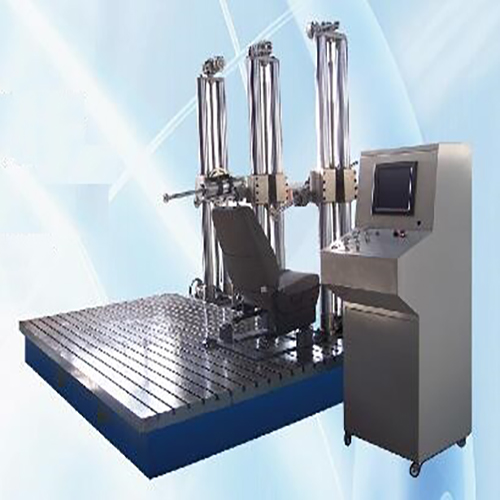
Composition of Seat Frame Durability Test Bench
The test bench adopts an integrally welded structure made of reinforced thick-walled steel, featuring high overall weight and excellent deformation resistance. It serves as the installation platform and seat fixation reference for the entire system. Even under long-term high-frequency loading conditions, the structure remains stable without shaking or deformation, ensuring reliable and consistent testing reference conditions.
The equipment is equipped with electric servo cylinders or hydraulic servo actuators, loading heads, and push-pull fixtures, allowing flexible switching among multiple loading directions, including vertical, horizontal, lateral, and torsional loading. It provides a wide adjustment range for force and displacement, meeting the loading requirements of seat frames from different vehicle models.
Customized locking fixtures can be designed according to different seat base structures. The fixtures are easy to install and remove, with high positioning accuracy, enabling rapid switching between different seat frame test samples and meeting the verification requirements of multiple product models.
The equipment integrates force sensors, displacement sensors, and strain acquisition modules to collect real-time data on loading force, deformation amount, and cycle counts. The signal transmission is stable with strong anti-interference capability, ensuring accurate and reliable test data.
The system is equipped with an industrial control computer and touch-screen operating interface, allowing users to edit various durability test programs, set loading parameters, cycle numbers, and protection thresholds, while displaying test curves in real time and automatically storing and exporting test reports.
The equipment is also equipped with safety protection fences, buffer anti-collision structures, audible and visual alarms, and emergency stop buttons. When conditions such as seat frame fracture, abnormal loading, or equipment failure occur, the system immediately stops operation for protection, ensuring the safety of operators and equipment.
For seat sliding mechanisms and angle adjustment systems, dedicated drive components are provided to simulate frequent adjustment operations and evaluate the coordinated durability performance of moving components and connecting seat frame structures.
Core Technologies of Coated Fabric Flexing Resistance Tester
The technical design of the Coated Fabric Flexing Resistance Tester fully complies with the requirements of relevant standards and focuses on solving three major challenges in flexing performance evaluation:
1. Dynamic Flexing Simulation Technology
The tester adopts a crank connecting rod transmission mechanism, enabling the specimen to perform reciprocating flexing at a preset frequency. Unlike static flexing tests, Method C requires simulation of the dynamic bending conditions experienced by materials during actual use, such as fabric folding and roll material curling.
The tester is driven by a high-precision servo motor, ensuring smooth and stable flexing operation without jamming. This effectively prevents specimen displacement caused by mechanical vibration during testing, minimizing interference with test results and improving measurement accuracy.
2. Coating Damage Observation Technology
The equipment is equipped with a 20-megapixel high-definition industrial camera and an adjustable lighting system, allowing real-time capture of coating changes during the specimen flexing process and supporting 10× magnified observation.
Traditional equipment mainly relies on manual visual inspection, which is easily affected by human factors. This tester utilizes image recognition technology to automatically identify the moment when coating damage occurs and simultaneously record the corresponding number of flexing cycles, significantly reducing manual evaluation errors and improving test reliability.
3. Multi-Specimen Synchronous Testing Technology
The tester features a dual-station design, allowing two groups of specimens to be tested simultaneously. Each station is independently controlled and can meet different testing requirements for flexing frequency and bending angle.
For enterprises requiring batch quality inspection, compared with single-station equipment, this design improves testing efficiency by 50%, greatly shortening the testing cycle and enhancing production quality control efficiency.
Applications of Seat Frame Durability Testing Bench
During the design and R&D stage of automotive seats, the testing bench is used to conduct durability tests on initial prototypes, verifying the rationality of parameters such as tube diameter, wall thickness, welding layout, and reinforcing rib structures. By analyzing areas prone to fatigue fracture or excessive deformation, engineers can optimize structural designs, improve overall strength and material utilization efficiency, and prevent structural failure risks at the design stage.
Evaluate the impact of different steel materials, welding processes, and welding consumables on seat frame durability life, and select raw materials with sufficient strength and excellent fatigue resistance. The system also helps inspect welding quality, identify process defects such as incomplete welding, slag inclusions, and insufficient weld size, standardize welding production processes, and improve the overall fatigue resistance of seat frames.
Automotive seat manufacturers can perform sampling inspections on finished products after production. Through durability testing, the quality of finished seat frames can be batch-screened to prevent products with potential structural defects from entering the vehicle assembly process. This helps reduce customer complaints related to seat deformation, abnormal noises, and adjustment failures after vehicle delivery, ensuring stable product quality.
Automotive OEMs can conduct strict durability certification tests on seat frames supplied by component manufacturers. Only products that meet requirements for cycle life and deformation strength according to vehicle safety standards can be approved for inclusion in the supplier procurement system. This ensures the safety and reliability of vehicle interiors from the component level and reduces after-sales maintenance costs.
Evaluate the durability performance of moving components and their connection points, including seat rails, recliners, lifting brackets, and other mechanisms connected to the frame. The test verifies whether frequent adjustment operations cause problems such as looseness, jamming, or detachment at connection areas, ensuring long-term smooth and stable operation of seat adjustment functions.
Combined with durability test data, the system assists in analyzing the impact resistance margin of seat frames after long-term fatigue exposure. It helps determine the load-bearing and protective capability of aged seat frames under emergency braking or minor collision conditions, thereby improving passive safety protection for vehicle occupants.
Automotive testing and certification organizations can use the testing bench for type approval tests, commissioned inspections, and quality sampling inspections. The generated test reports with legal validity can be used for product certification, market access approval, project bidding, and quality dispute assessment, helping standardize quality requirements for automotive seat components.
In summary, the future development of seat frame durability testing benches will focus on multi-channel coordinated synchronous loading, intelligent failure identification, cloud-based test data connectivity, and human-machine simulation coupled testing technologies. These advancements will further improve the accuracy of operating condition simulation and testing precision, continuously supporting the automotive seat industry in optimizing structural design, refining manufacturing processes, and enhancing safety quality. The technology will provide a solid testing and verification foundation for the durability and safety performance of seats used in passenger vehicles and commercial vehicles, promoting the steady advancement of reliability technologies for automotive interior components.
Previous: What is the Dry Fallen Wadding Tester?
N e x t : What is an automotive wire cyclic bending testing machine?
