





What is a dry heat shrinkage tester?
2026/08/21
Share:

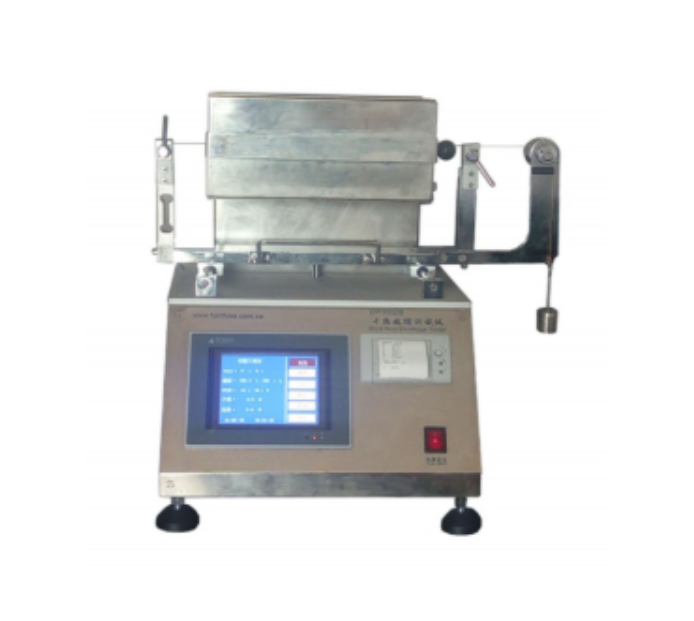
Principle of Dry Heat Shrinkage Tester
During the test, the textile cord specimen is first fixed under a preset pre-tension and then placed between the heating plates of the dry heat shrinkage tester, ensuring that the heating plates provide a uniformly heated dry heat environment and maintain a constant temperature throughout the test.
When the textile cord is exposed to heat, it undergoes shrinkage or elongation deformation. This deformation drives the displacement of the test wheel connected to the instrument, or causes a corresponding change in the tension of the cord itself. The test wheel is directly connected to a pointer indicator or a high-precision sensor. Through pointer indication or sensor data acquisition, the instrument accurately measures the shrinkage or elongation length of the cord specimen after heating, and then calculates the dry heat shrinkage rate.
If the test wheel is replaced with a dedicated force sensor, the instrument can directly collect and output the dry heat shrinkage force generated by the textile cord during the heating process in real time, enabling precise measurement of both the dry heat shrinkage rate and dry heat shrinkage force.
Applications of Dry Heat Shrinkage Tester
1. Industrial Filament Manufacturing (Polyester, Nylon, Polypropylene)
For industrial filament manufacturers producing polyester, nylon, and polypropylene yarns, the Dry Heat Shrinkage Tester is used throughout raw material inspection, spinning, drawing, and heat-setting processes to monitor dry heat shrinkage performance.
By analyzing shrinkage characteristics, manufacturers can optimize spinning temperature, drawing ratio, and heat-setting processes, achieving a balance between shrinkage control and tensile strength while preventing deformation during subsequent processing.
During new product development, the tester can be used to compare the thermal shrinkage performance of different formulations and process parameters, helping select the optimal production solution and improving product dimensional stability.
2. Tire Manufacturing Industry
The tire manufacturing industry is one of the key application fields of the Dry Heat Shrinkage Tester. Tire cords made from dipped Nylon 66. polyester, and aramid fibers require strict evaluation of dry heat shrinkage rate and shrinkage force.
Testing helps ensure that tire cords maintain uniform shrinkage and stable tension during the tire vulcanization process, preventing problems such as tire bulging, deformation, and delamination, thereby improving driving safety.
The instrument can also be used to evaluate the thermal stability of dipped tire cords and assess the compatibility and effectiveness of the dipping treatment process.
3. Textile and Garment Industries
Textile manufacturers use the Dry Heat Shrinkage Tester to evaluate yarns used in polyester and nylon woven or knitted fabrics, controlling shrinkage consistency and reducing dimensional deviations, deformation, and wrinkling after fabric finishing processes such as heat setting, dyeing, and printing.
Garment manufacturers can use shrinkage testing to select low-shrinkage raw materials, ensuring that finished clothing maintains its original shape after washing and ironing, thereby improving product quality and wearing comfort.
For functional textiles such as sportswear and outdoor fabrics, the instrument is mainly used to evaluate shrinkage performance after high-temperature setting treatments and ensure long-term dimensional stability.
4. Testing Laboratories and Quality Inspection Institutions
Testing laboratories with CMA/CNAS qualifications use the Dry Heat Shrinkage Tester to issue professional test reports for product certification, market access, and international trade applications.
The instrument is also used for quality inspection of chemical filaments, tire cords, and textile fabrics in the market, helping identify products with excessive shrinkage or poor dimensional stability, standardizing market quality control, and protecting consumer rights.
5. Universities, Research Institutes, and Material Science Laboratories
In textile engineering and material science laboratories, the Dry Heat Shrinkage Tester is used to study the thermal shrinkage mechanisms of synthetic fibers and the relationship between molecular structure and shrinkage behavior.
Research institutions use the instrument to evaluate the thermal stability of advanced functional fibers, such as flame-retardant fibers, antibacterial fibers, and high-strength fibers, providing data support for the development of new materials.
As an educational instrument, it also helps students understand the thermal properties of polymer materials and improves practical skills for future professionals in the textile and materials industries.
6. Industrial Textile Products and Special Applications
For industrial woven products such as safety belts, conveyor belts, filter fabrics, and fishing nets, the raw material yarns require dry heat shrinkage testing to ensure dimensional stability and strength retention during high-temperature operation or thermal processing.
Synthetic fiber materials used in aerospace and automotive interiors also require shrinkage performance evaluation under extreme temperature conditions to ensure reliable performance in specialized environments.
Importance of Dry Heat Shrinkage Tester
The Dry Heat Shrinkage Tester is a key instrument used in the textile and materials industries to evaluate the dimensional stability of fibers, yarns, and cords under heated conditions. Its importance is mainly reflected in the following three aspects, explained through clear and logical points without involving specific numerical indicators.
1. Ensuring the Dimensional Stability of Final Products
Fibers and yarns are the basic raw materials of textile products. If these materials undergo uncontrolled shrinkage after exposure to heat, such as during ironing, drying, or high-temperature service environments, finished products like garments, curtains, or industrial fabrics may suffer from deformation, shrinkage, or dimensional inconsistency.
The Dry Heat Shrinkage Tester can simulate these heating conditions in advance, helping manufacturers identify high-quality materials with stable thermal performance. This ensures that finished products maintain their original shape and dimensions during use and care.
2. Optimizing Production Processes and Cost Control
During textile processing, many manufacturing steps involve high-temperature treatments, such as heat setting. By using this instrument for testing, manufacturers can accurately understand the thermal behavior of materials and determine suitable processing temperatures and durations.
This not only prevents product defects or waste caused by improper temperature control but also reduces raw material consumption, improves production efficiency, and ensures consistent quality across different production batches.
3. Improving Product Safety and Durability
For high-strength application materials such as tire cords and industrial ropes, thermal shrinkage performance is directly related to structural integrity under high-temperature working conditions. Excessive shrinkage at elevated temperatures may generate excessive internal stress, leading to breakage or performance failure.
Strict testing with this instrument helps eliminate materials with potential safety risks, ensuring the reliability and service life of industrial products under demanding operating conditions.
In summary, the Dry Heat Shrinkage Tester acts like a “health check doctor” for materials. It identifies the thermal response characteristics of materials before product manufacturing, enabling quality control from the source and helping end users obtain products that are more durable, better fitting, and safer.
Previous: How does the Mask Respiratory Resistance Tester work?
N e x t : the last page
