





What is the Standard Helmet Visual Field Tester used for?
2026/09/02
Share:

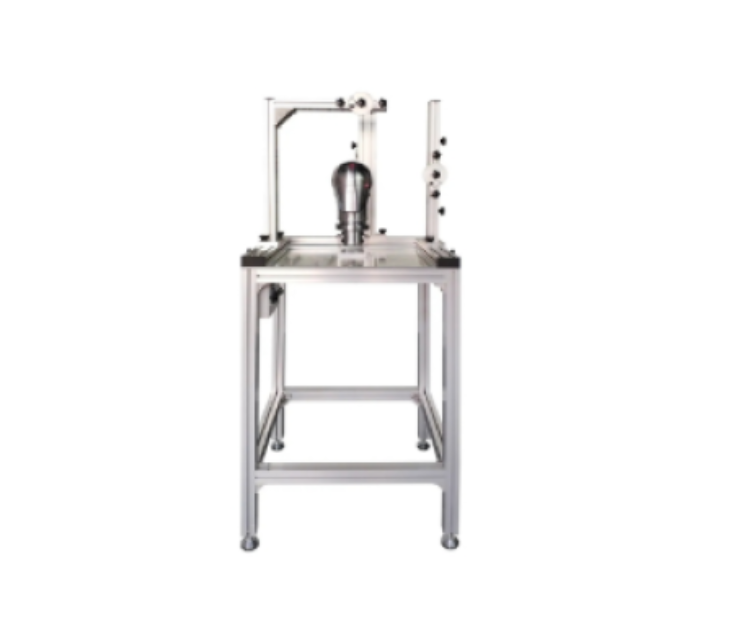
The Core Mission of the Instrument: Balancing Protection and Perception
The core design challenge of a helmet lies in the trade-off between “coverage” and “visibility.” An excessively thick cushioning layer or an overly narrow visor opening may improve structural strength, but can also create visual blind spots and increase the risk of accidents. The Standard Helmet Field of Vision Tester was developed specifically to address this conflict. Its primary purpose is to simulate the actual field of vision of the human eye while wearing a helmet and scientifically quantify the extent to which the helmet restricts the wearer’s field of vision.
This instrument is not simply an angle-measuring device, but a specialized testing instrument designed in accordance with stringent domestic and international standards. It is widely used in the R&D, production, quality supervision, and scientific research and education of motorcycle helmets, electric bicycle helmets, sports helmets, and even fire helmets. Through precise measurement, it ensures that every helmet leaving the factory can provide users with an unobstructed field of vision that complies with regulatory requirements while ensuring adequate head protection.
Precision Construction: The Integration of Mechanical and Electronic Technologies
The design of the Standard Helmet Field of Vision Tester fully reflects the rigor and scientific approach consistently upheld in the field of industrial measurement. Its main structure is not simply an accumulation of individual components, but a precision-integrated system composed of multiple core modules, including a dedicated headform, fixed base, photoelectric encoder, compound pointer, and instrument readout mechanism. Each component plays an essential role in ensuring measurement accuracy.
The dedicated headform serves as the foundation and core carrier of the entire testing system. It is designed and manufactured strictly according to the anatomical characteristics of the human head, enabling highly realistic simulation of the contact relationship and spatial positioning between the helmet and the head under actual wearing conditions. To meet the testing requirements of helmets with different specifications and categories available on the market, the headform is typically available in multiple sizes and can be flexibly replaced through standardized interfaces. This ensures that each helmet under test can be evaluated under test conditions that most closely reproduce the actual wearing scenario in terms of fit and wearing posture. The fixed base is responsible for providing critical support and stability. Through rigid connections and precision leveling mechanisms, it ensures that the headform remains completely stable throughout the testing process, effectively preventing measurement drift caused by mechanical micro-vibrations or external interference and minimizing system errors.
At the data acquisition and processing level, modern standard field of vision testers have largely abandoned traditional visual estimation methods and instead widely adopted photoelectric rotary encoders or high-precision wire-draw encoders as core sensing components. These high-precision sensors feature excellent resolution and response speed, enabling them to convert the purely mechanical angular displacement generated by headform rotation into standard electrical signals in real time and without distortion. The signals are then digitally converted and algorithmically corrected through built-in signal processing circuits, ultimately enabling precise capture and determination of the angular values defining the field-of-vision boundaries. Meanwhile, combined with a high-brightness LED digital display or a clear and easy-to-read compound pointer-type instrument, operators can directly read and record key field-of-vision data in real time at the test site without complicated calculations, significantly reducing the testing cycle. This electromechanical integration, which deeply combines precision mechanical structures with modern electronic sensing technology, not only fundamentally ensures the stability and repeatability of measurement results, but also significantly improves the instrument’s user-friendliness and ease of daily operation, meeting the stringent requirements of modern industrial production for efficient quality inspection.
Testing Method: A Precise Standard for Field-of-Vision Measurement
Standard field-of-vision measurement is typically performed using a dedicated field-of-vision measuring device.
The basic method involves placing the helmet on a test headform of a specified size according to the standard wearing procedure, ensuring that the helmet is correctly positioned and the retention straps are properly fastened.
A device that simulates the function of the human eye, such as a laser emitter or photoelectric sensor, is installed at the eye-point position of the test headform. The headform is precisely rotated in the horizontal and vertical planes. When the edge of the helmet’s eye opening begins to obstruct the emitted light beam or enters the sensing area, the rotation angle at that moment is recorded.
For horizontal field-of-vision measurement, the headform is rotated horizontally to the left and right until the field of vision becomes obstructed. The left and right limiting angles are recorded separately, and their sum represents the total horizontal field-of-vision angle.
For vertical field-of-vision measurement, the headform is rotated upward and downward in the sagittal plane, with the upper and lower limiting angles recorded separately. All tests are generally repeated along multiple axes to ensure the accuracy and repeatability of the results.
The entire testing process must be conducted under controlled lighting conditions to eliminate interference from external light.
Multidimensional Testing: Comprehensive Coverage of the Visual Field
Human vision is a three-dimensional process of spatial perception. Therefore, helmet field-of-vision testing must cover both horizontal and vertical dimensions. The Standard Helmet Field of Vision Tester features a wide measurement range, covering large positive and negative angles in the horizontal direction as well as upward and downward viewing angles in the vertical direction.
In the horizontal direction, the instrument focuses on measuring the width of the field of vision on both the left and right sides, ensuring that riders are not excessively obstructed by the edges of the helmet when turning their heads to observe traffic conditions to the side or rear. In the vertical direction, the upward and downward fields of vision are measured separately. The upward field of vision is important for observing overhead obstacles and traffic signals, while the downward field of vision affects the ability to assess road conditions. Through comprehensive testing across these three dimensions, the instrument can fully evaluate the impact of a helmet on the wearer’s spatial perception.
Overall, the Standard Helmet Field of Vision Tester provides an invisible line of defense for riding safety through its scientific design, rigorous testing procedures, and precise measurement capabilities. It not only verifies the physical performance of helmets but also reflects a commitment to protecting human life and safety. With continuous technological advancement, such testing equipment will continue to drive the helmet industry toward greater safety and user-oriented design, ensuring clear and unobstructed vision for every journey.
Previous: What is a 20L spherical explosion tester?
N e x t : the last page
